Radboud University Researchers Build Liquid Robots That Hand Over Oil Droplets Along Arrays Without Human Control
A new system of sub-surface actuator droplets uses growing lipid filaments and fluid currents to transport and position cargo rafts autonomously.
Researchers at Radboud University have built a liquid robotic platform using 10 actuator droplets that can autonomously catch, hand over, and position oil cargo droplets along programmable arrays. Published in Advanced Science, the system relies on tubular microstructures that grow upward from the bottom of an aqueous solution to manipulate floating objects on the water surface.
Creating smart matter that can adapt and reconfigure itself without continuous external control remains a major challenge in soft robotics. The Radboud University team turned to fluid dynamics and self-assembling chemical structures to solve this problem. By separating force-generating units below the water from floating cargo on top, the system achieves a delicate balance of attractive and repulsive forces.
How Sub-Surface Droppets Grow Microscopic Filaments
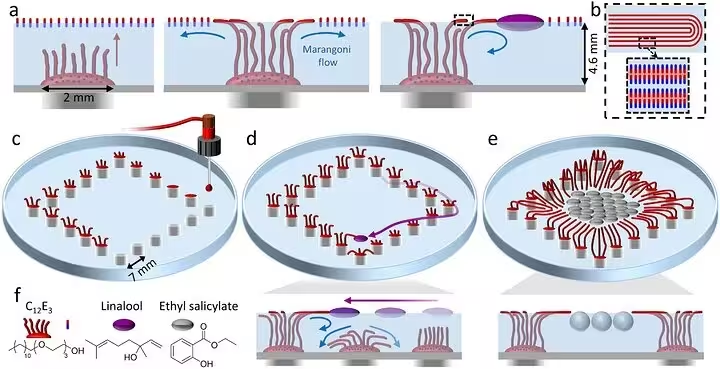
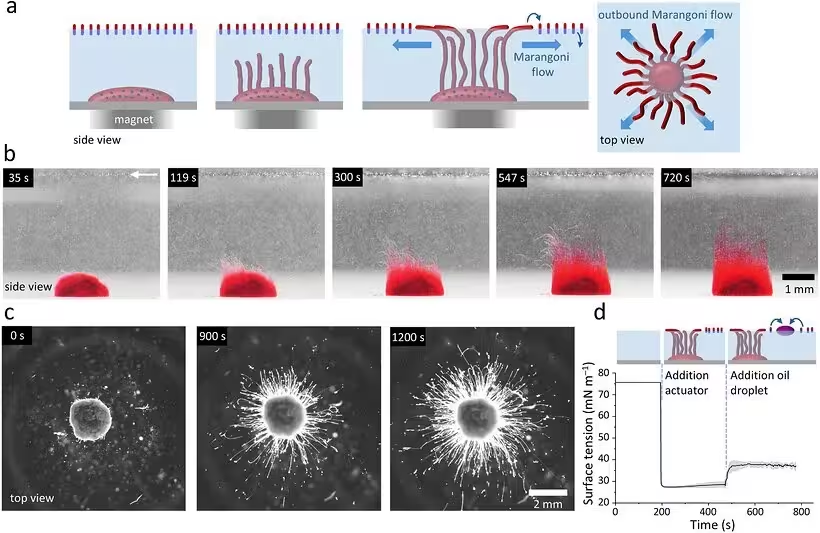
The system uses tri(ethylene glycol) monododecyl ether, known as C12E3, mixed with magnetic iron oxide particles to anchor actuator droplets at a depth of 4.6 mm. Driven by buoyancy, these sub-surface droplets grow tubular lipid bilayers called myelin filaments toward the air-water interface over roughly 10 minutes. Once the filaments reach the surface, they release surfactants, which are specialized chemical compounds that lower surface tension and create outward fluid currents known as Marangoni flows.
When oil droplets like linalool are placed on the water, they drain the surfactant and trigger intense counter-currents. Lead author Dimitrios Karagrigoriou and colleagues found that the floating oil does not merge with the actuator below. Instead, it hovers at a fixed distance, held in place by a dense network of growing filaments that exert pulling forces.
Why Cargo Droplets Move Along a Conveyor Belt
When multiple actuator droplets are arranged in a circular array spaced 9 mm apart, floating cargo undergoes a symmetry-breaking event. As a cargo droplet approaches one actuator, sub-subsurface return currents push its trailing filaments away, preventing re-attachment. Simultaneously, the droplet is grabbed by filaments from the next actuator downstream.
This sequential handover propels the cargo along a continuous path, completing up to 9 full rotations and as many as 180 consecutive handovers without human intervention. The setup operates reliably across various cargo volumes, demonstrating strong resilience against physical variations.
How Silica Nanoparticles Shape Floating Rafts
To prevent different oil droplets from merging into a single mass, the researchers added silica nanopowder to ethyl salicylate droplets. Supported by a specialized surfactant called Capstone FS-30, these stabilized droplets sink deeper into the liquid phase and form non-merging clusters called rafts. These rafts constantly interact with surrounding filaments to negotiate their position within square box boundaries.
When small rafts containing 16 droplets are placed inside a 5 by 5 box array, they stay pinned in a corner. However, as more droplets are added to reach a critical threshold of 47 units, the raft migrates toward the center of the box. At this stage, uniform pulling forces from all directions balance out the assembly.
What Limits This Autonomous Liquid Technology
Despite the impressive multi-step transport, the system has physical boundaries. Sub-surface actuators maintain their mechanical integrity for roughly 1 hour before larger pieces begin to dislodge and drift upward. Furthermore, increasing the spacing between actuators to 10 mm disrupts the handover process, causing cargo droplets to stall and get stuck for extended periods.
The research was published in Advanced science (Weinheim, Baden-Wurttemberg, Germany) on November 25, 2026.
This article has been fact checked for accuracy, with information verified against reputable sources. Learn more about us and our editorial process.
Last reviewed on .
Article history
- Latest version
Reference(s)
- Karagrigoriou, Dimitrios., et al. “Liquid Robots: Non‐Equilibrium Assemblies Catching, Handing Over and Positioning Oil Droplets Along Arrays.” Advanced Science, November 25, 2026 Wiley, doi: 10.1002/advs.78921. <https://doi.org/10.1002/advs.78921>.
Cite this page:
- Posted by Zubair Ali