Mindong Hospital Researchers Test 12-Month Exercise Protocol To Rebuild Strength In Frail Spine Surgery Patients
A new clinical study protocol investigates whether hybrid multimodal exercise training can safely reverse muscle and bone loss in older adults with osteosarcopenic obesity.
Researchers at Mindong Hospital have designed a structured clinical protocol to test whether a tailored 12-month exercise program can accelerate recovery and rebuild strength in older adults suffering from osteosarcopenic obesity after spinal surgery. Osteosarcopenic obesity is a complex syndrome defined by the simultaneous loss of muscle mass and bone density coupled with an excess accumulation of body fat.
Older adults dealing with this condition face extreme physical frailty, making conventional workout regimens nearly impossible to follow safely. To address this hurdle, the research team developed a progressive framework combining resistance, aerobic, balance, and flexibility training, as published in PloS one. The clinical trial intends to enroll 120 older patients and assign them evenly to either the supervised exercise intervention or a routine care control group.
How Can Frail Patients Exercise Safely After Spine Surgery?
Structured physical activity is often restricted for elderly patients recovering from spinal procedures due to high risks of injury and fatigue. The new protocol introduces a tiered system where exercises are adapted to individual physical capabilities and environmental safety standards. Initial movements start in a supine or seated position before gradually progressing toward standing activities.
Medical staff will monitor patients using the Borg Rating of Perceived Exertion scale to track subjective fatigue during training sessions. The regimen relies on portable equipment such as resistance bands and lightweight sandbags to lower barriers to entry. By tailoring intensity to each participant, the researchers aim to prevent muscle strain while still delivering enough physical stimulus to rebuild lost tissue.
What Makes This Hybrid Training Different From Standard Care?
Traditional rehabilitation programs typically stack independent exercise modalities without accounting for the interconnected nature of bone loss, muscle wasting, and obesity. This clinical study implements a hybrid multimodal exercise training protocol that integrates multiple fitness dimensions within a single structured framework. Participants rotate between resistance days and aerobic days while weaving balance and flexibility work into every session.
To improve long-term adherence, the trial incorporates participant preferences by offering a menu of approved alternative movements that deliver equivalent physiological benefits. All home-based activities will be rigorously tracked using exercise logs, wearable activity monitors, and regular remote check-ins. This multi-source verification helps researchers separate true behavioral compliance from accidental data omissions.
How Will Patient Recovery And Bone Density Be Measured?
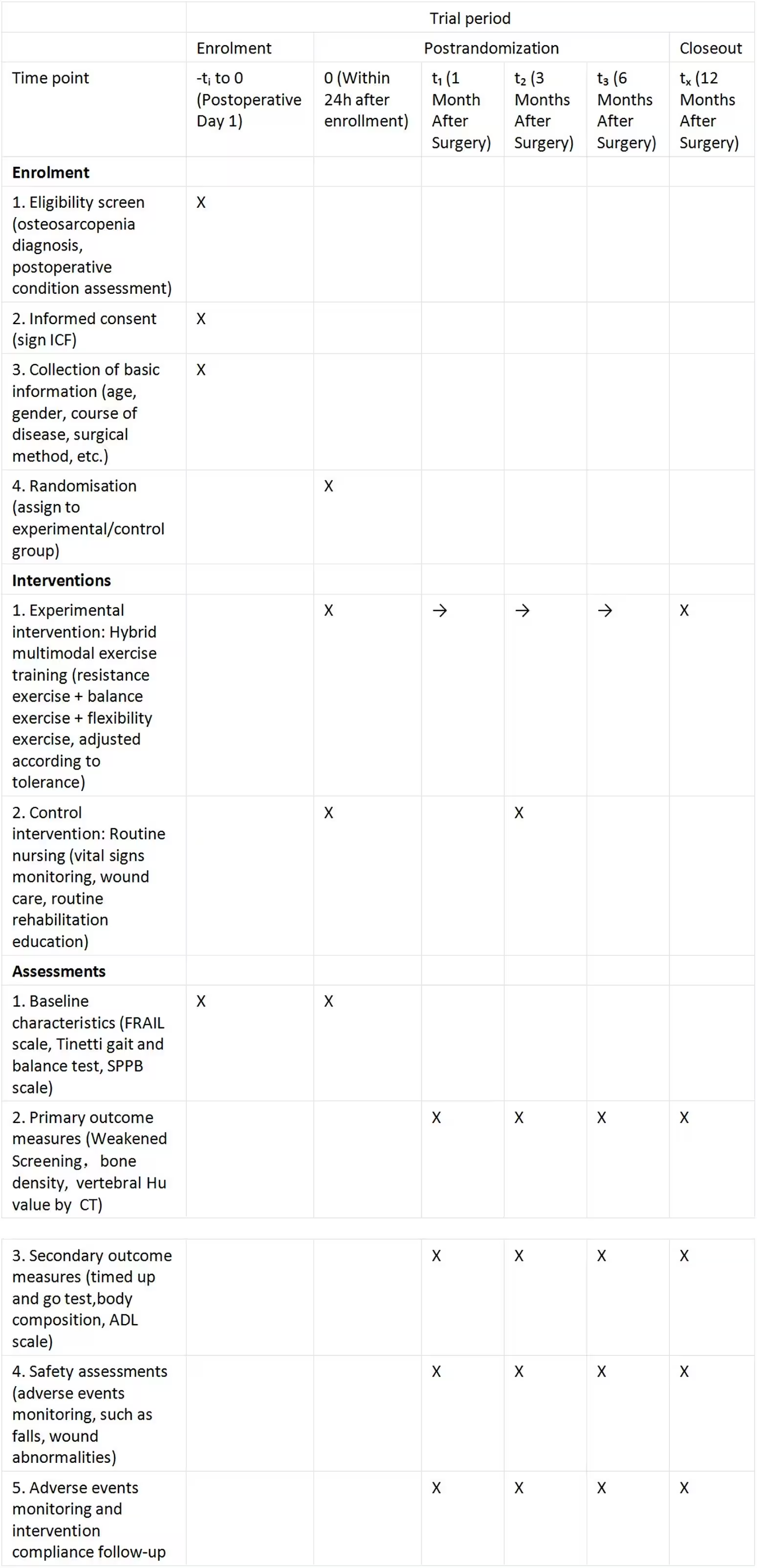
The trial establishes two joint primary endpoints to evaluate overall success across the 12-month intervention period. The first primary endpoint measures changes in patient frailty using the FRAIL scale at 6 months postoperatively. The second primary endpoint tracks vertebral bone quality through computerized tomography Hounsfield unit measurements evaluated at 12 months.
Secondary outcomes will assess walking capacity, balance, and activities of daily living through standardized geriatric tests like the Timed Up and Go test. Body composition and bone mineral density will be verified using dual-energy X-ray absorptiometry and bioelectrical impedance analysis. By tracking these metrics closely, the team hopes to establish a reproducible standard for post-surgical rehabilitation.
What Are The Main Safety Rules And Potential Limitations?
Because the target population is inherently vulnerable, the protocol outlines strict pre-enrollment contraindications and immediate suspension criteria. Training will be paused immediately if participants experience chest pain, severe dizziness, or significant spikes in blood pressure. The study also enforces strict limits on high-risk movements like jumping jacks, restricting them to patients who have achieved solid spinal fusion and stable bone density.
The authors acknowledge several limitations inherent to the study design, including the potential for patients to reduce independent training after formal supervision ends. Furthermore, individual dietary variations outside the clinical setting could influence muscle anabolism and bone metabolism outcomes. Despite these challenges, the trial provides a foundational framework for improving recovery and quality of life in frail older adults.
The research was published in PloS one on November 25, 2026.
This article has been fact checked for accuracy, with information verified against reputable sources. Learn more about us and our editorial process.
Last reviewed on .
Article history
- Latest version
Reference(s)
- Miao, Chenfang., et al. “Hybrid multimodal exercise training promotes enhanced recovery after surgery and improves musculoskeletal strength in patients with osteosarcopenic obesity: A clinical study protocol.” PLOS One, vol. 21, no. 11, November 25, 2026, pp. e0363044 Public Library of Science (PLoS), doi: 10.1371/journal.pone.0363044. <https://doi.org/10.1371/journal.pone.0363044>.
Cite this page:
- Posted by William Moore