Butterflies Reveal Why Genomic Climate Forecasts Require Caution And Deep Genetic Diversity
A century-long genomic analysis of 42 butterfly populations shows that genetic diversity and gene flow dictate climate mismatch better than population size.

Genomic forecasting models used to predict climate maladaptation in 42 Lycaeides butterfly populations show that environmental offsets vary significantly across space and time, driven heavily by genetic diversity and connectivity rather than contemporary population size alone. Researchers at Utah State University analyzed genetic and climatic data from 922 individual butterflies to evaluate how well genomic offsets track population vulnerability under warming climatic conditions. The findings were published in Evolutionary Applications.
How Genomic Offsets Measure Climate Mismatch
Genomic offset calculations rely on genotype-environment associations, which connect localized allele frequencies to regional temperature and precipitation patterns. Under these models, researchers estimate the genetic shift required for a population to maintain adaptation in a changing climate, using the resulting mismatch to gauge extinction risk. However, translating these theoretical genomic gaps into reliable demographic predictions remains a major challenge in conservation biology.
For years, conservation scientists have debated whether these computed mismatches reliably signal imminent population declines in nature. While common garden experiments validate such metrics in trees, testing their predictive power in insects and other mobile organisms has proven difficult. The new study addresses this gap by examining butterfly populations across western North America, incorporating historical and projected climate data spanning an entire century.
Temperature and Admixture Drive Allele Variation
Led by Kenen Goodwin and Zachariah Gompert, the team evaluated 142,307 single nucleotide polymorphisms across the 42 populations, uncovering deep genetic structure tied to hybridization between the species Lycaeides idas and Lycaeides melissa. The researchers found that mean annual temperature, cumulative annual precipitation, and historical admixture together explained 47.6 percent of the variation in genome-wide allele frequencies. Furthermore, climate-associated genetic variants were heavily concentrated on specific chromosomes, with chromosome Z and chromosome 1 containing the highest proportions of significant associations.
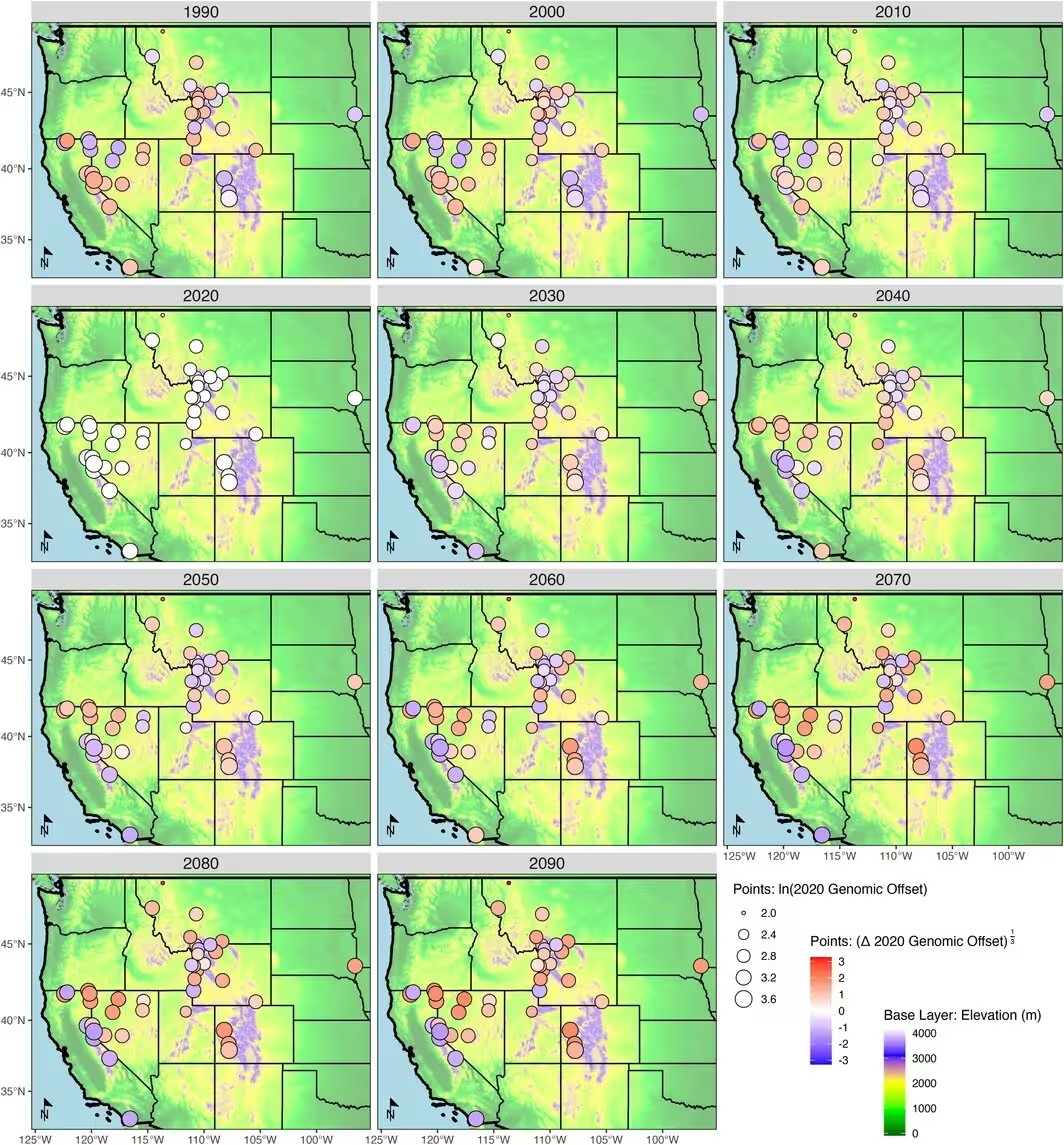
Gene enrichment analyses revealed functional links to biological stress responses, including enzymatic activity connected to molting and cellular components involved in starvation and autophagy. These patterns suggest that butterfly populations harbor locally adapted traits linked to seasonal temperature and moisture shifts. Yet, projecting these relationships forward reveals complex trajectories that defy simple interpretations.
Why Genetic Diversity Matters More Than Population Size
When tracking projected genomic offsets from 1990 through 2090 using regional climate models under an upper-intermediate warming scenario, the team observed a steady upward trend. Averaged across all populations, mean annual temperatures are projected to climb by roughly 3 degrees Celsius by 2090. Genomic mismatch values increased over time in 12 percent of the studied populations, while no populations exhibited a detectable decrease in offset.
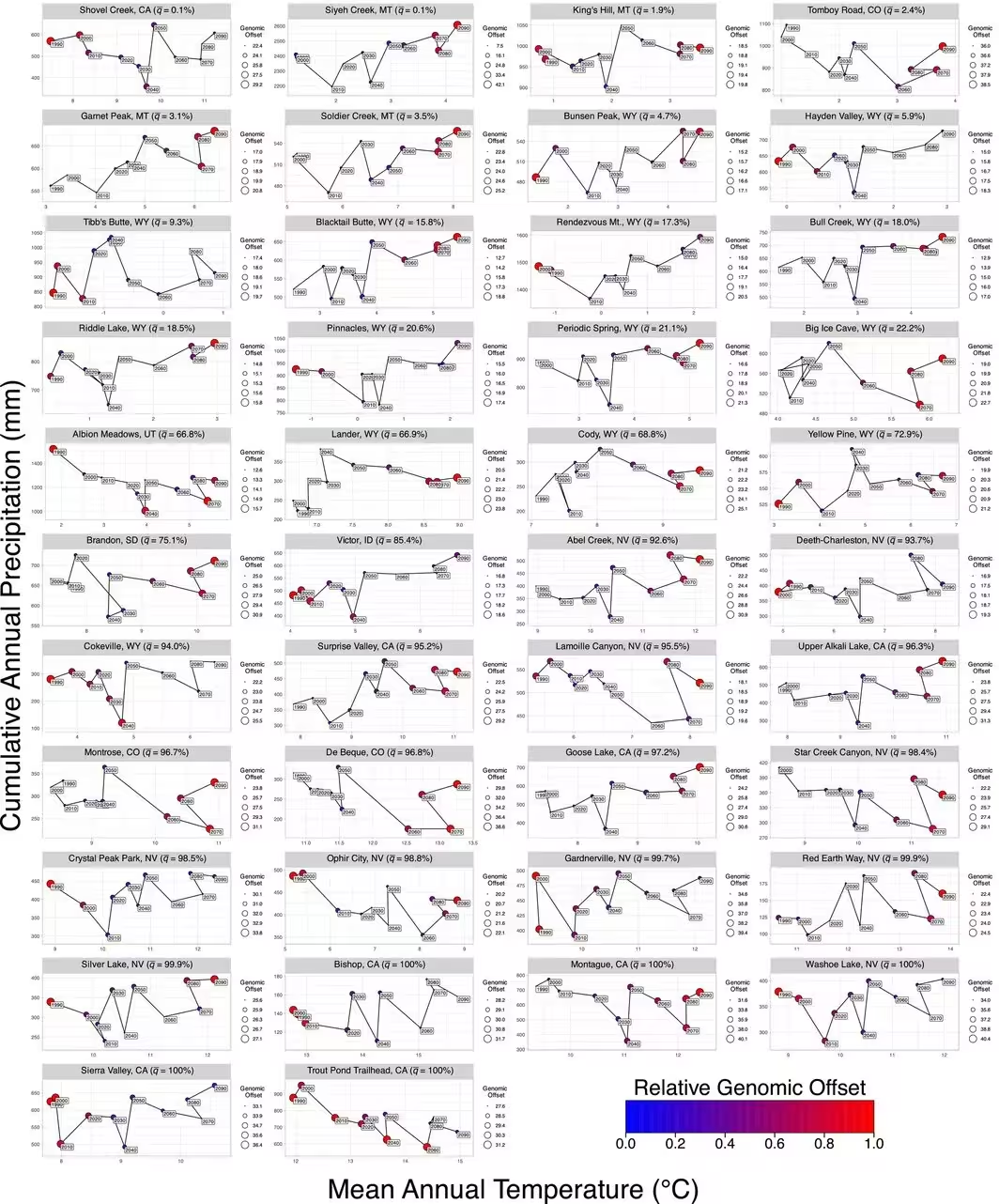
Surprisingly, contemporary effective population size showed no meaningful relationship with current genomic offsets. Instead, genetic diversity and effective gene flow together explained 27.3 percent of the variation in contemporary genomic offsets.
What These Findings Reveal for Conservation Policy
Populations characterized by higher genetic diversity and greater connectivity exhibited lower genomic offsets, highlighting the protective role of adaptive capacity and gene flow. Stronger genetic drift in low-diversity populations can artificially inflate genomic mismatch scores regardless of true climate adaptation, meaning that high offsets do not automatically equate to immediate extinction vulnerability.
The authors caution against simplistic interpretations of genomic offsets as direct measures of population decline in management contexts. While these genomic tools offer valuable insights into evolutionary potential, researchers emphasize that multifaceted validation against long-term demographic monitoring data is essential before relying on them to guide conservation policy.
The research was published in Evolutionary applications on November 23, 2026.
This article has been fact checked for accuracy, with information verified against reputable sources. Learn more about us and our editorial process.
Last reviewed on .
Article history
- Latest version
Reference(s)
- Goodwin, Kenen B.., et al. “Genomic Forecasts of Maladaptation in Lycaeides Butterflies.” Evolutionary Applications, vol. 19, no. 11, November 23, 2026 Wiley, doi: 10.1111/eva.70367. <https://doi.org/10.1111/eva.70367>.
Cite this page:
- Posted by Divya Iyer