Researchers Map 11,970 Predictable Genes With Network Models, Revealing Hidden Trans-Regulatory Drivers of Brain Traits
A novel computational framework harnesses biological network topology to prioritize distant gene regulators, outperforming traditional local-only association models.
Researchers led by Central South University uncovered that modeling hierarchical gene regulatory networks across 12 neuropsychiatric traits pinpoints 11,970 predictable genes, outperforming traditional local search limits.
Genome-wide association studies link genetic variants to complex human traits, but traditional transcriptome-wide association studies focus primarily on local cis-variants found right next to genes. This narrow local view misses distal trans-regulatory mechanisms happening far away across the genome because the vast search space creates too much computational noise. To solve this limitation, the study is published in Advanced Science, introducing a novel computational framework called GRNTWAS that harnesses gene regulatory networks to constrain the search space.
How Network Topology Guides Variant Selection
The method relies on the biological premise that genetic effects on upstream regulatory proteins propagate down through hierarchical gene regulatory networks to modulate distant target genes. Shixian Wang and colleagues used random walk with restart algorithms on these biological networks to calculate topological proximity scores between candidate transcription factors and target genes. These network scores function as adaptive penalty weights in sparse regression models, allowing the system to prioritize relevant upstream regulators while discarding spurious genetic background noise.
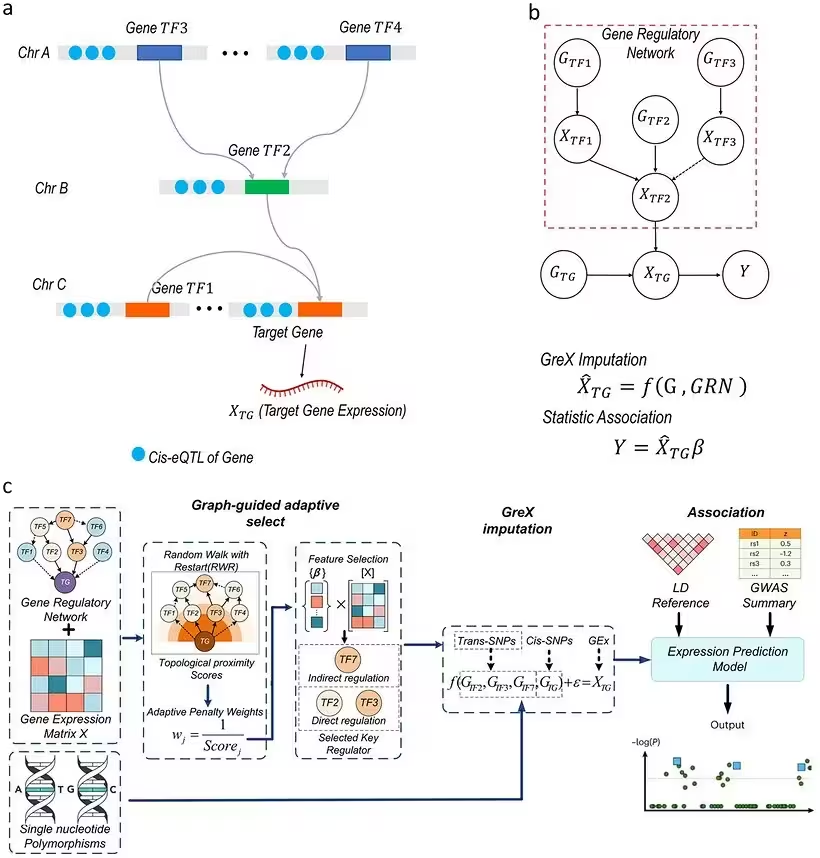
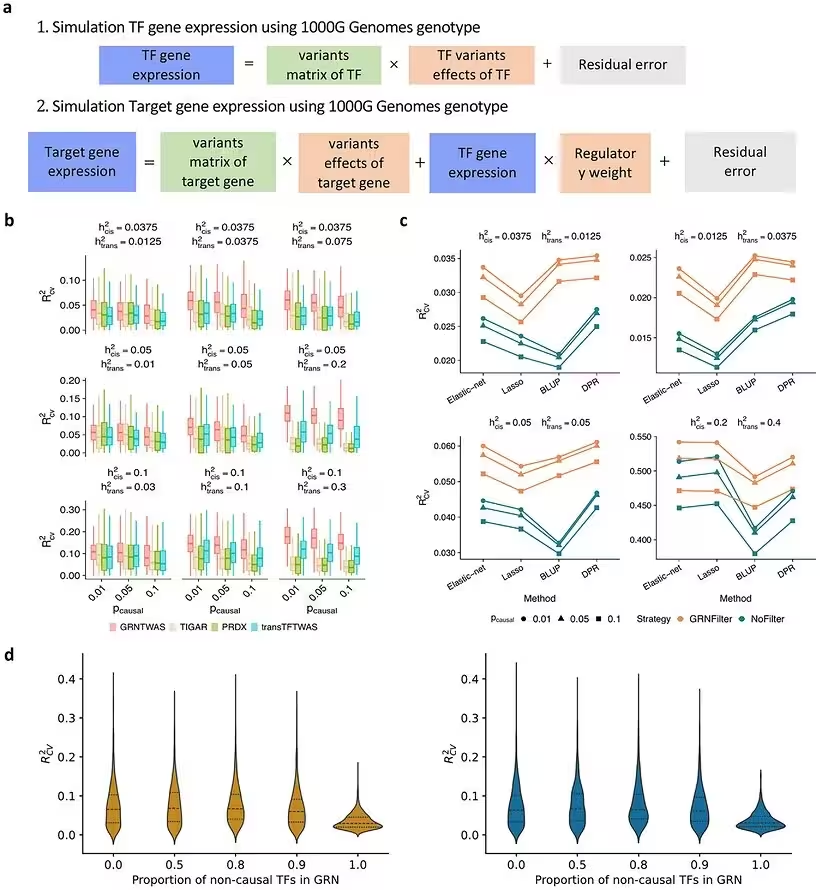
By connecting local cis-variants of prioritized transcription factors to distant target genes, the framework builds a joint prediction model of genetically regulated expression. Across simulations using European reference panels from 503 individuals, this network-guided approach achieved higher cross-validated prediction accuracy when trans-heritability matched or exceeded local cis-heritability. The graph-guided adaptive selection strategy consistently outperformed unfiltered models that incorporated every available distal variant without network constraints.
Mapping Disease Risks Across Human Populations
When evaluated on real transcriptomic datasets including 462 individuals from the GEUVADIS project and 272 brain temporal cortex samples from the Mayo RNA-seq study, the framework successfully predicted expression for significantly more genes than older tools. For instance, in the Finnish population subset, the model identified 11,970 predictable genes compared to just 7,657 genes found by traditional PrediXcan methods. Tests using randomized control networks confirmed that using tissue-matched biological networks is essential for uncovering these additional predictable genetic targets.
Applying the new model to 12 major neuropsychiatric traits revealed dozens of disease-associated genes that conventional cis-only models completely miss. These newly prioritized genes showed strong enrichment for biological functions under high evolutionary constraint, defined by probability of loss-of-function intolerance scores above 0.9. Across conditions like schizophrenia, neuroticism, and cross-disorder groups, the network-prioritized gene sets demonstrated a substantially broader overlap with established genome-wide significant findings from previous large-scale clinical studies.
Uncovering Clinicopathological Links in Alzheimer Disease
Using 71,880 Alzheimer disease cases and 383,378 controls as a case study, the team highlighted prominent candidate genes including NHP2 and ENAH that were driven largely by trans-regulatory mechanisms. Analyses in independent brain tissue cohorts from the Mount Sinai Brain Bank demonstrated that the expression levels of these trans-dominant candidate genes correlate strongly with key neuropathological measures, including Braak neurofibrillary tangle stages and neuritic plaque density scores. A combined regression model incorporating these network-prioritized genes accounted for more disease variance than the standard APOE-varepsilon4 genetic risk factor alone.
Despite these advances, the authors note important technical limitations in the current study design. Because the framework does not explicitly account for linkage disequilibrium confounding or horizontal pleiotropy across distant genomic regions, its output should be interpreted as prioritization signals rather than definitive proof of causal mediation. Future work incorporating single-cell transcriptomics and spatial multi-omic data could soon yield even higher cellular resolution for mapping distal gene regulation.
The research was published in Advanced science (Weinheim, Baden-Wurttemberg, Germany) on November 25, 2026.
This article has been fact checked for accuracy, with information verified against reputable sources. Learn more about us and our editorial process.
Last reviewed on .
Article history
- Latest version
Reference(s)
- Wang, Shixian., et al. “Hierarchical Gene Regulatory Networks Improve Gene Prioritization in TWAS by Constraining Trans‐Regulatory Search.” Advanced Science, November 25, 2026 Wiley, doi: 10.1002/advs.79015. <https://doi.org/10.1002/advs.79015>.
Cite this page:
- Posted by Faisal Qureshi