Wasp Genome Uncovers 148 Odorant Receptors and Shows How Olfaction Drives Maternal Care, But Deleting Co-Receptors Triggers Reproductive Collapse
CRISPR knockout of the Orco gene in Sclerodermus guani reveals that insect olfaction is required for host localization, mating efficiency, and oviposition fidelity.

Parasitoid wasps named Sclerodermus guani rely heavily on a massive expansion of 148 odorant receptors to coordinate complex behaviors, yet deleting their core olfactory gene triggers catastrophic reproductive failures. Researchers at Guizhou Normal University and their collaborators have mapped the 322.5 Mb genome of this subsocial species, uncovering how three-dimensional chromatin architecture organizes its sensory genes and governs critical social tasks.
Insect olfaction typically relies on tuning receptors paired with a universal co-receptor to detect chemical signals in the environment. In S. guani, a beneficial biocontrol agent deployed against wood-boring beetles that transmit pine wilt disease, females manage a dual life history involving host exploitation followed by prolonged maternal care. To investigate the genetic foundation of these traits, the team published in Advanced Science, combining chromosome-scale genomics, chromatin conformation capture, and CRISPR/Cas9 mutagenesis.
How LTR Retrotransposons Doubled Genome Size
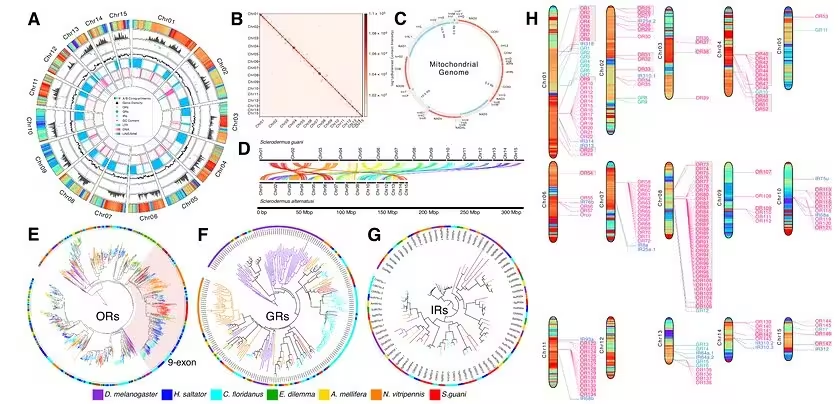
Comparing the genome of S. guani with its congener Sclerodermus alternatusi revealed a dramatic size difference, with the former reaching 322.5 Mb despite both species sharing 15 chromosomes. Repeat annotation demonstrated that long terminal repeat retrotransposons, which are mobile genetic elements that copy and paste themselves across chromosomes, account for 48.7 percent of the S. guani genome. This massive expansion contrasts sharply with the 1.42 percent repeat content found in the related wasp, highlighting how transposable element proliferation can rapidly remodel genomic landscapes without altering chromosome counts.
Why Chemosensory Receptors Occupy Permissive Chromatin Domains
Analyzing high-resolution chromatin conformation maps showed that the 148 chemosensory receptors are predominantly located within active, gene-dense chromosomal compartments. Specifically, odorant receptor genes frequently sit within interaction-rich topologically associating domains, which are three-dimensional genomic neighborhoods characterized by elevated contact frequencies. The authors suggest these permissive environments may facilitate localized gene duplication events, such as the extensive tandem arrays that make up the 9-exon family of receptors.
What Happens When Olfactory Co-Receptor Genes Are Disrupted
To test the behavioral significance of this sensory system, the researchers generated a heritable null mutation in the Orco gene, which encodes the obligatory odorant receptor co-receptor required for functional ion channels. Mutant wasps exhibited widespread reductions in electroantennogram responses across dozens of ecologically relevant odorants. While mutant females successfully located hosts in simplified two-dimensional arenas, their host-seeking success dropped to 24 percent in complex three-dimensional environments, proving that functional olfaction is essential for navigating natural search spaces.
Where Maternal Care and Oviposition Fidelity Breakdown
The Orco mutants suffered profound reproductive and social deficits, including an inability to maintain oviposition site selection. Normal females lay eggs directly on paralyzed hosts, but mutant wasps deposited eggs indiscriminately on non-host surfaces, waste piles, and even directly on top of conspecific larvae and pupae. This loss of kin recognition led to severe larval cannibalism and a drastic reduction in offspring survival. Furthermore, mutant females failed to perform maternal care behaviors such as larval aggregation and cocoon promotion.
The research was published in Advanced science (Weinheim, Baden-Wurttemberg, Germany) on November 25, 2026.
This article has been fact checked for accuracy, with information verified against reputable sources. Learn more about us and our editorial process.
Last reviewed on .
Article history
- Latest version
Reference(s)
- Ye, Zi., et al. “Interaction‐Rich Odorant Receptor Neighborhoods and Olfaction‐Dependent Subsocial Behavior in a Parasitoid Wasp.” Advanced Science, November 25, 2026 Wiley, doi: 10.1002/advs.78976. <https://doi.org/10.1002/advs.78976>.
- Posted by Elizabeth Taylor