University Researchers Compare Six AI Models and Four Strategies To Reveal How Historical Data Size Shapes Rainfall Forecasts
A comprehensive evaluation of machine learning algorithms shows that joint multi-output strategies outperform traditional iterative methods for regional agricultural planning.

Bienvenu Sonon and colleagues at the University of Abomey-Calavi evaluated six artificial intelligence algorithms and four forecasting strategies using up to 54 years of historical rainfall data from the Kandi synoptic station in Benin, finding that joint multi-output strategies consistently outperformed traditional iterative methods.
Reliable rainfall forecasting remains a major hurdle for agricultural planning and water resource management in data-scarce regions. In climatology, time series forecasting involves predicting future atmospheric values based on past observations. When trying to forecast multiple steps ahead, researchers must choose between different output strategies, such as predicting each future step independently, iterating predictions recursively, or forecasting multiple future steps simultaneously using joint multi-output frameworks. The study published in PLOS One examined how these strategies interact with machine learning architectures and historical data record lengths.
How Do Different Multi-Step Strategies Shape Forecast Accuracy?
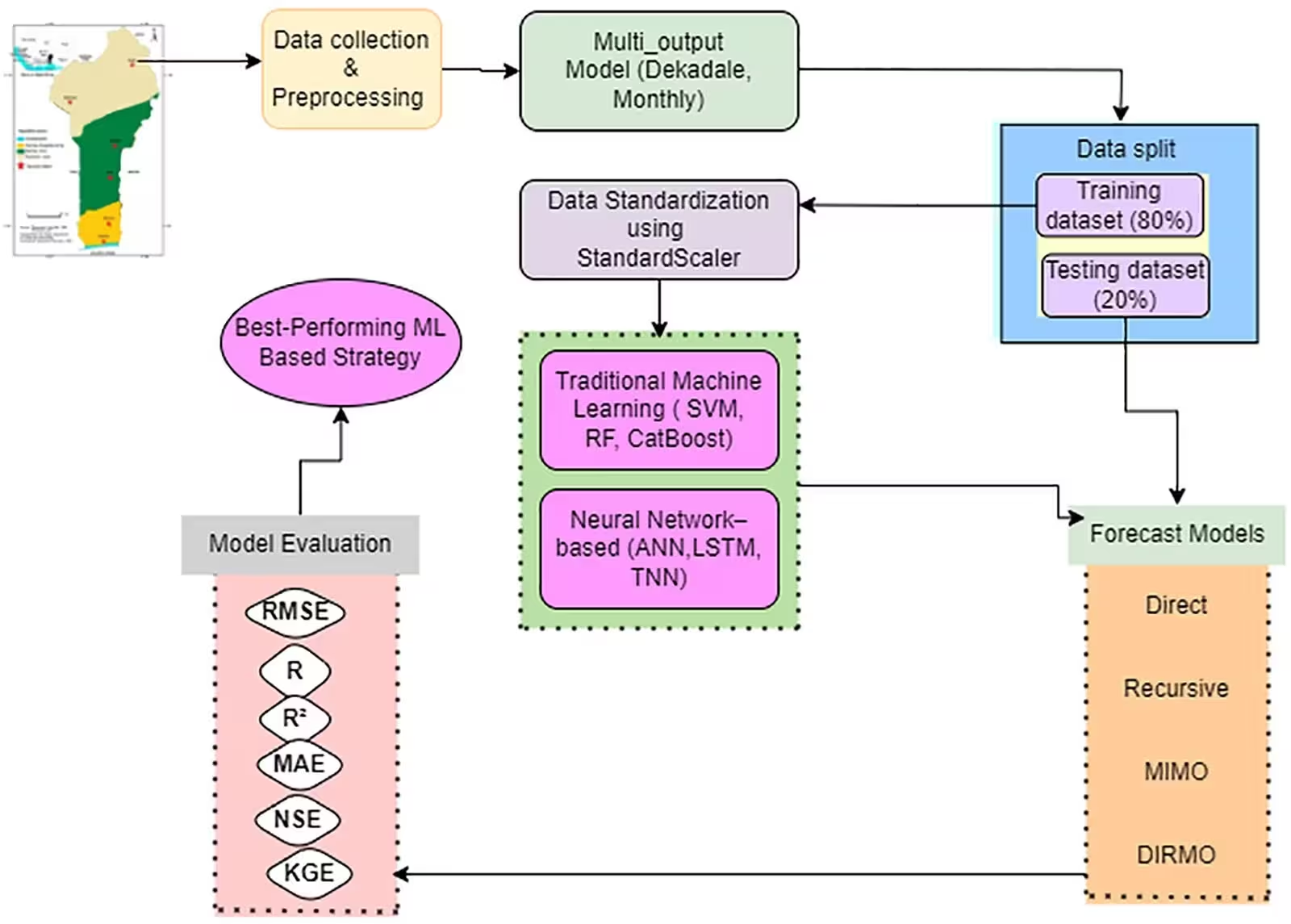
The research team tested four distinct forecasting strategies, namely Direct, Recursive, Multiple-Input Multiple-Output (MIMO), and Direct-MIMO (DIRMO). The Direct strategy builds an independent model for each forecast horizon, whereas the Recursive approach predicts one future value at a time and feeds that prediction back into the model as input for subsequent steps. The MIMO strategy predicts all target horizon values simultaneously, and DIRMO divides the forecasting horizon into multiple segments predicted independently by optimized models.
Statistical evaluations revealed that the Recursive strategy consistently underperformed compared to the non-recursive approaches. Across both monthly and dekadal temporal scales, Friedman tests confirmed statistically significant performance differences among the forecasting strategies. The Nemenyi post-hoc pairwise comparisons showed that Direct, MIMO, and DIRMO exhibited near-identical rank distributions, while the Recursive strategy suffered from accumulating errors at longer forecast horizons.
Which Artificial Intelligence Models Perform Best at Different Temporal Scales?
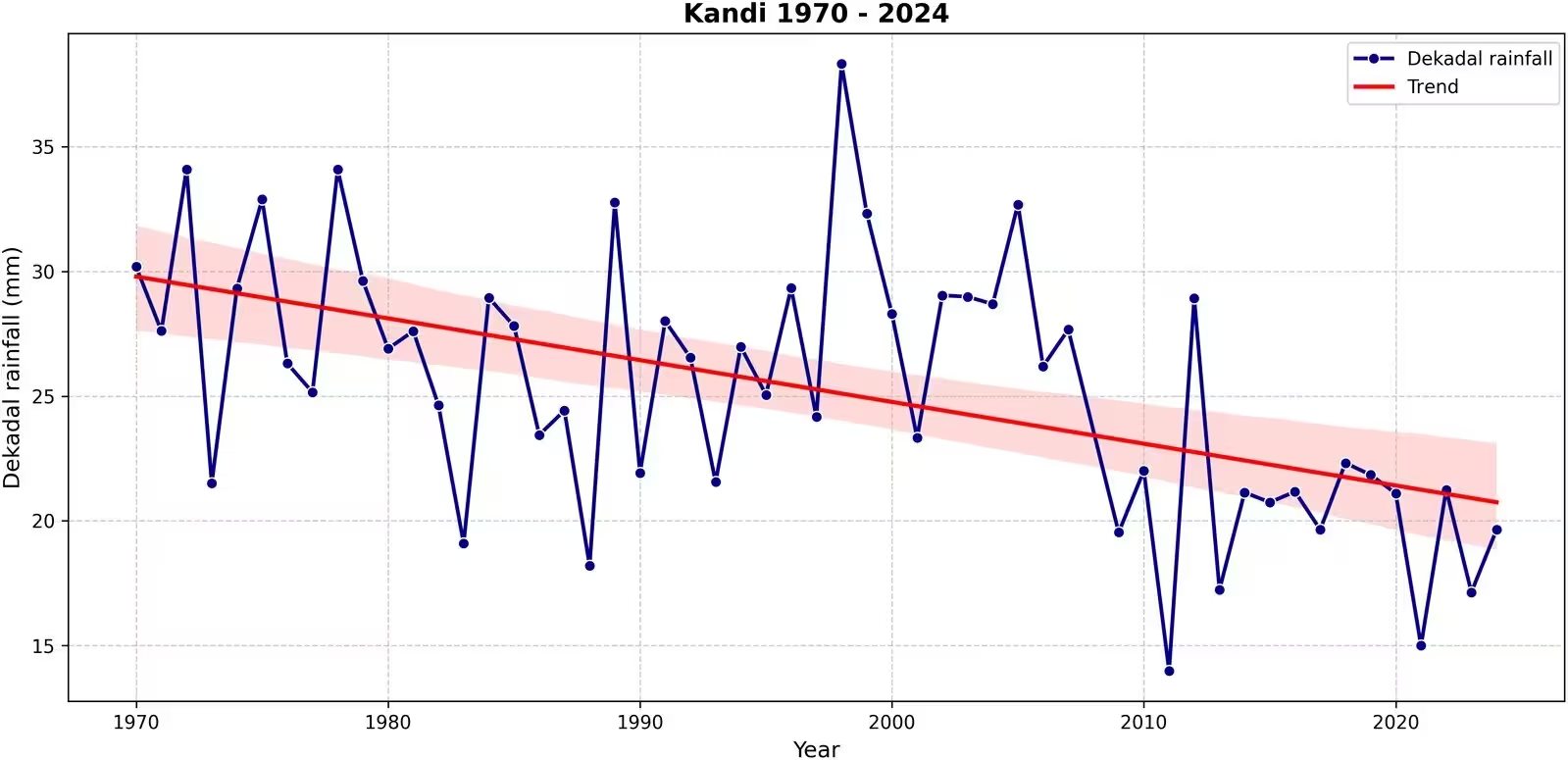
The study compared three traditional machine learning models, which are Support Vector Regression (SVR), Random Forest (RF), and CatBoost, alongside three deep learning architectures, namely Artificial Neural Networks (ANN), Long Short-Term Memory (LSTM) networks, and Temporal Neural Networks (TNN). Tree-based ensemble models like CatBoost and Random Forest demonstrated robust and stable predictive performance across both monthly and dekadal scales.
Performance varied significantly across temporal resolutions for other architectures. While SVR proved competitive at the monthly scale, its predictive accuracy dropped significantly at the finer dekadal resolution. Conversely, Temporal Neural Networks achieved performance comparable to the leading tree-based ensemble models for high-resolution dekadal forecasting.
What Role Does Historical Data Size Play in Weather Prediction?
The authors analyzed two historical rainfall datasets spanning 37 and 54 years, which provided training configurations of 30 and 44 years respectively. For dekadal rainfall forecasting, the best-performing models achieved Root Mean Squared Error values of approximately 24 millimeters with the 30-year training configuration and dropped to about 14 to 15 millimeters with the 44-year training configuration. Similar error reductions were observed for monthly rainfall forecasting.
Paired Wilcoxon signed-rank tests identified statistically significant differences in forecasting errors between the two historical data configurations. However, because the two configurations were evaluated over different testing periods, the authors noted that these differences cannot be interpreted as isolated evidence of a direct causal link between training record length and improved accuracy.
Why Do These Findings Matter for Climate-Resilient Agriculture?
In sub-Saharan rain-fed agricultural systems, dekadal rainfall accumulation serves as a critical operational threshold for agronomic services to determine optimal planting windows and detect early-season dry spells. The research indicates that integrating joint multi-output strategies like DIRMO and MIMO with robust ensemble tree models or temporal neural networks yields favorable predictive performance over 10-day to 30-day horizons. These frameworks can help provide reliable hydro-meteorological information for future agricultural planning and early warning systems.
The research was published in PloS one on November 25, 2026.
This article has been fact checked for accuracy, with information verified against reputable sources. Learn more about us and our editorial process.
Last reviewed on .
Article history
- Latest version
Reference(s)
- Sonon, Bienvenu., et al. “Impact of training data size and multi-step output strategies on AI-based dekadal and monthly rainfall forecasting.” PLOS One, vol. 21, no. 11, November 25, 2026, pp. e0363219 Public Library of Science (PLoS), doi: 10.1371/journal.pone.0363219. <https://doi.org/10.1371/journal.pone.0363219>.
Cite this page:
- Posted by Robert Brown