Engineered Porous Sensor Detects Feather Touches And Decodes Morse Code
A microfluidic assembly strategy creates deterministic porous dielectrics that translate physical pressure into real-time medical alerts and motion data.
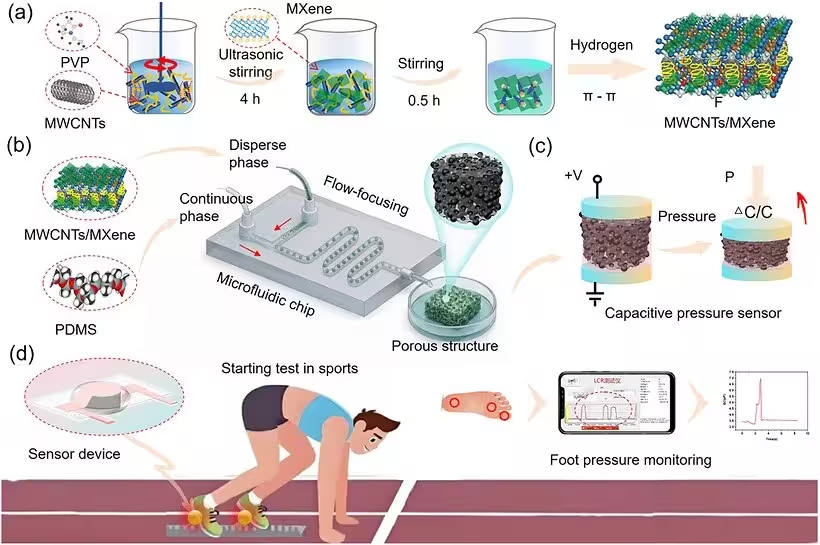
Researchers built a 3D porous pressure sensor from carbon nanotubes and titanium carbide sheets that detects a feather’s touch while handling loads up to 365 kPa. The laboratory prototype relies on a microfluidic assembly technique to overcome the structural randomness of traditional foam sensors.
Flexible pressure sensors measure physical touch by converting mechanical compression into electrical signals. Traditional manufacturing methods create pores randomly through foaming or templating, which limits control over how the material deforms and changes its electrical capacitance. To solve this, Xiaojun Chen and colleagues at Lingnan Normal University developed a bottom-up approach using microfluidic droplets as permanent building blocks, as published in Advanced Science.
How Microfluidic Engineering Controls Pore Architecture
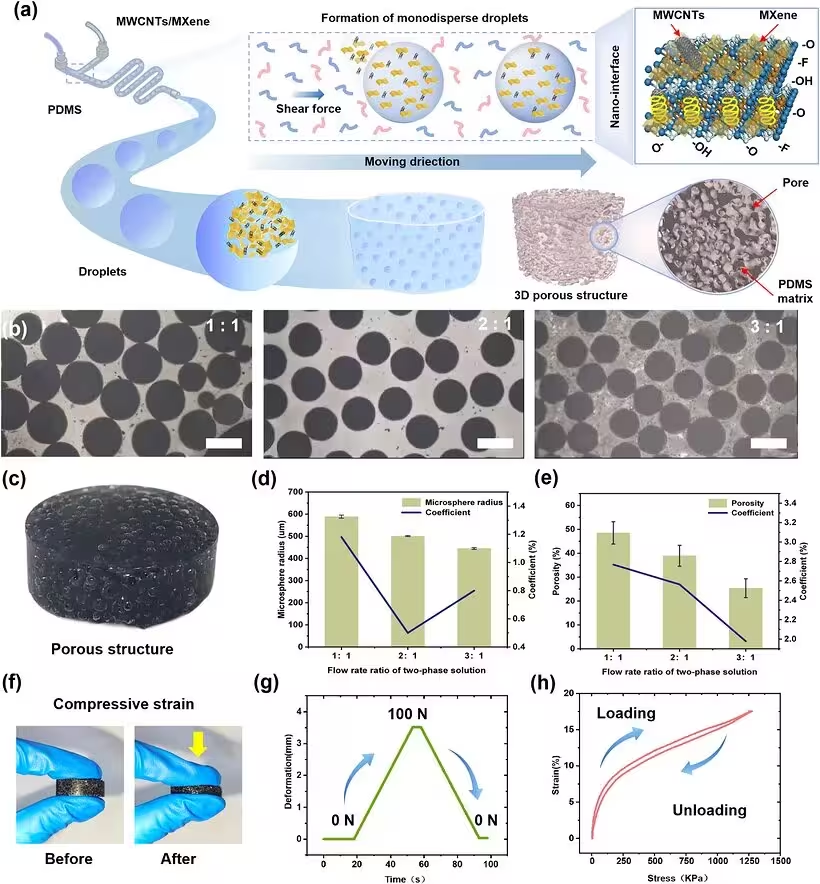
The team generated uniform composite microspheres by combining a dispersed phase of multi-walled carbon nanotubes and MXene nanosheets with a continuous phase of polydimethylsiloxane, a silicone-based elastomer. Polyvinylpyrrolidone acted as a dispersant to prevent carbon nanotube agglomeration through steric stabilization. Adjusting the flow rate ratios in a 3D-printed microfluidic chip allowed precise control over the size and porosity of the resulting microspheres. The average microsphere radius decreased from 588 to 445 micrometers as the continuous phase flow rate increased, dropping the overall porosity from 48% to 25%.
Scanning electron microscopy confirmed that the microspheres assembled into a stable, highly interconnected 3D network with uniform pore distribution. This biomimetic structure significantly reduced the effective compressive modulus of the material, allowing large and recoverable elastic deformation under minimal pressure. Raman spectroscopy and X-ray diffraction analyses indicated that the components integrated primarily through physical interactions like hydrogen bonding and pi-pi stacking without chemical alterations.
Why Dielectric Synergistic Enhancement Amplifies Signals
Under external compression, the sensor exhibits a coupled mechanical and electrical response that changes across different pressure regimes. At low pressures up to 5 kPa, the sensor achieved a high sensitivity of 0.1889 kPa−1 with a low detection limit of 3 Pa, which is comparable to the force of a falling feather. The initial capacitance change is driven largely by geometric compression and electrode spacing reduction.
As pressure increases, the porous skeleton collapses and densifies, bringing the encapsulated nanofillers closer together. This shift triggers a dielectric synergistic enhancement effect driven by Maxwell-Wagner interfacial polarization and dynamic microcapacitor interactions. The carbon nanotubes act as conductive bridges, while the titanium carbide sheets provide polarizable interfaces for charge accumulation, boosting the effective dielectric constant without causing electrical short circuits.
How Wearable Sensors Track Joint Motion and Gait
To evaluate practical performance, the team mounted the sensors onto human joints and the soles of athletic shoes. Bending the elbow to angles of 30, 60, 90, and 120 degrees produced distinct relative capacitance change signals scaling from 0.033 to 0.586. The device also resolved subtle movements like mouse clicks, generating clear capacitance pulses of 0.228.
When integrated into the sole of a sports shoe, the sensor array distinguished slow walking, medium-speed walking, and fast walking by capturing spatiotemporal differences in plantar pressure. A convolutional neural network trained on these signals achieved 100 percent accuracy in classifying pressure patterns from the toe, forefoot, and heel during starting movements in sports trials.
Can Pressure Sensors Translate Morse Code for Medical Needs
Beyond physical monitoring, the team demonstrated nonverbal communication by encoding pressure levels into Morse code. A low pressure press of 1 N represented a dot, while a 10 N press represented a dash. Rhythmic finger flexing successfully transmitted medical terms and urgent messages such as SOS, pain, hunger, and thirst, offering a potential communication tool for individuals with speech or motor impairments.
The research was published in Advanced science (Weinheim, Baden-Wurttemberg, Germany) on November 25, 2026.
This article has been fact checked for accuracy, with information verified against reputable sources. Learn more about us and our editorial process.
Last reviewed on .
Article history
- Latest version
Reference(s)
- Chen, Xiaojun., et al. “Deterministic Porous Dielectrics Through Microfluidic Building‐Block Assembly for Enhanced Pressure Transduction.” Advanced Science, November 25, 2026 Wiley, doi: 10.1002/advs.78933. <https://doi.org/10.1002/advs.78933>.
Cite this page:
- Posted by Rohan Kumar