Tacrolimus Restores Protective Protein And Prevents Esophageal Stricture After Injury
A newly identified protein axis explains why traditional steroids fail and points to an immunosuppressant drug as a superior defense against scarring.
Researchers at Ningbo University discovered that the immunosuppressant drug tacrolimus, also known as FK506, restores a vital protective protein called cystatin A and prevents severe scarring after esophageal injury in rats. The findings offer a potential new way to prevent painful narrowing of the food pipe that often follows surgical removal of early tumors.
Esophageal stricture is a difficult complication that occurs when a wound in the food pipe heals by forming excessive scar tissue, narrowing the passage and making it hard to swallow. This scarring often happens because the delicate inner lining, known as the epithelial barrier, fails to seal properly after doctors perform a procedure called endoscopic submucosal dissection to strip away early cancerous growths. Without a functional barrier, digestive irritants seep into deeper tissues and trigger chronic inflammation that drives thick fibrosis. Standard treatments rely on anti-inflammatory steroids such as triamcinolone acetonide, but their effectiveness varies widely because they fail to directly repair the broken cellular seal.
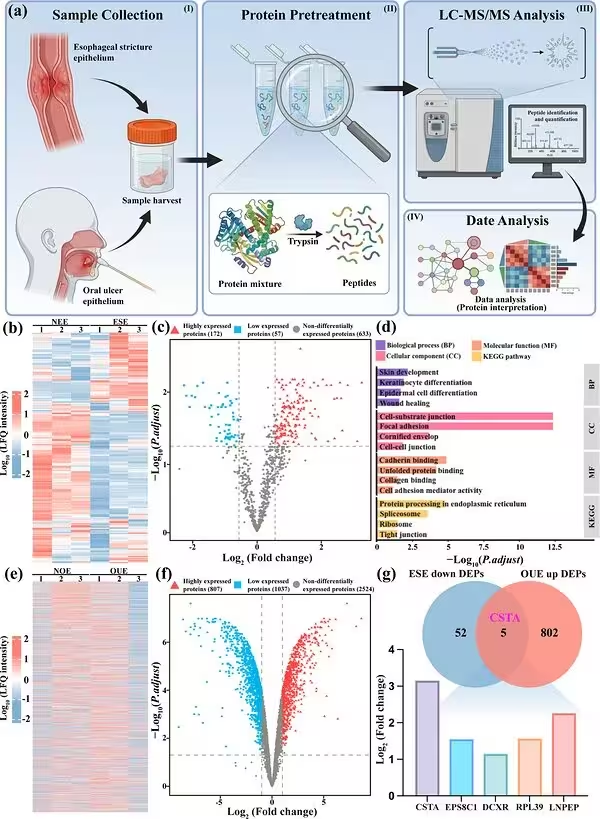
To find better molecular targets, Fang Yang and colleagues at Ningbo University compared human scar tissue from narrowed esophagus sites with healthy, fast-healing oral mucosa. As published in Advanced Science, this comparative proteomic screening identified **cystatin A**, a protective protein that acts as a molecular brake on destructive digestive enzymes, as heavily depleted in strictures but well-preserved in healing oral tissue. When the researchers depleted cystatin A in human esophageal cells using genetic silencing, cell junctions broke down rapidly.
How Defective Protein Brakes Trigger Tissue Damage
Without enough cystatin A to keep them in check, cellular enzymes called cathepsins run wild and chew up key structural proteins that hold cells together. The experiments showed that cystatin A deficiency directly unleashes **cathepsin B and L activities**, which then slice apart E-cadherin, a master protein responsible for gluing neighboring cells to one another. Once E-cadherin is cleaved, the tight seals between cells collapse, leaving the tissue vulnerable to outside irritants.
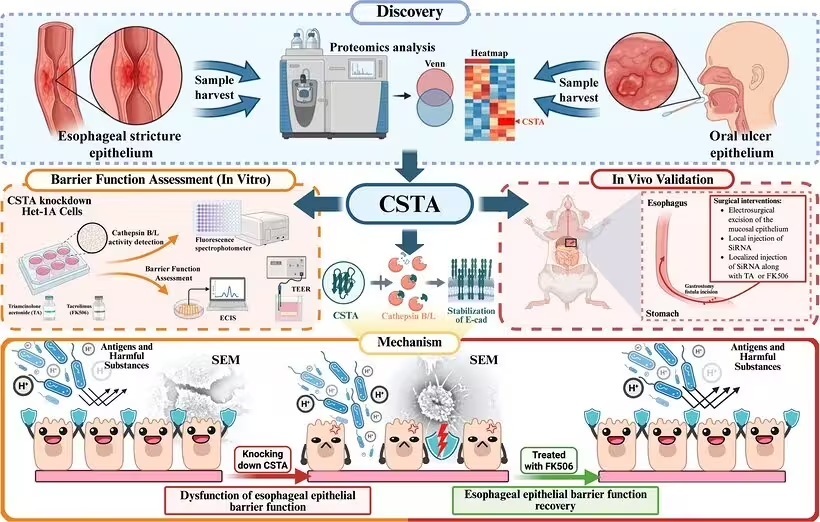
When the team tested standard steroid treatment on cells lacking cystatin A, the drugs failed to rescue the broken barrier. The researchers realized that low cystatin A levels create a hard ceiling on how well traditional steroids can work, explaining why some patients continue to develop severe strictures despite therapy.
Why Tacrolimus Outperforms Standard Steroids
Looking for an alternative approach, the team tested **tacrolimus**, an FDA-approved medication commonly used to prevent organ transplant rejection. In cell cultures exposed to inflammatory triggers, tacrolimus successfully restored cystatin A expression and brought runaway cathepsin activity back down to normal levels. Further signaling experiments suggested this restoration operates through a cellular pathway involving calcium-dependent signaling molecules.
When evaluated in a rat thermal-injury model of esophageal stricture, local injections of tacrolimus dramatically accelerated wound repair and reduced collagen accumulation compared to the steroid group. By day 14, treated animals maintained a well-preserved lumen and strong protein markers of structural integrity.
What Limitations Remain Before Human Trials Begin
Despite the promising results, the study has notable limitations that must be addressed before human testing can begin. The rat model relied on thermal injury rather than surgical dissection, which creates deeper tissue damage and more intense inflammation than typical clinical procedures. Furthermore, the researchers caution that local drug delivery immediately after injury requires more practical, sustained release systems, such as specialized hydrogels or drug-eluting stents, to be clinically useful.
The team also emphasized that systemic safety profiles for locally administered tacrolimus need rigorous evaluation. Although animal body weights remained stable across experimental groups, local injection alone does not rule out potential systemic exposure or organ-specific toxicity. Future investigations must establish optimal dosing kinetics and long-term safety before this strategy can advance toward clinical practice.
The research was published in Advanced science (Weinheim, Baden-Wurttemberg, Germany) on November 25, 2026.
This article has been fact checked for accuracy, with information verified against reputable sources. Learn more about us and our editorial process.
Last reviewed on .
Article history
- Latest version
Reference(s)
- Yang, Fang., et al. “FK506 Preserves Esophageal Barrier Integrity With Cystatin A Restoration and Reduced E‐Cadherin Cleavage.” Advanced Science, November 25, 2026 Wiley, doi: 10.1002/advs.78867. <https://doi.org/10.1002/advs.78867>.
Cite this page:
- Posted by Omar Mirza