Researchers Uncover Perovskite Catalyst That Clears Fuel Cell Peroxide Damage, And Reveals A New Way To Predict High Performance
Quantum simulations reveal that copper-doped lanthanum perovskites achieve a low overpotential of 0.49 volts by optimizing electron sharing at active atomic sites.
Computers simulating atomic interactions have identified a specialized lanthanum cobalt oxide catalyst that achieves an exceptionally low overpotential of 0.49 V for converting unwanted hydrogen peroxide back into harmless oxygen inside fuel cells.
Proton exchange membrane fuel cells frequently suffer from performance drops because they generate reactive oxygen species that chemically attack internal polymer membranes and metal supports. These destructive byproducts shorten the operating lifespan of clean energy devices. Finding ways to selectively break down hydrogen peroxide before it causes damage remains a major chemical engineering challenge. A research team led by Ranjit Thapa at SRM University AP used quantum mechanical calculations published in Advanced Science to model eighteen distinct perovskite variants, testing how structural vacancies and copper doping alter catalytic behavior.
How Defect Engineering Changes Electronic States
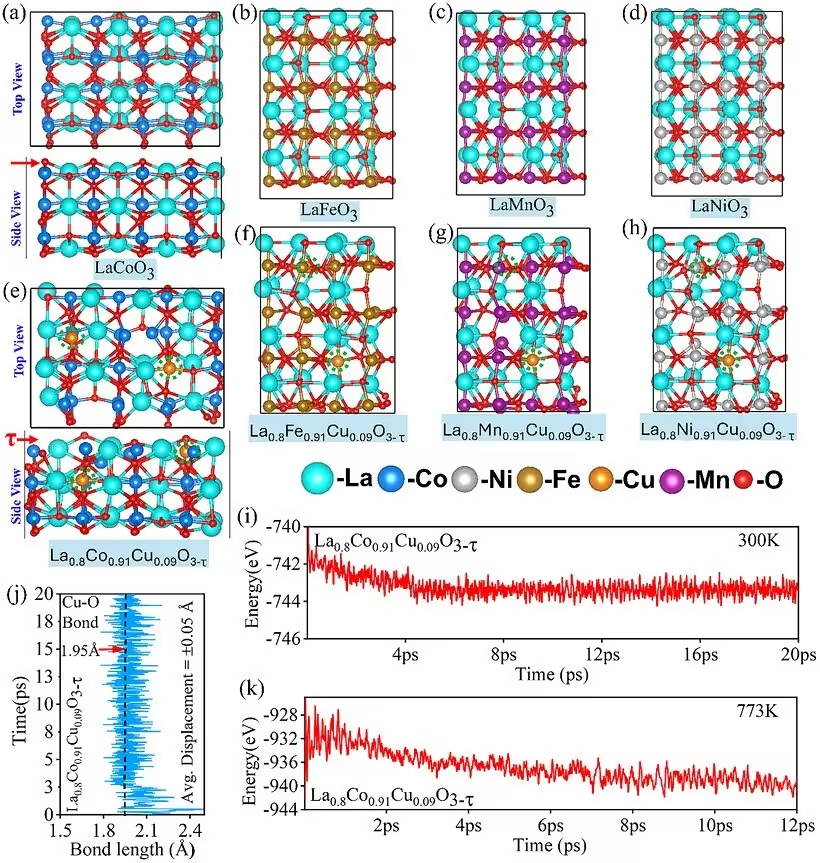
Materials science researchers routinely study perovskites because their crystalline frameworks tolerate extensive chemical substitutions without losing structural integrity. The team modified baseline structures by removing specific lanthanum atoms from the outer crystal layer and substituting cobalt sites with copper atoms. These structural adjustments alter the surrounding electronic architecture, shifting how the material shares electrons with visiting molecules. Quantum models showed that creating these atomic vacancies decreases d-orbital electron occupancy near the Fermi level while increasing the density of accessible states, which improves chemical reactivity.
Testing Thermal Stability at High Temperatures
To verify whether these modified structures could withstand real operating environments, the authors ran molecular dynamics simulations lasting up to 20,000 femtoseconds at temperatures of 300 K and 773 K. The simulations revealed only minor energy fluctuations and smooth structural evolution without sudden atomic displacements. Radial distribution function analyses confirmed that short-range metal-oxygen bonds remained intact even under elevated thermal stress. This structural stability suggests that copper-doped lanthanum perovskites can maintain their chemical configuration during continuous electrochemical operation.
Why Copper Doping Boosts Catalytic Activity
Detailed analysis of the reaction pathway revealed that the Co1 site within the copper-substituted lattice exhibited optimal intermediate binding characteristics. During the reaction cycle, the catalyst transfers approximately 0.197 electrons to the adsorbed hydroperoxyl intermediate, facilitating strong orbital overlap between metal d-orbitals and oxygen p-orbitals. The team found that binding energies followed a classic Sabatier volcano curve across all eighteen tested variations. The optimal material achieved a low overpotential of 0.49 V after applying corrections for zero-point energy and thermal entropy.
Predicting New Materials Using Machine Learning
Because screening thousands of material combinations manually is impractical, the investigators developed a multiple linear regression model utilizing specific electronic descriptors. Combining parameters such as the dxz fermi orbital state, d-band center, and dx2-y2 fermi state yielded a predictive model with a coefficient of determination of 0.85 and a cross-validation score of 0.80. Shapley additive explanations indicated that the dxz fermi descriptor accounted for over 51 percent of the model predictive power. This computational screening tool provides a reliable framework for designing advanced electrocatalysts for next-generation energy conversion devices.
The research was published in Advanced science (Weinheim, Baden-Wurttemberg, Germany) on November 24, 2026.
This article has been fact checked for accuracy, with information verified against reputable sources. Learn more about us and our editorial process.
Last reviewed on .
Article history
- Latest version
Reference(s)
- Pathak, Arupjyoti., et al. “A‐Site Vacancies and Cu‐Doping in Lanthanum‐Based Perovskite Anodes for Selective H 2 O 2 Oxidation to O 2 : A Descriptor‐Based Approach.” Advanced Science, November 24, 2026 Wiley, doi: 10.1002/advs.78896. <https://doi.org/10.1002/advs.78896>.
Cite this page:
- Posted by Michael Ellison