Xizang Mountain Travelers Lost 10 Percentage Points In Blood Oxygen And Suffered Brain Impairments That Oxygen Boosts And Descent Could Reverse
A longitudinal tracking study reveals that high-altitude hypoxia disrupts neurovascular coupling and triggers cognitive errors, though recovery is possible.
Xizang Expedition Researchers Discovered That High Altitudes Drop Blood Oxygen by 10 Percentage Points And Impair Brain Function, Yet Brief Oxygen Boosts Help
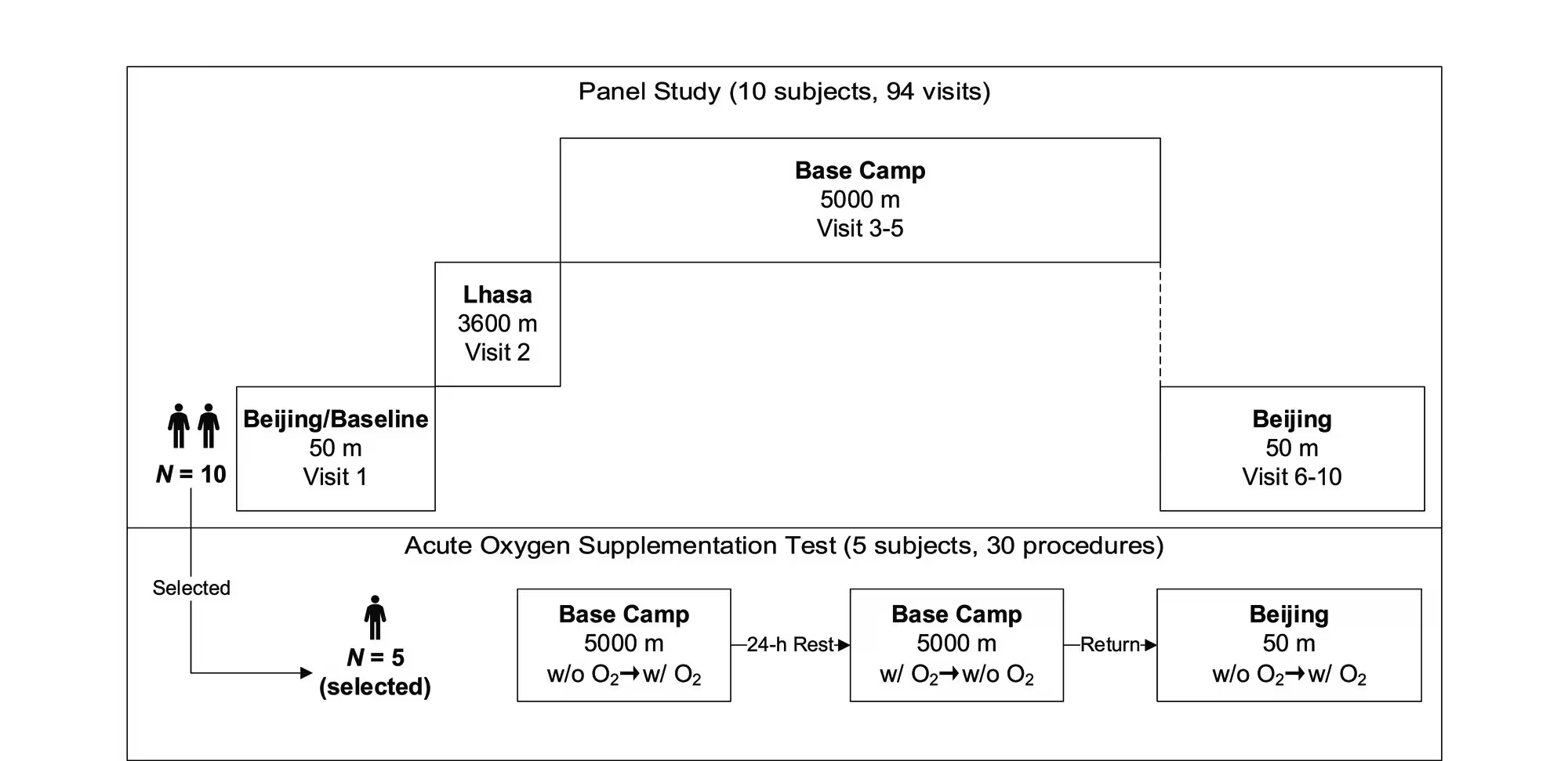
Travel to elevations reaching 5,000 meters above sea level plunges the human body into a state of low atmospheric pressure and reduced oxygen availability known as hypobaric hypoxia. While millions of travelers and workers visit high-altitude regions every year, the exact physiological toll on human thinking and brain blood flow has remained poorly defined until now. To track these neural changes, researchers led by Qianli Dong and Tong Zhu at Peking University organized a longitudinal panel study, published in Environment & Health, following 10 healthy participants as they traveled from Beijing at 50 meters above sea level up to Xizang and back down.
How Mountain Sickness and Lower Blood Oxygen Disrupt Attention
Upon arriving in the mountain regions, participants experienced an average drop in peripheral oxygen saturation of 10.5 percentage points alongside a 2.48-point surge in acute mountain sickness symptoms. Dizziness and severe headaches dominated these early health complaints, which correlated strongly with negative emotional states and a measurable drop in self-esteem scores. Tests of attention and mental control revealed that the odds of making errors on cognitive tasks jumped significantly during the high-altitude stay. Specifically, the odds of errors on a choice reaction time test increased more than three times during the first mountain visit, while errors on an executive function test assessing cognitive interference rose twofold during later high-altitude check-ins.
Why Brain Blood Flow Mismatches Metabolic Demand
The team utilized functional near-infrared spectroscopy, a non-invasive optical technique measuring changes in brain hemoglobin concentrations, to monitor neurovascular coupling, which is the physiological process where active neurons trigger increased local blood flow to match energy demands. At low elevations, brain oxygenated hemoglobin rises and deoxygenated hemoglobin falls during demanding mental tasks as blood rushes to fueled areas. At high altitudes, however, this pattern reversed or became delayed, showing deoxygenated hemoglobin increases of 3.0 micrometers per millimeter during testing. Mediation analysis indicated that this dysregulated neurovascular coupling accounted for about 15 percent of the observed cognitive decline. Blood markers also showed elevated levels of chitinase-3-like protein 1, pointing to inflammatory activation, alongside a compensatory rise in brain-derived neurotrophic factor, which acts as a neuroprotective response.
Can Short Oxygen Sessions and Descent Reverse the Damage?
To test whether quick interventions could restore brain function, a subset of five participants underwent acute oxygen supplementation trials using a nasal cannula delivering 1.5 liters per minute of oxygen for 5 minutes. Following this brief oxygen boost, participant blood oxygen levels rose above 92 percent, and their brain hemodynamic response curves closely resembled those recorded at low altitudes. Reaction times and error rates showed favorable, though statistically non-significant, improvements during these oxygen tests. Furthermore, when participants descended back to low-altitude Beijing, their physiological metrics, acute mountain sickness scores, and mood disturbances returned toward baseline levels within 7 days, highlighting the potential reversibility of these high-altitude neural impacts.
The research was published in Environment & health (Washington, D.C.) on September 29, 2026.
This article has been fact checked for accuracy, with information verified against reputable sources. Learn more about us and our editorial process.
Last reviewed on .
Article history
- Latest version
Reference(s)
- Dong, Qianli., et al. “High-Altitude Exposure: Effects on Cognitive Performance, Neurovascular Mechanisms, and Mitigation Strategies.” Environment & Health, vol. 4, no. 11, September 29, 2026, pp. 2480-2490. American Chemical Society (ACS), doi: 10.1021/envhealth.6c00248. <https://doi.org/10.1021/envhealth.6c00248>.
Cite this page:
- Posted by Kamran Akhtar