U.S. Seafood Imports Reveal Hidden Vulnerabilities And Tilapia Ranks Most At Risk
A new multi-factor index shows that standard import statistics miss critical supply chain risks across core marine species.
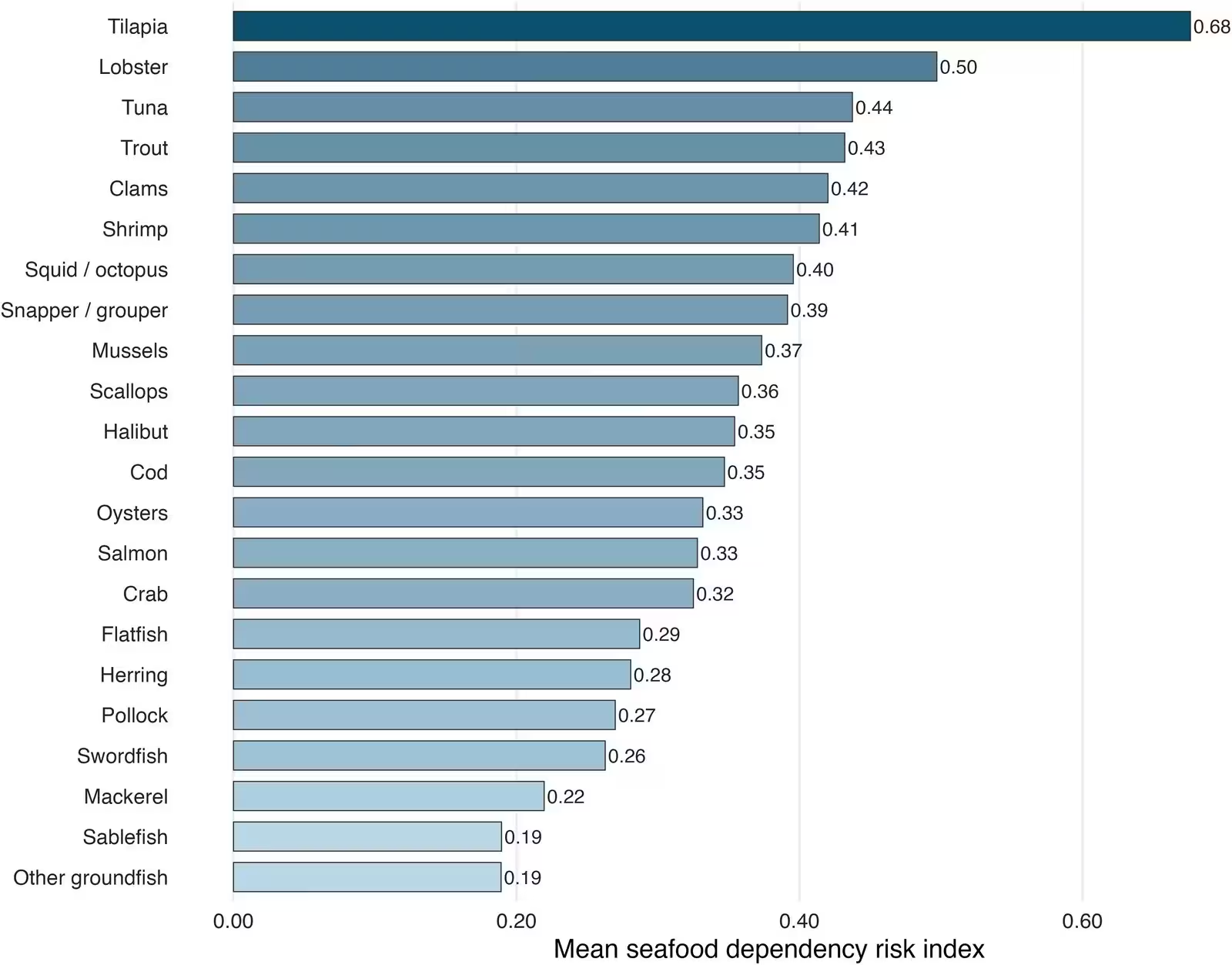
University of Maine researchers mapped 22 core seafood groups between 2009 and 2023 and found that tilapia carried the highest average vulnerability risk score of 0.68 due to heavy import reliance and supplier concentration. While the United States relies heavily on foreign markets to fill its dinner plates, standard trade numbers fail to show which specific marine species face the greatest structural danger from supply shocks. To uncover these hidden vulnerabilities, a team of scientists created a custom screening tool that evaluates not just how much fish crosses borders, but also where it comes from and how stable those supplier nations are. The new findings reveal that simple reliance metrics miss crucial warning signs about food security and trade stability.
Aquatic foods provide vital protein and essential micronutrients, making them a cornerstone of healthy diets. However, globalized seafood supply chains stretch across distant ecosystems, processing centers, and regulatory environments, exposing local markets to distant political, economic, and environmental shocks. Traditional self-reliance metrics look only at domestic production versus imports, ignoring whether a country sources its fish from a single fragile supplier or dozens of stable trade partners. The researchers, including Tolulope Samuel Oyikeke, Joshua S. Stoll, and Tracy MacKeracher, published their findings in PloS one, detailing how a multidimensional risk index changes our understanding of national food security.
How Does The New Index Measure Seafood Supply Risk?
To capture the true vulnerability of the American seafood supply, the team developed the U.S. Seafood Dependency Risk Index, known as U.S.-SDRI. This composite metric combines export-adjusted import dependence, which measures the share of fish coming from abroad after accounting for domestic exports. It also factors in supplier concentration using trade data to see if imports come from a diverse group of nations or a tiny handful of sources. Finally, the framework incorporates exporter risk, utilizing the Notre Dame Global Adaptation Initiative framework to assess each supplier country’s climate vulnerability alongside its economic and governance readiness.
Which Species Face The Highest Risk And Why?
The analysis revealed sharp contrasts across the 22 core seafood groups examined over the 15-year study period. Tilapia ranked as the highest-risk group with a mean score of 0.68, driven by complete import dependence combined with moderate supplier concentration and exporter risk. Lobster took second place with a score of 0.50, demonstrating that high vulnerability is not limited to imported species because domestic landings are largely exported while import streams remain heavily concentrated. Meanwhile, tuna and shrimp combined massive import dependence with higher exporter risk from their primary supplier nations, highlighting different pathways to structural exposure.
Why Do Concentration And Exporter Stability Matter?
Traditional metrics often rank seafood security based solely on self-reliance, but adding trade structure completely reshapes the picture. Sixteen out of 22 core groups changed their rank once supplier concentration and exporter risk were factored into the equation. For example, clams jumped from 13th under basic self-reliance up to 5th under the full risk index due to moderate scores across all vulnerability dimensions. Conversely, species like sablefish and pollock showed that high import concentration does not automatically create severe risk if foreign products represent only a tiny fraction of total domestic availability.
Can Reallocating Trade Partners Reduce National Vulnerability?
The researchers tested a hypothetical sourcing scenario for 2023 by reallocating 10% of the largest supplier’s volume across alternative trade partners for tilapia, tuna, lobster, and sablefish. While spreading out imports successfully lowered supplier concentration scores for all four groups, the final risk index did not always drop. For sablefish, the composite risk score ticked up slightly because the alternative supplier mix carried a higher national exporter risk profile. This outcome demonstrates that finding new trade partners requires careful evaluation of governance and climate readiness rather than simply chasing numerical diversification.
The research was published in PloS one on November 25, 2026.
This article has been fact checked for accuracy, with information verified against reputable sources. Learn more about us and our editorial process.
Last reviewed on .
Article history
- Latest version
Reference(s)
- Oyikeke, Tolulope Samuel., et al. “Risk-weighted import dependence reveals uneven supply exposure across U.S. seafood species.” PLOS One, vol. 21, no. 11, November 25, 2026, pp. e0356940 Public Library of Science (PLoS), doi: 10.1371/journal.pone.0356940. <https://doi.org/10.1371/journal.pone.0356940>.
Cite this page:
- Posted by Raj Joshi