Clam Climate Resilience Paradox Reveals Hidden Life-Stage Trade-Offs
A multi-generation study shows that clam families surviving acidification best as larvae struggle most as adults.
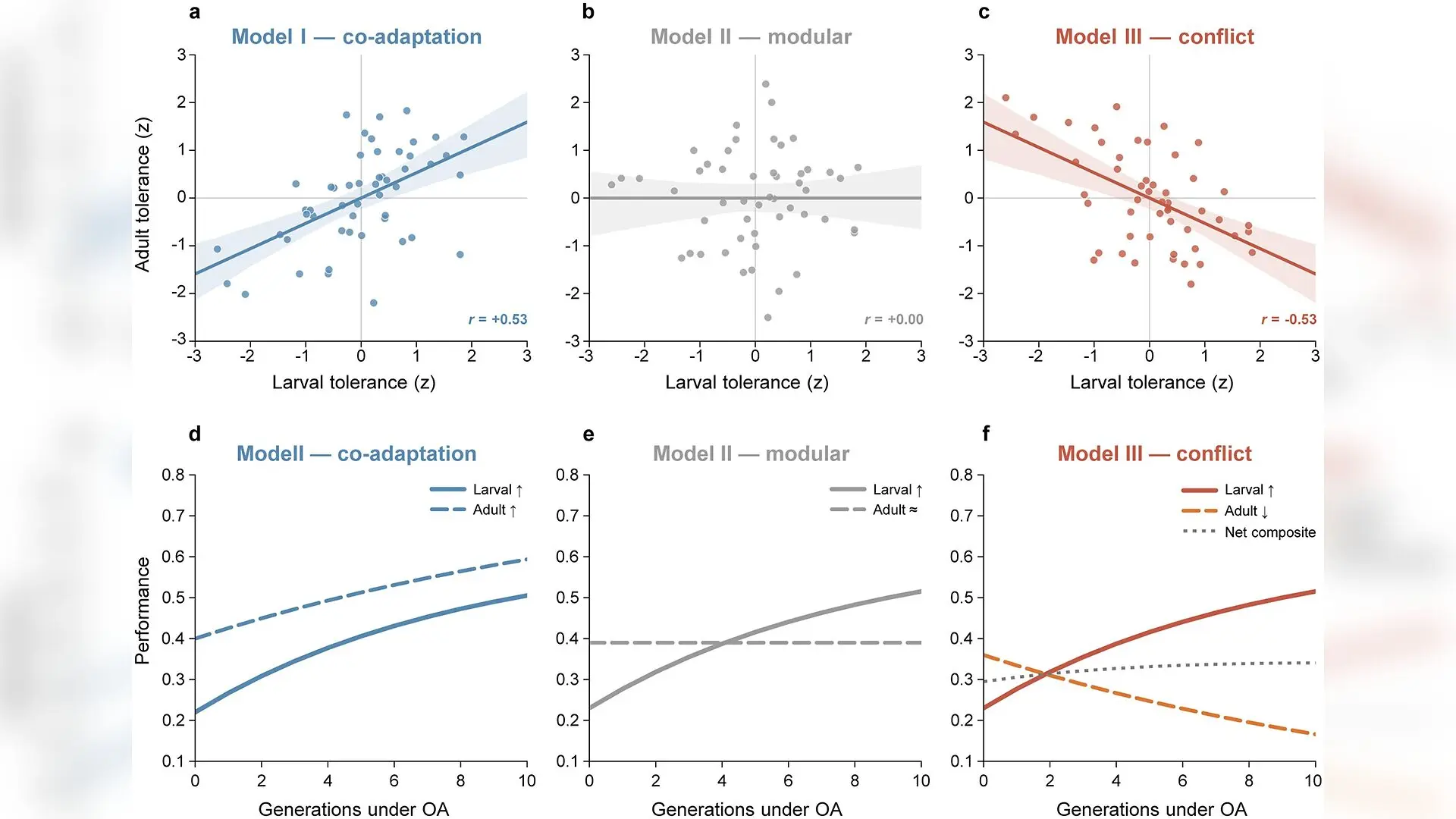
When young hard clams from Long Island Sound face acidic waters, the traits that help them survive their earliest days come with a heavy hidden cost later in life. Researchers tracking 51 families of the hard clam Mercenaria mercenaria discovered that climate resilience measured at one developmental stage completely fails to predict success across the rest of the organism’s life cycle. Instead of staying consistent, climate tolerance in these animals undergoes a dramatic reversal after metamorphosis.
Marine animals with complex life histories make up roughly 80% of marine invertebrate species, yet scientists have traditionally relied on single-stage tolerance assays—most commonly examining fragile larvae—to forecast how populations will cope with climate change. This new study, published in PLOS Biology, reveals that this widespread assumption is fundamentally flawed because ocean acidification actively reorganizes the genetic architecture of the organism.
Why Early Success Leads to Later Failure
To uncover how tolerance changes across life stages, Hao Song and colleagues bred 51 distinct clam families using a partial half-sib pedigree. They exposed the offspring to both present-day conditions and end-century ocean acidification scenarios, tracking larval survival, shell growth, thickness, hardness, and developmental timing. Afterward, surviving juveniles were grown in a 90-day acidification nursery, followed by a two-year recovery period in a common ambient marine garden to measure their eventual reproductive output.
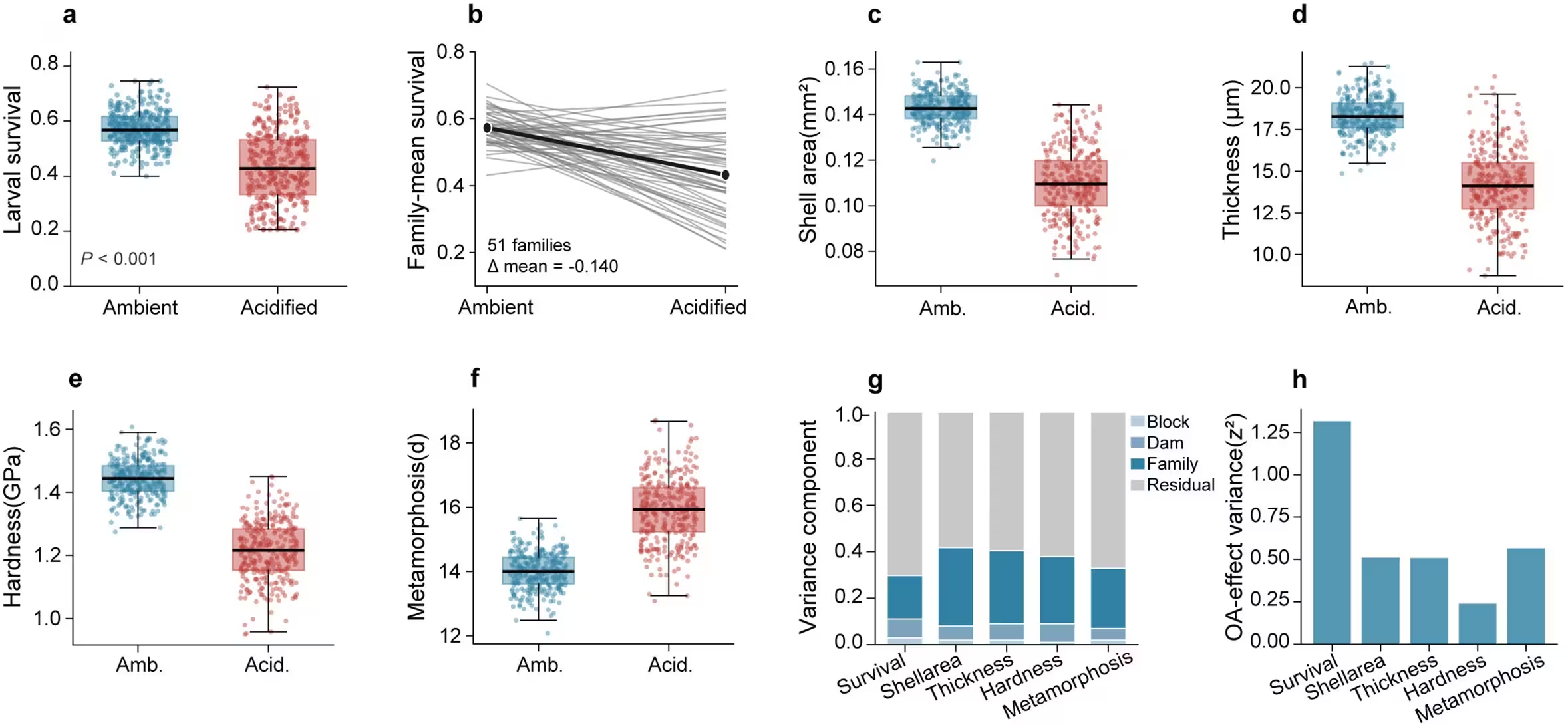
The results showed a strong negative correlation between larval and post-metamorphic tolerance. Clam families that thrived as larvae under acidified conditions tended to perform poorly as juveniles and adults, while the top adult performers had been mediocre or poor larvae. Out of all 13 families that ranked in the top quartile during the larval stage, 10 fell below the median during adulthood. Not a single family managed to occupy the top quartile in both life stages.
How Acidification Reshapes the Genetic Landscape
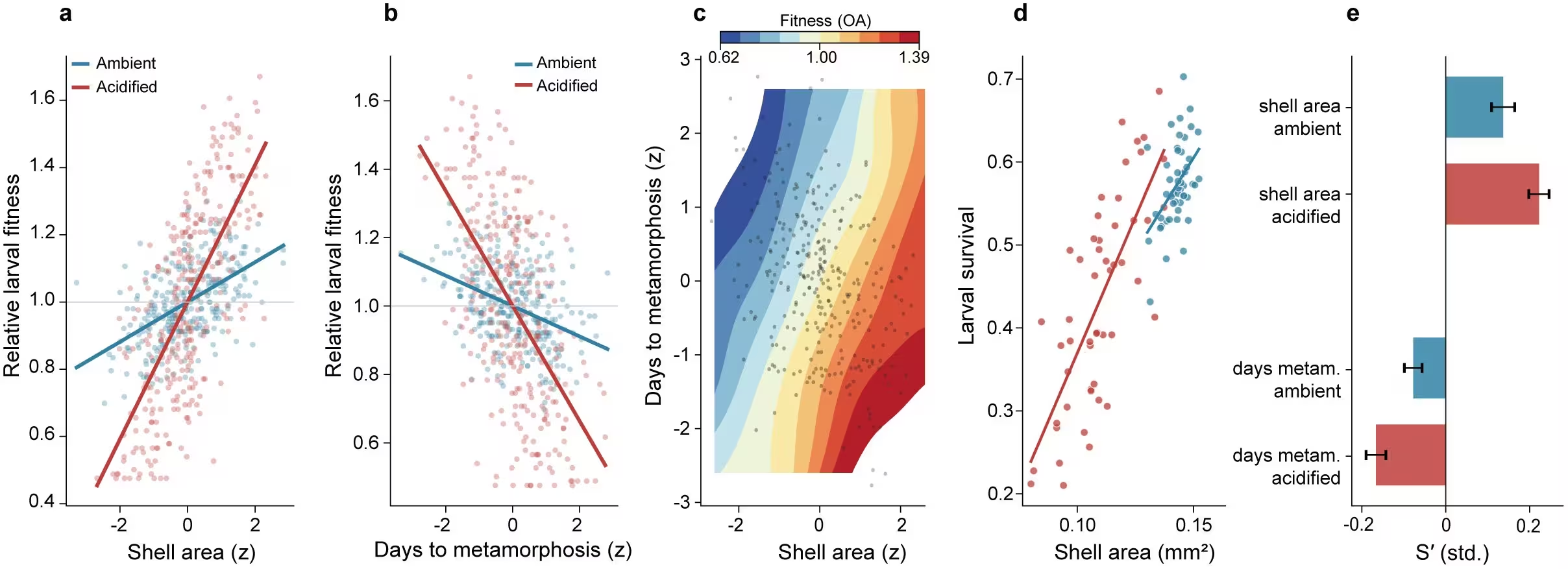
A detailed multivariate analysis of the among-family covariance matrix showed that ocean acidification does not simply reduce overall fitness in a uniform way. Under acidified conditions, 57% of the total variance among families collapsed onto a single dominant axis that loaded positively on every larval trait and negatively on every post-metamorphic trait. By contrast, under normal ambient conditions, the same families showed no cross-stage correlation at all.
This means that acidification forces the organism into a physiological trade-off. Families that rapidly clear the early calcification bottleneck as larvae appear to pay for this speed through elevated maintenance metabolism, reduced shell dissolution resistance, and lower reproductive output later in life. The evolutionary pressure required to survive the planktonic stage inadvertently selects against long-term adult resilience.
What This Means for Future Ocean Conservation
Using a 20-generation evolutionary projection model, the researchers simulated how different breeding and selection strategies would shape population survival over time. When selection focused entirely on a single stage, it successfully improved tolerance during that specific window while actively eroding resilience elsewhere. Only a balanced multi-stage selection approach prevented the accumulation of hidden liabilities and preserved genetic diversity.
The authors note that these findings carry significant implications for marine restoration and aquaculture programs. Relying exclusively on larval screenings to select resilient broodstock risks producing populations that stumble once they hit the benthic adult stage. To protect marine species from ongoing environmental shifts, scientists must account for how complex life cycles and genetic trade-offs interact across every stage of development.
The research was published in PLOS Biology on October 26, 2026.
This article has been fact checked for accuracy, with information verified against reputable sources. Learn more about us and our editorial process.
Last reviewed on .
Article history
- Latest version
Reference(s)
- Song, Hao., et al. “Tolerance measured at one developmental stage mispredicts climate resilience in an animal with a complex life cycle.” PLOS Biology, vol. 24, no. 10, October 26, 2026, pp. e3004079 Public Library of Science (PLoS), doi: 10.1371/journal.pbio.3004079. <https://doi.org/10.1371/journal.pbio.3004079>.
Cite this page:
- Posted by Divya Iyer