Century of Olympic Swimming Data Reveals How Pools and Suits Slashed Times
Analysis of over 3,000 elite finalists from 1924 to 2024 highlights the specific Olympic years that triggered massive performance leaps.
Elite Olympic swimmers racing in freestyle, backstroke, breaststroke, and butterfly events have shaved massive amounts of time off their final results over the past century, with women cutting 22.55 seconds off the 100-meter freestyle alone. A century of historical race data reveals how engineering breakthroughs and rule changes reshaped aquatic sports.
To understand how elite performance evolved, researchers analyzed official finalist records for 1,553 women and 1,641 men competing across 24 Olympic Games spanning from Paris 1924 to Paris 2024. The study, published in PLOS One by sports scientists Ayça Anameriç and colleagues, tracked final race times, start reaction times, and calculated swimming speeds across all official distances from 50 meters up to 1,500 meters.
The historical analysis shows that final race times dropped substantially across every single stroke and distance over the 100-year timeline. Freestyle and long-distance events demonstrated the most pronounced overall improvements. For instance, women competing in the 400-meter freestyle final in 1924 swam an average time of 369.05 seconds, whereas female finalists in 2024 completed the distance in 241.34 seconds, representing a total reduction of 34.6 percent. Men competing in the 1,500-meter freestyle improved from an average of 1,280.48 seconds in 1924 down to 880.95 seconds in 2024, marking a 31.2 percent reduction in time.
Which Olympic Cycles Saw the Fastest Times?
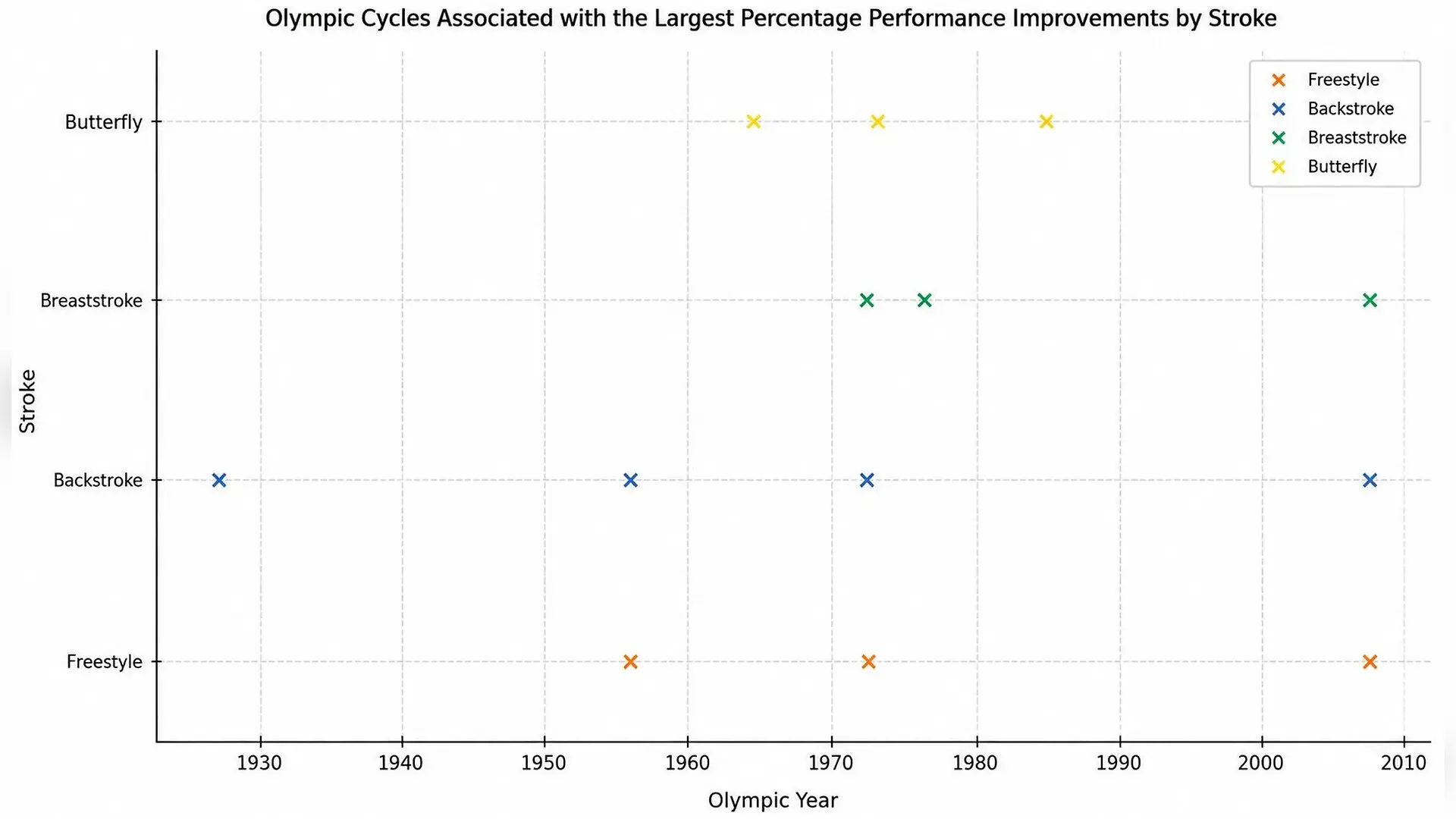
The data highlights specific historical Olympic years where performance improvements spiked dramatically compared to surrounding decades. Major leaps occurred during the 1956 Melbourne Games, the 1972 Munich Games, and the 2008 Beijing Games. These high-improvement periods closely matched major technological, structural, and regulatory shifts in competitive swimming.
The 1956 Olympics marked the first time events were held in fully enclosed, environmentally controlled indoor pools equipped with wave-dampening gutter systems. These structural changes stabilized water temperature, minimized turbulence, and coincided with the introduction of early synthetic nylon swimsuits that reduced drag. Decades later, the 1972 Games benefited from deeper pool basins, anti-wave lane ropes, and the widespread rise of modern training science featuring structured interval training and lactate-guided pacing.
How Did High-Tech Swimsuits Change the Sport?
The most dramatic single-cycle performance leaps often involved equipment revolutions. The 2008 Beijing Olympics delivered some of the largest percentage improvements in swimming history, driven by the widespread adoption of polyurethane-based full-body racing suits such as Speedo’s LZR Racer. These high-tech garments compressed the swimmer’s body into a more hydrodynamic form, increased buoyancy, and reduced active drag.
Comparative studies from that era noted that polyurethane suits produced performance gains of approximately 1.5 to 3.5 percent. High-drag strokes like breaststroke and butterfly saw particularly strong gains because improvements in suit materials and body positioning yielded proportionally larger reductions in resistance compared to freestyle.
What Does Reaction Time Data Reveal About Modern Starts?
Reaction-time records, which were officially tracked starting at the 2000 Sydney Olympic Games, revealed significant improvements in start performance across the board. The fastest reaction times in both male and female athletes consistently occurred in sprint events, such as the 50-meter freestyle where female finalists averaged 0.67 seconds and male finalists averaged 0.62 seconds in recent games.
Researchers noted that these faster reaction times stem from refined starting techniques, improved starting block designs, and specialized training programs focused on explosive starts. While reaction time represents only a fraction of total race duration, it remains vital in sprint races where medals are decided by hundredths of a second.
What Are the Limitations of This Century-Long Study?
The authors acknowledge several limitations in their retrospective design. Because the dataset relied on mean finalist values rather than individual gold-medal winning times, exceptional peak performances by outlier champions may have been smoothed out. Furthermore, while the study correlated specific technological eras with performance jumps, it did not run formal change-point statistical modeling to isolate individual variables.
Despite these caveats, the century-long dataset provides a definitive benchmark for sports scientists, coaches, and athletes. Understanding how pool engineering, suit technology, and biomechanics interact will help guide talent development and future training strategies as international competition continues to evolve.
The research was published in PLOS One on October 26, 2026.
This article has been fact checked for accuracy, with information verified against reputable sources. Learn more about us and our editorial process.
Last reviewed on .
Article history
- Latest version
Reference(s)
- Anameriç, Ayça., et al. “Performance evolution in Olympic swimming over the last 100 years: A retrospective stroke-based analysis.” PLOS One, vol. 21, no. 10, October 26, 2026, pp. e0361289 Public Library of Science (PLoS), doi: 10.1371/journal.pone.0361289. <https://doi.org/10.1371/journal.pone.0361289>.
Cite this page:
- Posted by Kamran Akhtar