Suspended Desert Dust Reveals Surprising Far-Infrared Absorption That Challenges Climate Models
Laboratory analysis of global mineral dust samples shows strong far-infrared optical activity, improving satellite remote sensing accuracy for climate studies.
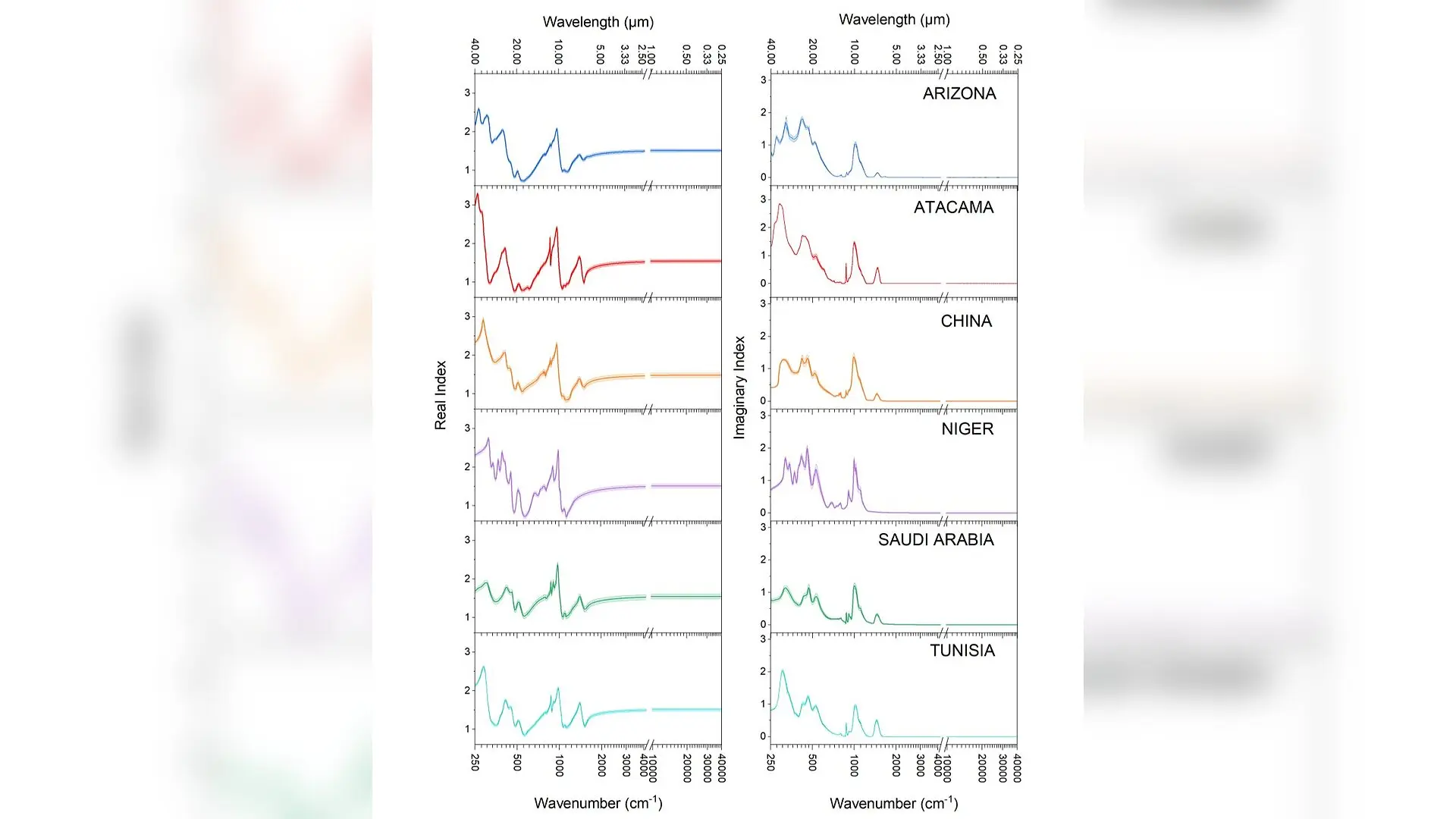
Desert dust particles suspended in the atmosphere absorb and scatter thermal radiation across a broad spectral range extending from 25 to 40 micrometers, revealing critical optical signatures that challenge long-standing climate assumptions. In a new study published in arXiv, Perla Alalam and colleagues investigated six natural mineral dust samples originating from major source regions worldwide, including the Sonoran Desert in Arizona, the Patagonian Desert in Argentina, the Gobi Desert in China, the Sahel in Niger, the Nefud Desert in Saudi Arabia, and the Sahara Desert in Tunisia. By analyzing freely suspended aerosols rather than compressed pellets, the researchers mapped optical properties into the far-infrared domain.
Unlocking Far-Infrared Signatures in Suspended Dust
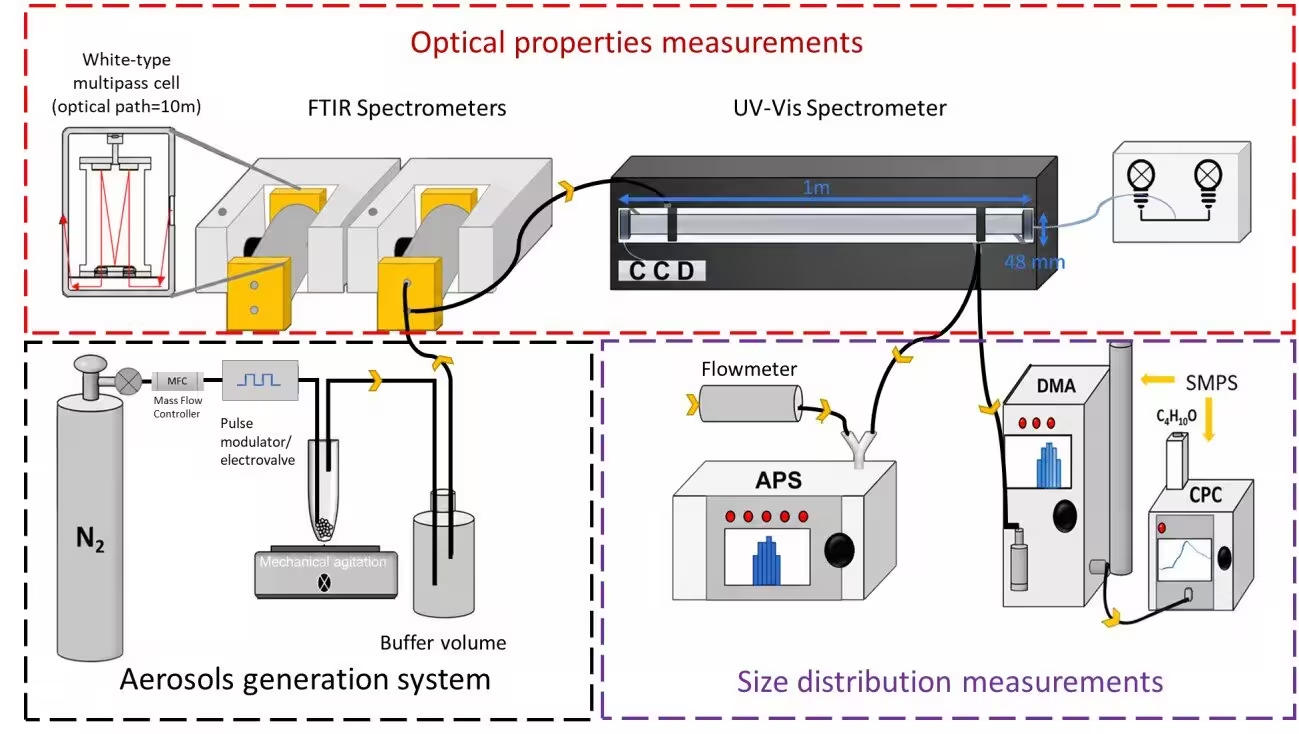
Quantifying how atmospheric dust interacts with Earth radiation remains a major source of uncertainty in climate models. Historically, scientists measured mineral optical properties by embedding powders or single crystals into pellets or films. However, these traditional preparation methods can alter particle size, shape, and internal vibrational modes, leading to errors in determining the complex refractive index, which links physical properties to radiation behavior. To overcome this limitation, the research team generated dry aerosol samples inside a controlled laboratory platform connecting specialized spectrometers and particle sizing instruments.
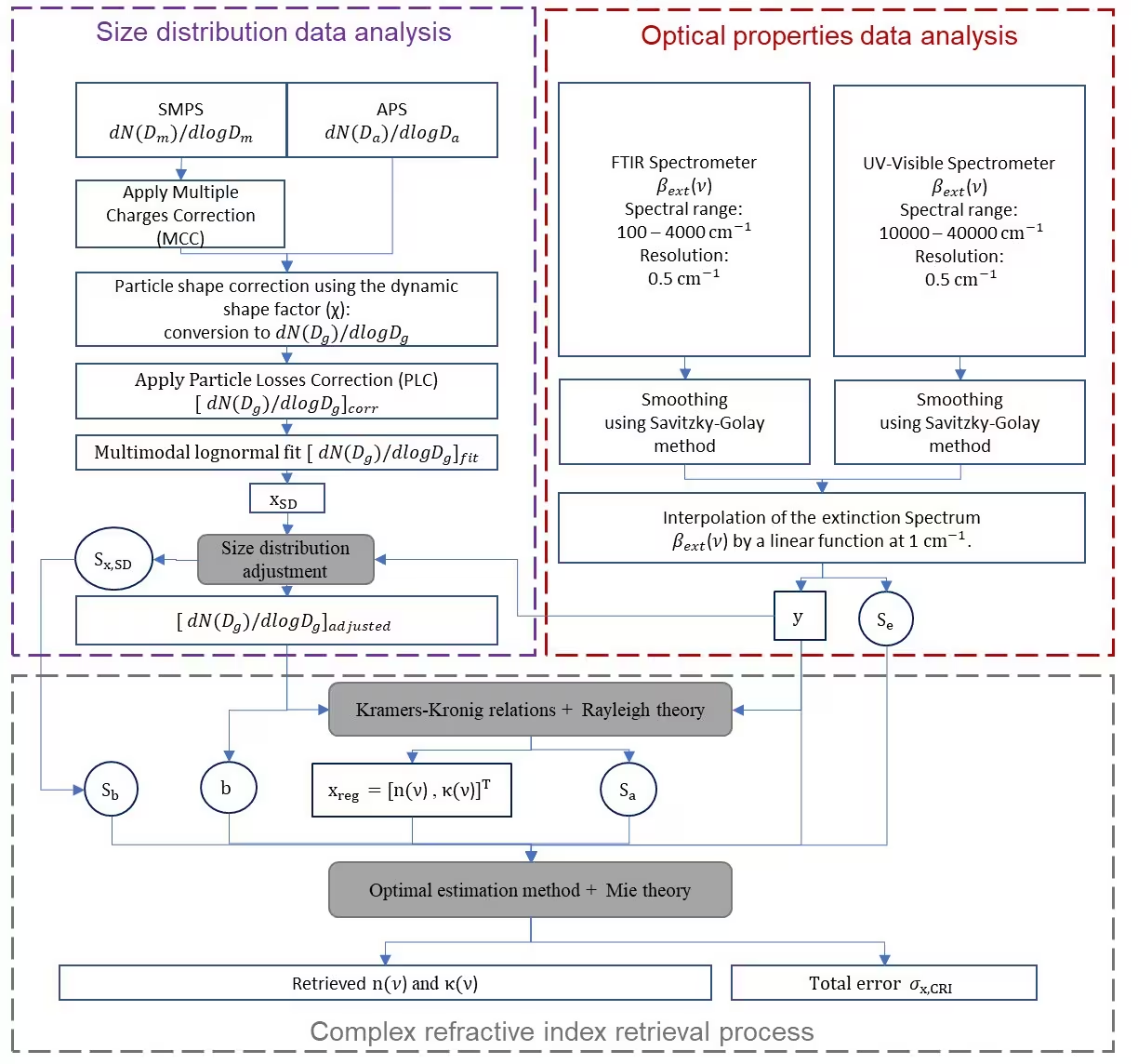
The authors utilized extinction spectroscopy covering wavenumbers from 250 to 4000 inverse centimeters in the infrared range, alongside ultraviolet-visible measurements up to 40000 inverse centimeters. Their setup featured a Thermo Fisher FTIR Nicolet iS50 spectrometer paired with a ten-meter multipass cell and specialized detectors. Particle size distributions were simultaneously tracked using a Scanning Mobility Particle Sizer and an Aerodynamic Particle Sizer. These instruments measured particles ranging from 14 nanometers up to 20 micrometers in diameter, capturing ultrafine, fine, and coarse modes across all geographic samples.
How Regional Mineralogy Shapes Optical Behavior
The retrieved complex refractive index datasets revealed that imaginary refractive index values in the far-infrared region below 650 inverse centimeters reach magnitudes between 0.003 and 2.85, matching or exceeding values observed in the mid-infrared spectral domain. This intense absorption stems from distinct mineral vibrational modes. The dominant feature between 1000 and 1100 inverse centimeters corresponds to silicon-oxygen stretching vibrations found in silicate minerals like quartz and clays. Meanwhile, carbonate minerals displayed pronounced absorption near 875 inverse centimeters due to carbon-oxygen bending, which appeared strongly in samples from Tunisia and Atacama but remained virtually absent in soil dust from Niger.
By extending measurements down to 250 inverse centimeters, the team captured lower-wavenumber structures such as silicon-oxygen-silicon bending modes and calcium-oxygen lattice vibrations. The authors note that while iron oxides like hematite produce features between 250 and 560 inverse centimeters, these signals were largely masked by stronger silicate and carbonate lattice vibrations because iron oxides occur in minor proportions across the tested soils.
Refining Climate Models for Next-Generation Satellites
The optical data acquired in this study provide essential constraints for interpreting future spaceborne missions designed to monitor Earth radiation budgets. Forthcoming satellite platforms, such as the Infrared Atmospheric Sounding Interferometer - New Generation and the Far-infrared Outgoing Radiation Understanding and Monitoring mission, will deliver high-resolution hyperspectral observations of outgoing longwave radiation down to 100 inverse centimeters. Because radiance sensitivity to dust optical depth in the far-infrared is comparable to mid-infrared levels, accurate refractive indices across the entire thermal infrared spectrum are vital.
The authors emphasize that future work should expand this spectral dataset to cover a broader range of global dust sources and extend measurements across the entire far-infrared spectrum up to 100 micrometers. Incorporating these suspended-phase optical constants into global circulation models will help researchers better evaluate dust radiative forcing and improve climate projections.
The study was posted to the arXiv preprint server on October 30, 2026.
This article has been fact checked for accuracy, with information verified against reputable sources. Learn more about us and our editorial process.
Last reviewed on .
Article history
- Latest version
Reference(s)
- Alalam, Perla. “Laboratory study of mineral dust optical properties extending in the far-infrared spectral range.” arXiv.org <http://arxiv.org/abs/2610.41907v1>.
Cite this page:
- Posted by Divya Iyer