Hybrid AI And Physics Weather Models Outperform Traditional Forecasts
Combining artificial intelligence ensembles with Met Office physics models improves United Kingdom temperature and wind speed predictions across multiple lead times.
A hybrid forecasting approach that merges physics-based meteorology with data-driven artificial intelligence over the United Kingdom successfully outperforms traditional forecasting models across multiple spatial grids and lead times. Weather researchers at the University of Exeter and the Met Office set out to determine whether incorporating an ensemble artificial intelligence model into standard multi-model operational blends could enhance overall prediction skill for surface temperatures and wind speeds.
Traditional meteorological centers frequently rely on multi-model blends to combine various numerical prediction systems, but blending ensemble-based artificial intelligence frameworks remains a relatively unexplored frontier. The authors investigated this question by pairing the European Centre for Medium-Range Weather Forecasts ensemble artificial intelligence model, known as AIFS-CRPS, with the Met Office convection-permitting physics-based ensemble, MOGREPS-UK. They analyzed site screen temperature data from 130 locations spanning a 123-day period from October 1, 2024, to January 31, 2025, using training data from October and evaluation data through January. The analysis published in arXiv evaluates how these probabilistic blends perform when individual models are assigned weights proportional to their forecast skill.
Why Model Diversity Matters More Than Artificial Intelligence Alone
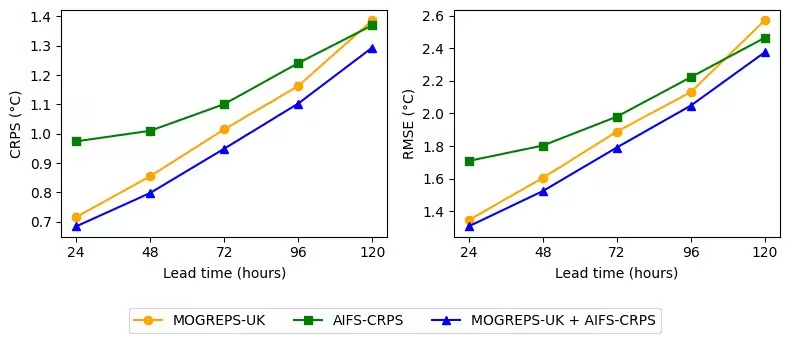
The results indicate that blending MOGREPS-UK with the artificial intelligence model AIFS-CRPS yields a significant increase in overall forecast skill spatially, across various lead times, and across specific exceedance thresholds. Interestingly, the researchers discovered that the accuracy boost does not stem solely from the artificial intelligence nature of AIFS-CRPS, but rather from the underlying differences in model error characteristics. When the team tested a blend of the physics-based Integrated Forecasting System alongside AIFS-CRPS, both developed by the European Centre for Medium-Range Weather Forecasts, performance lagged behind the MOGREPS-UK combinations because those two systems share training ancestry and exhibit less structural diversity.
By decomposing the continuous ranked probability score of the blend into component means and diversity terms, the team demonstrated that achieving superior accuracy requires pairing models with complementary errors. A three-model blend consisting of 50 percent MOGREPS-UK, 30 percent Integrated Forecasting System, and 20 percent AIFS-CRPS achieved the highest performance improvement, particularly from day two through day five of the forecast horizon. The authors highlight that as more appropriately weighted models are added to the mix, the ensemble spread and skill ratios improve correspondingly.
How Calibration Amplifies Forecast Accuracy Before and After Blending
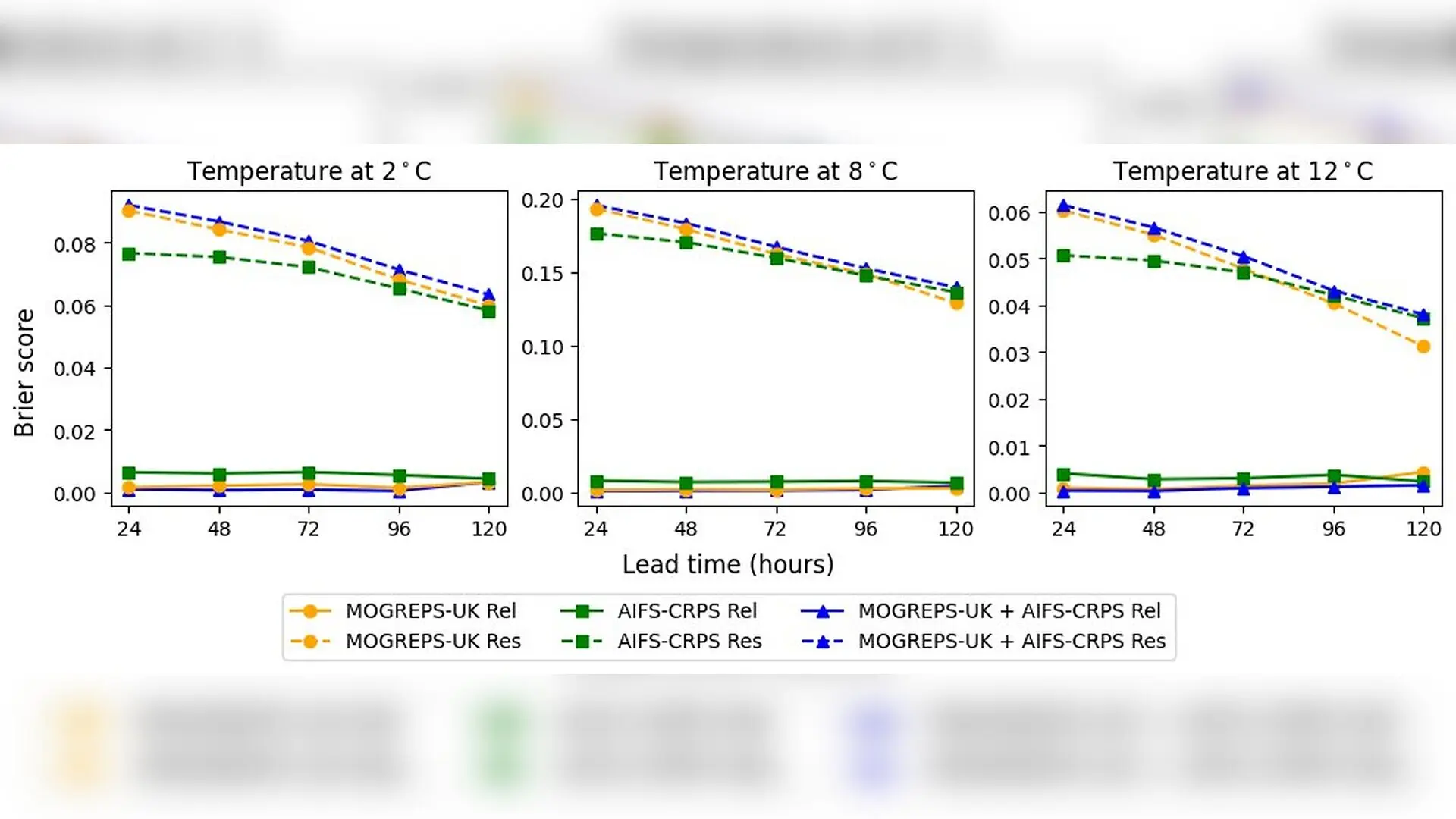
Weather ensembles frequently suffer from systematic biases and under-dispersion, requiring targeted post-processing to align predictions with real-world observations. The team applied ensemble model output statistics, a robust and computationally efficient parametric post-processing method, to calibrate individual forecast sources prior to integration. The findings confirm that calibrating artificial intelligence forecasts yields skill improvements comparable to those observed in calibrated physics-based ensembles. Furthermore, applying calibration routines both before source blending and again to the final blended output enhances overall prediction accuracy, particularly at shorter lead times.
While the current study utilized a static weighting configuration of 80/20 or 50/50 splits depending on the experiment, the spatiotemporal variations observed across different United Kingdom regions suggest that dynamic weighting could unlock even greater precision. Future developments in operational meteorology will likely explore optimized weighting strategies that adapt to specific geographic locations and forecast lead times to maximize the public utility of these hybrid weather prediction systems.
The study was posted to the arXiv preprint server on October 30, 2026.
This article has been fact checked for accuracy, with information verified against reputable sources. Learn more about us and our editorial process.
Last reviewed on .
Article history
- Latest version
Reference(s)
- Nkuiate, Harris. “Value of Adding AI Weather Model Ensembles to a Multi-model Probabilistic Blend.” arXiv.org <http://arxiv.org/abs/2610.42130v1>.
Cite this page:
- Posted by Divya Iyer