Atlantic Gulf Stream Found To Remotely Drive Pacific Kuroshio Warming
Climate models reveal a stratospheric atmospheric bridge connecting Atlantic boundary currents to multiyear temperature shifts in the North Pacific.
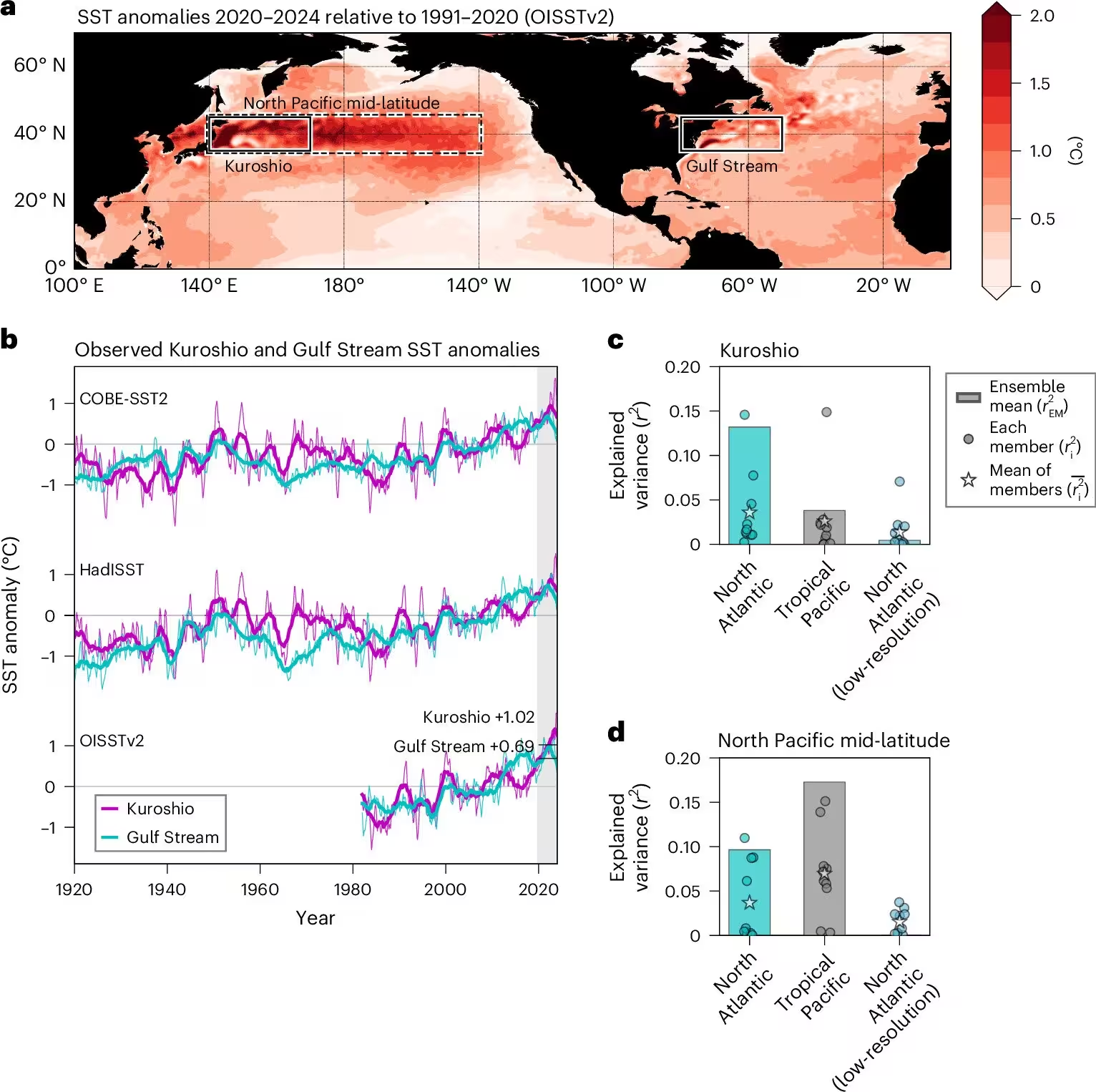
Unprecedented ocean warming across the Northern Hemisphere extratropics has been linked to distant teleconnections between the Atlantic and Pacific oceans, according to a study published in Nature Geoscience. Researchers investigated how thermal shifts in major western boundary currents interact across ocean basins.
How the Atlantic Ocean Remotely Drives Pacific Current Variability
Using a suite of 100-year idealized climate model simulations, the team discovered that variability in the Gulf Stream remotely modulates the behavior of the Kuroshio Extension in the North Pacific. Specifically, the Gulf Stream accounts for roughly 13 percent of the internal sea surface temperature variance in the Kuroshio region over multiyear timescales. By contrast, the reverse influence is negligible, demonstrating an asymmetric teleconnection between the two massive current systems.
The researchers, led by Yoko Yamagami and colleagues, utilized the Model for Interdisciplinary Research on Climate version 6 (MIROC6) to run ensemble experiments. When sea surface temperature anomalies were constrained in the North Atlantic, the model successfully reproduced low-frequency covariability in the Kuroshio Extension. The team also found that ocean resolution matters significantly for capturing these dynamics. When non-eddying ocean model configurations were tested, the remote influence nearly vanished, highlighting the critical role of mesoscale eddies in facilitating interbasin communication.
Atmospheric Pathways Connecting the Atlantic and Pacific Basins
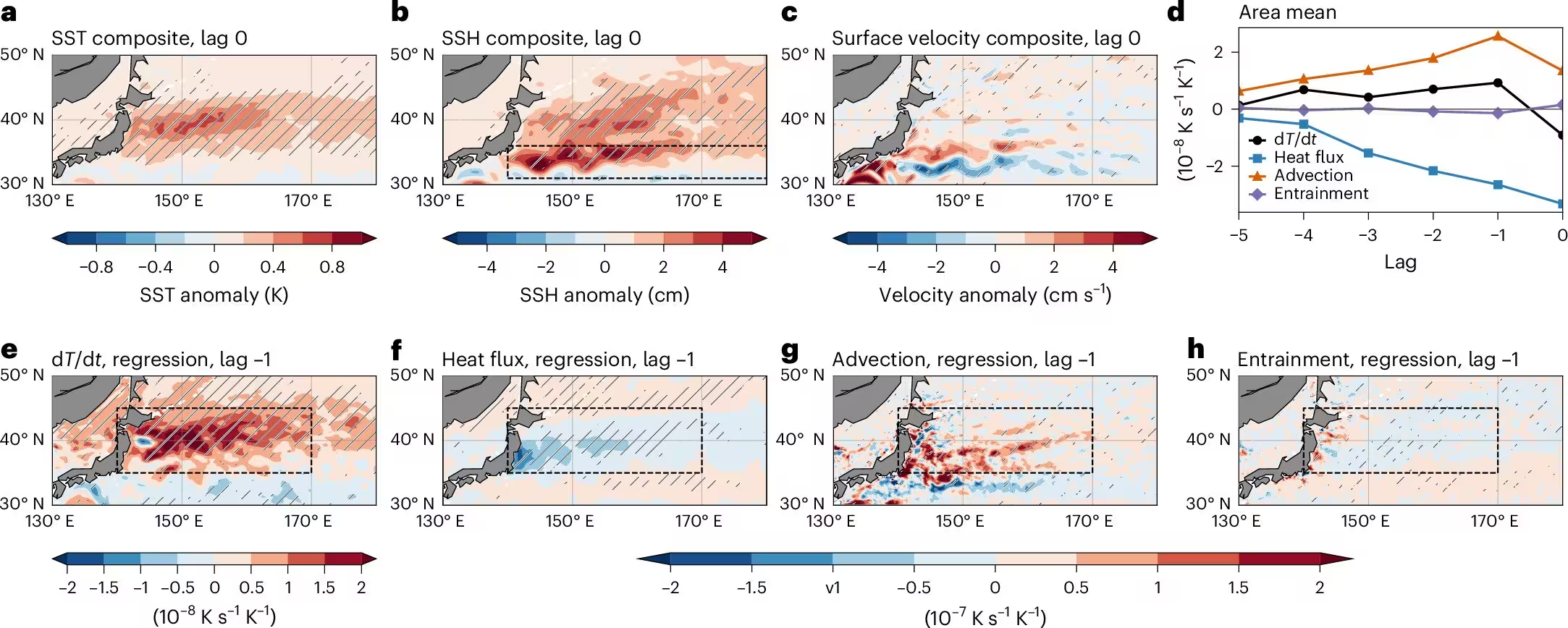
The physical mechanism driving this interbasin connection relies on a complex atmospheric bridge operating through stratosphere-troposphere coupling. Positive sea surface temperature anomalies in the Gulf Stream shift the local thermal front northward, altering lower-tropospheric baroclinicity and storm track activity. This atmospheric disturbance projects onto a Northern Annular Mode-like structure, eventually weakening the Aleutian Low over the North Pacific in late winter.
Once the Aleutian Low weakens, the altered wind stress fields trigger westward-propagating oceanic Rossby waves across the mid-latitude North Pacific. These internal Rossby waves gradually accumulate sea surface height anomalies along the Kuroshio Extension over a span of up to five years. Ocean mixed-layer heat budget analyses confirmed that horizontal advection plays the central role in translating these dynamical shifts into localized surface warming.
Implications for Recent Extreme North Pacific Marine Heatwaves
The newly identified stratospheric pathway provides a compelling explanation for the exceptional marine heatwaves and sea surface temperature anomalies observed across the mid-latitude North Pacific between 2019 and 2024. Additional pacemaker simulations restoring observed sea surface temperatures indicated that North Atlantic forcing specifically contributed to extreme warming in the western mid-latitude North Pacific, complementing the broader eastern Pacific influence of the tropical Pacific.
While these insights advance our comprehension of decadal climate variability, the authors note that coupled model control simulations alone cannot fully resolve all causal ambiguities regarding internal atmospheric noise. Nevertheless, incorporating high-resolution ocean components into climate models enhances our ability to simulate cross-basin interactions, offering a promising avenue to overcome longstanding predictive hurdles in climate science.
The research was published in Nature Geoscience on November 17, 2026.
This article has been fact checked for accuracy, with information verified against reputable sources. Learn more about us and our editorial process.
Last reviewed on .
Article history
- Latest version
Reference(s)
- Yamagami, Yoko., et al. “Kuroshio Extension warming shaped by Gulf Stream variability via the Arctic atmosphere.” Nature Geoscience, November 17, 2026 Springer Science and Business Media LLC, doi: 10.1038/s41561-026-02139-2. <https://doi.org/10.1038/s41561-026-02139-2>.
Cite this page:
- Posted by Divya Iyer