Hidden Fungal Jumping Genes Reveal Surprising Complexity In Crop Disease Resistance
Genetics

Hidden Fungal Jumping Genes Reveal Surprising Complexity In Crop Disease Resistance

Analysis of European field strains uncovers novel transposable element insertions and secondary loci shaping agricultural pathogen survival.

By Faisal Qureshi
Published:
Email this Article
Hidden Fungal Jumping Genes Reveal Surprising Complexity In Crop Disease Resistance
Photo by Gabriela on Unsplash

Tiny jumping gene insertions in a major wheat fungal pathogen can drive multi-drug resistance, but the genetic wiring behind these crop-threatening traits turns out to be surprisingly complex. European field strains of the fungus Zymoseptoria tritici, which causes severe septoria tritici blotch disease in wheat crops across the continent, show that certain promoter mutations do not tell the whole story of how microbes shrug off agricultural treatments.

How Transposable Elements Hijack Fungal Promoters

Agricultural fungicide programs rely heavily on alternating chemical modes of action to keep destructive crop blights at bay. Yet, intensive spraying exerts intense evolutionary pressure on fungal populations, frequently unlocking multidrug resistance where a single mutation confers broad-spectrum tolerance to multiple unrelated chemical agents. In this fungus, resistance has long been tracked through structural alterations in the promoter region of a major facilitator superfamily transporter gene known as MFS1. Specifically, long terminal repeat retrotransposons insert themselves directly upstream of the gene, driving its constitutive overexpression and pumping out toxic compounds before they can harm the cell.

To understand the true scale of this resistance mechanism, researchers examined a vast collection of 374 field strains sampled across Northern and Western Europe between 2020 and 2021. The team used terbinafine, a squalene epoxidase inhibitor class of compound not even used in agriculture, as a reliable proxy to identify multidrug-resistant isolates. Through a combination of polymerase chain reaction amplicon screening, targeted Sanger sequencing, and whole-genome reassembly, the study published in PLOS Pathogens mapped an unprecedented degree of promoter polymorphism at the MFS1 locus.
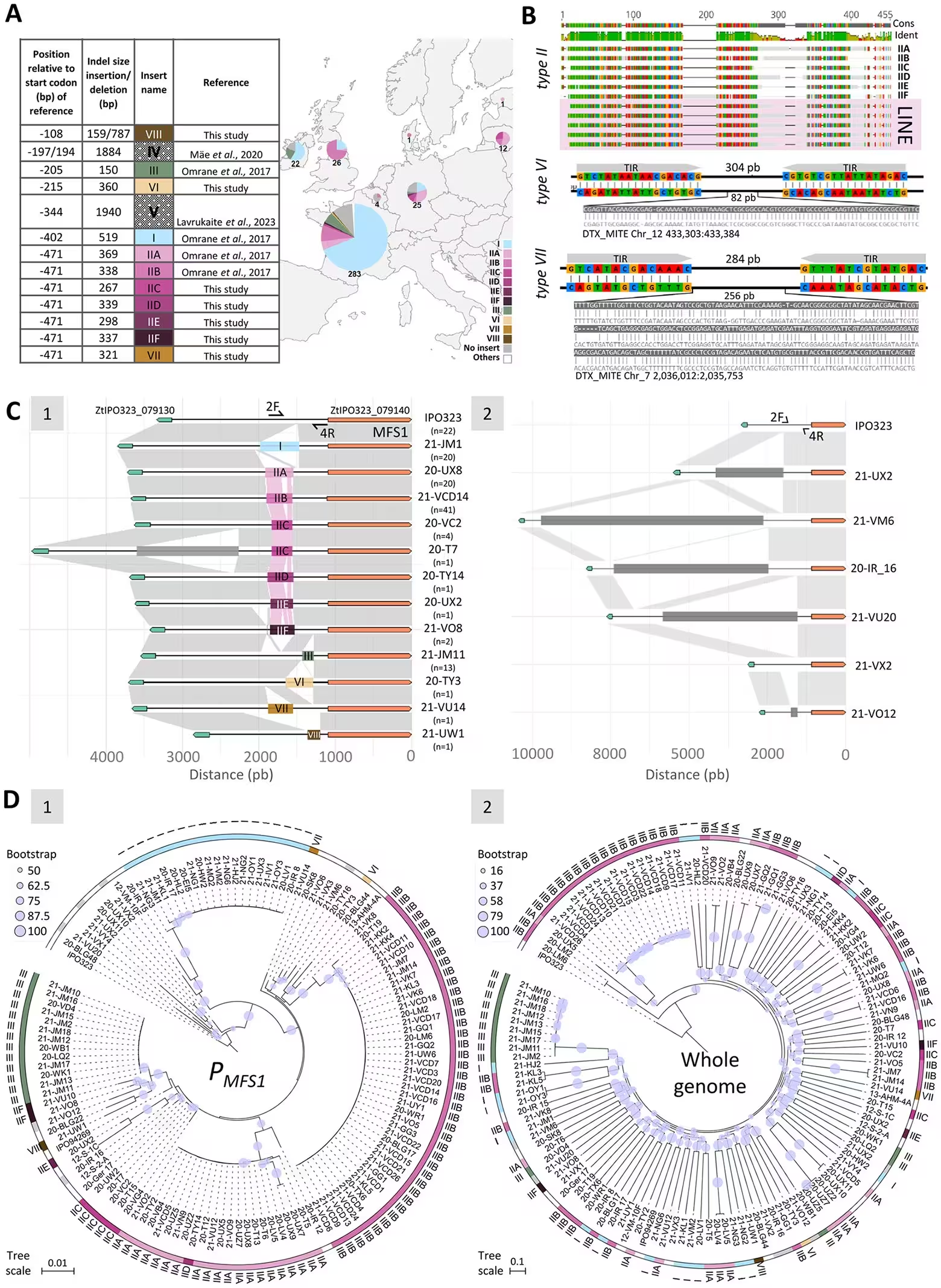
Fig 1: MFS1 promoter (PMFS1) of Zymoseptoria tritici European field strains shows an extended transposon insertion polymorphism. A. Summary of inserts detected by PCR amplicon sequencing of the proximal PMFS1 and geographic origin of detected polymorphisms from 2020-2021 survey. Inserts are listed according to their localization relative to the start codon of MFS1 in the IPO323 reference genome. Insert numbering is according to their chronological discovery. Frequencies shown for French isolates reflect proportions of each PMFS1 genotype in multidrug resistant (MDR) field populations. For other European countries, strains were provided by partners because they displayed particular PMFS1 amplicon size or sequence. Inserts indicated with a dotted pattern were reported in previous studies but not detected in this survey. “Others” refers to genotypes not characterized by PCR amplicon sequencing due to amplification failure. The map has been built using R and country-boundary shapefile obtained fr
MFS1 promoter (PMFS1) of Zymoseptoria tritici European field strains shows an extended transposon insertion polymorphism. A. Summary of inserts detected by PCR amplicon sequencing of the proximal PMFS1 and geographic origin of detected polymorphisms from 2020-2021 survey. Inserts are listed according to their localization relative to the start codon of MFS1 in the IPO323 reference genome. Insert numbering is according to their chronological discovery. Frequencies shown for French isolates reflect proportions of each PMFS1 genotype in multidrug resistant (MDR) field populations. For other European countries, strains were provided by partners because they displayed particular PMFS1 amplicon size or sequence. Inserts indicated with a dotted pattern were reported in previous studies but not detected in this survey. “Others” refers to genotypes not characterized by PCR amplicon sequencing due to amplification failure. The map has been built using R and country-boundary shapefile obtained fr Credit: Elza Neau et al. / PLOS Pathogens

Six New Structural Variants and Unexpected Genetic Plasticity

While the classic type I, type II, and type III insertions dominated roughly 87 percent of the French multidrug-resistant strains, the genetic screen uncovered six entirely novel structural variants. These newly cataloged insertions derived from diverse transposable element families, including long interspersed nuclear elements and miniature inverted-repeat transposable elements. Phylogenetic reconstruction of the intergenic regions demonstrated that these various insertions arose through recurrent, independent transposition events rather than a single ancestral mutation spreading through the agricultural landscape.

However, the presence of an insert did not always guarantee high resistance. When the authors evaluated quantitative effective concentration values that inhibit half of fungal growth, several of the newly identified insertions failed to confer any significant resistance compared to sensitive reference strains. For instance, novel type II variants such as type IID and type IIF showed inconsistent or negligible effects on terbinafine tolerance. Even among strains carrying identical canonical insertions, the measured resistance factors varied substantially, ranging from two-fold to more than fifteen-fold increases over baseline susceptibility.
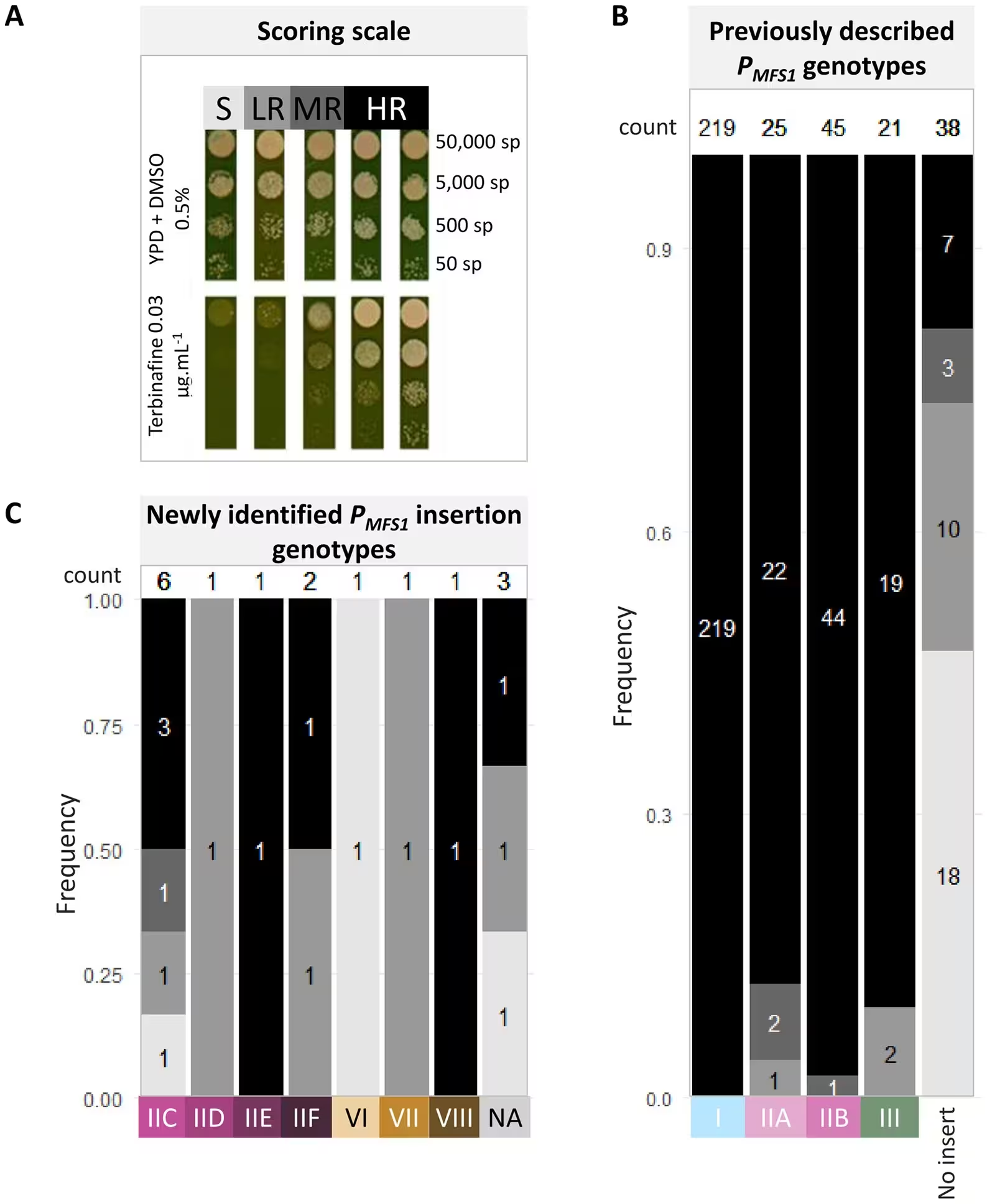
Fig 2: Qualitative terbinafine resistance assessment reveals intra and inter PMFS1 genotype phenotype variations. A total of 374 strains selected on terbinafine or tolnaftate from the 2020–2021 collection was genotyped for insertions in the 500-pb proximal PMFS1 sequence via PCR amplicon sequencing. The strains were also screened for terbinafine resistance through growth tests on YPD solid medium supplemented with discriminatory terbinafine dose (0.03 µg.mL−1) A. scoring scale used to categorize strains, sp = spores. Strains are grouped by insertions: B. previously associated with MDR (I, IIA, IIB, IIC) and C. newly identified insertions (IID, IIE, IIF, VI, VII, VIII) as well as NA for uncharacterized genotypes due to PCR amplification failure. Resistance classes: HR = high resistance, MR = medium resistance, LR = low resistance, S = sensitive.
Qualitative terbinafine resistance assessment reveals intra and inter PMFS1 genotype phenotype variations. A total of 374 strains selected on terbinafine or tolnaftate from the 2020–2021 collection was genotyped for insertions in the 500-pb proximal PMFS1 sequence via PCR amplicon sequencing. The strains were also screened for terbinafine resistance through growth tests on YPD solid medium supplemented with discriminatory terbinafine dose (0.03 µg.mL−1) A. scoring scale used to categorize strains, sp = spores. Strains are grouped by insertions: B. previously associated with MDR (I, IIA, IIB, IIC) and C. newly identified insertions (IID, IIE, IIF, VI, VII, VIII) as well as NA for uncharacterized genotypes due to PCR amplification failure. Resistance classes: HR = high resistance, MR = medium resistance, LR = low resistance, S = sensitive. Credit: Elza Neau et al. / PLOS Pathogens

Uncovering a Polygenic Architecture Beyond the Transporter Locus

To determine what caused these broad phenotypic differences among strains sharing identical promoter genotypes, the researchers analyzed sexual crosses and conducted genome-wide association studies. Crosses between parental strains carrying type III insertions yielded progeny with a continuous, normal distribution of resistance levels and a broad-sense heritability of roughly 40 percent, strongly implying a polygenic genetic architecture.

The genome-wide association scan across 128 isolates confirmed that while the MFS1 locus remains the primary driver of resistance, multiple additional genomic regions contribute significantly to the phenotypic variance. Significant single nucleotide polymorphisms mapped to distant chromosomes near genes encoding short-chain dehydrogenases, reductases, and homologs of fungal multidrug efflux regulators like FLU1. These secondary loci suggest that while jumping gene insertions provide a major adaptive leap, cellular detoxification networks and regulatory adjustments act in concert to fine-tune fungal survival under agricultural selection pressure.

The research was published in PLOS Pathogens on November 17, 2026.

Fact Checked

This article has been fact checked for accuracy, with information verified against reputable sources. Learn more about us and our editorial process.

Last reviewed on .

Article history

  • Latest version

Cite this page:

Qureshi, Faisal. “Hidden Fungal Jumping Genes Reveal Surprising Complexity In Crop Disease Resistance.” BioScience. BioScience ISSN 2521-5760, 17 November 2026. <https://www.bioscience.com.pk/en/subject/genetics/the-complex-landscape-of-multidrug-resistance-mdr-in-zymoseptoria-tritici-mfs1-promoter-plasticity-and-beyond>. Qureshi, F. (2026, November 17). “Hidden Fungal Jumping Genes Reveal Surprising Complexity In Crop Disease Resistance.” BioScience. ISSN 2521-5760. Retrieved November 17, 2026 from https://www.bioscience.com.pk/en/subject/genetics/the-complex-landscape-of-multidrug-resistance-mdr-in-zymoseptoria-tritici-mfs1-promoter-plasticity-and-beyond Qureshi, Faisal. “Hidden Fungal Jumping Genes Reveal Surprising Complexity In Crop Disease Resistance.” BioScience. ISSN 2521-5760. https://www.bioscience.com.pk/en/subject/genetics/the-complex-landscape-of-multidrug-resistance-mdr-in-zymoseptoria-tritici-mfs1-promoter-plasticity-and-beyond (accessed November 17, 2026).
End of the article