Laser Beams Reveal Hidden Arctic Algae Blooms Growing All Winter Long
Spaceborne LiDAR data shows winter phytoplankton production adds 13.3 percent to annual Arctic carbon estimates, rewriting our view of polar marine ecosystems.
Hidden beneath the retreating sea ice of the Arctic Ocean, microscopic marine algae are blooming during the dimly lit winter months in quantities that conventional satellites have completely missed for decades. Researchers analyzing a massive trove of 2.39 million spaceborne laser pulses revealed that phytoplankton productivity across the Arctic during the October-to-March winter-shoulder period is growing significantly faster than previously understood. The study, published in Science Advances, demonstrates that winter carbon fixation in marginal seas and ice-edge zones adds roughly 13.3 percent to annual net primary production estimates for the region.
How Spaceborne Laser Beams Overcome the Winter Darkness Blind Spot
For decades, scientists relied on passive ocean color radiometers such as the Moderate-resolution Imaging Spectroradiometer, known as MODIS, to monitor marine plant growth. These conventional instruments require substantial sunlight to detect chlorophyll and are easily blocked by persistent cloud cover and absolute polar night, leaving a massive observational gap covering roughly 70 to 80 percent of the Arctic winter ocean. To pierce through this seasonal blind spot, researchers led by Zhenhua Zhang and Peng Chen turned to the Cloud-Aerosol Lidar with Orthogonal Polarization, known as CALIOP, aboard the CALIPSO satellite. Active laser sensors do not depend on direct solar illumination, allowing them to measure backscattered light and evaluate optical water column properties even when the sun is below the horizon.
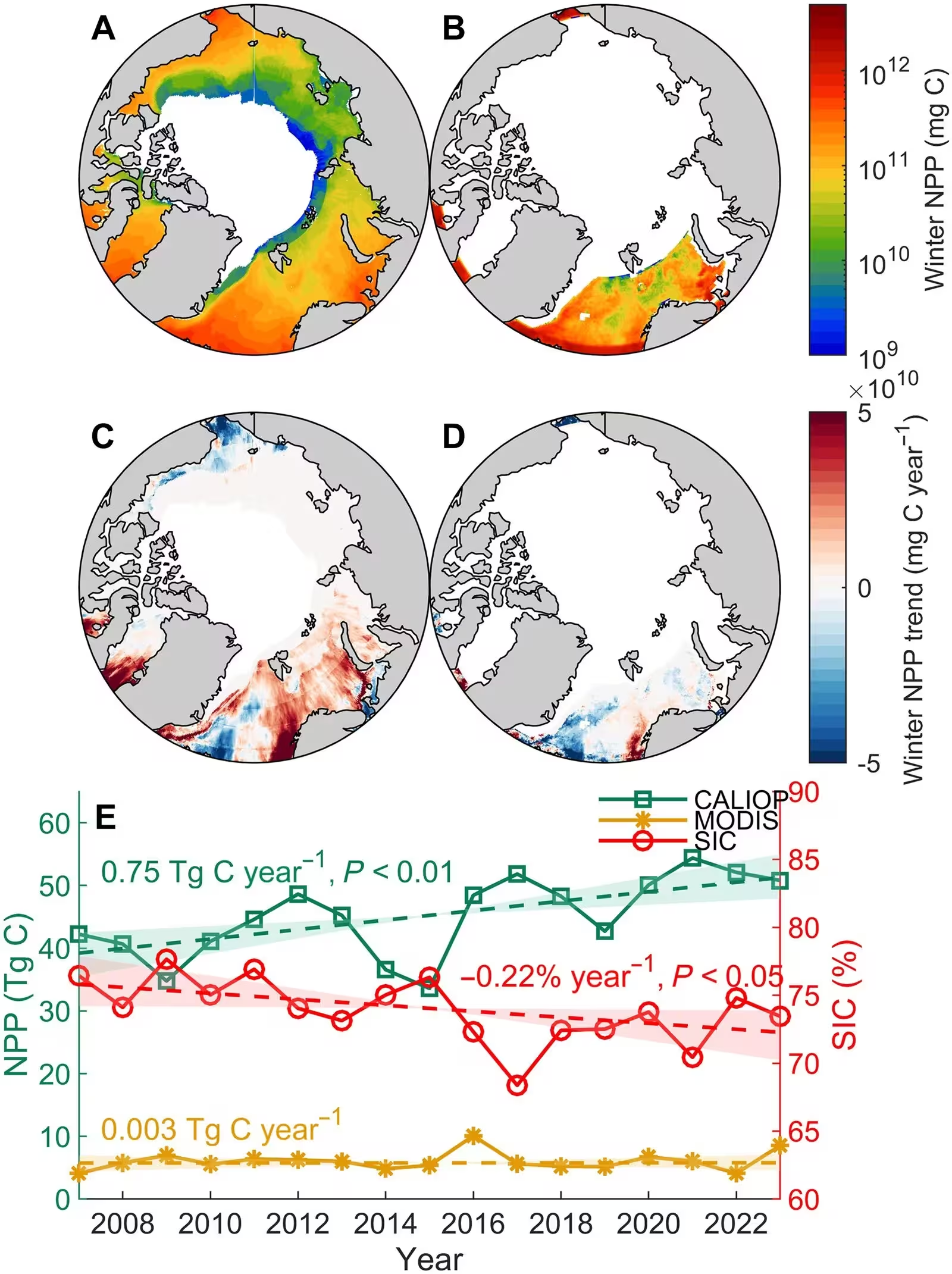
By training their bio-optical retrieval models on illuminated MODIS observations and then applying rigorous physical constraints to extrapolate into dimmer regimes, the team reconstructed winter net primary production across the Arctic from 2007 to 2023. The active laser profiles expanded winter observational coverage from roughly 20 to 30 percent up to 70 to 75 percent. The resulting data show that low-light winter production is not an isolated anomaly, but a widespread phenomenon occurring across Arctic marginal seas, seasonal ice zones, and Atlantic inflow sectors like the Barents and Kara seas.
Surprising Interannual Trends and the Drive of Sea Ice Retreat
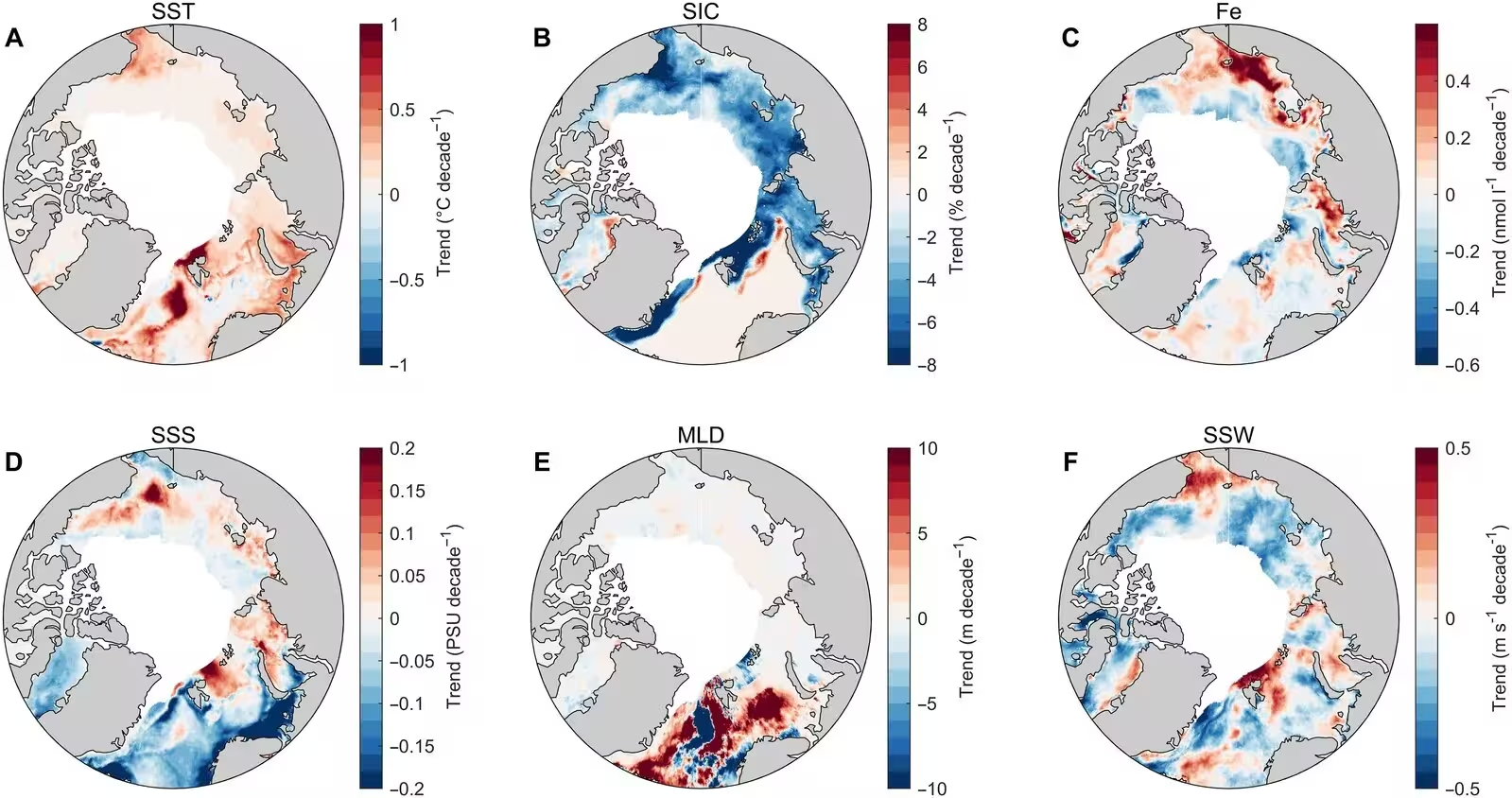
The reconstructed time series uncovered a pan-Arctic winter productivity increase of 0.75 teragrams of carbon per year between 2007 and 2023. In stark contrast, passive sensor calculations showed a nearly negligible trend of just 0.003 teragrams of carbon per year over the same timeframe. Statistical modeling demonstrated that this climbing winter production correlates strongly with declining sea ice concentration, yielding a coefficient of determination of $R^2 = 0.47$ at a significance of $P < 0.01$. As winter sea ice retreats and thins, more light penetrates the upper ocean, extending the seasonal window available for marine plant growth.
The authors emphasize that these findings do not imply photosynthesis occurs during the absolute blackness of the peak polar night. Instead, they capture vital biological activity during the extended low-light shoulder periods of late autumn and early spring. Phytoplankton species in these extreme environments often rely on specialized adaptations, including exceptionally high light-use efficiency, low-light specialization, and mixotrophy, which allows them to consume organic compounds when solar energy is sparse.
What These Hidden Winter Blooms Mean for the Arctic Carbon Cycle
Underestimating winter biological activity introduces systematic biases into broader calculations of air-sea carbon dioxide exchange and carbon export potential. If carbon fixation is spreading across a larger portion of the annual cycle rather than remaining confined to a short summer burst, the traditional view of the Arctic marine ecosystem is fundamentally shifting. However, important uncertainties remain, including how rapidly changing upper-ocean stratification and nutrient supply pathways will influence these microalgae over coming decades.
The researchers note that validation remains challenging because deploying ships and autonomous biogeochemical floats into the Arctic during freezing winter months is logistically difficult. Future assessments will require expanded in-situ observations from autonomous platforms to refine absolute production magnitudes. Nonetheless, the active-sensor reconstruction highlights that the Arctic carbon cycle is reorganizing not just in total output, but in seasonal timing as well.
The research was published in Science advances on November 11, 2026.
This article has been fact checked for accuracy, with information verified against reputable sources. Learn more about us and our editorial process.
Last reviewed on .
Article history
- Latest version
Reference(s)
- Zhang, Zhenhua., et al. “A LiDAR-based reconstruction reveals increasing Arctic phytoplankton production during low-light winter-shoulder period.” Science Advances, vol. 12, no. 46, November 13, 2026 American Association for the Advancement of Science (AAAS), doi: 10.1126/sciadv.aej4633. <https://doi.org/10.1126/sciadv.aej4633>.
Cite this page:
- Posted by Kamran Akhtar