Teen Social Media Risks Depend Heavily on One Brain-Based Skill
A large-scale study reveals that a teenager’s cognitive control capacity significantly alters how social media exposure relates to anxiety and depression.

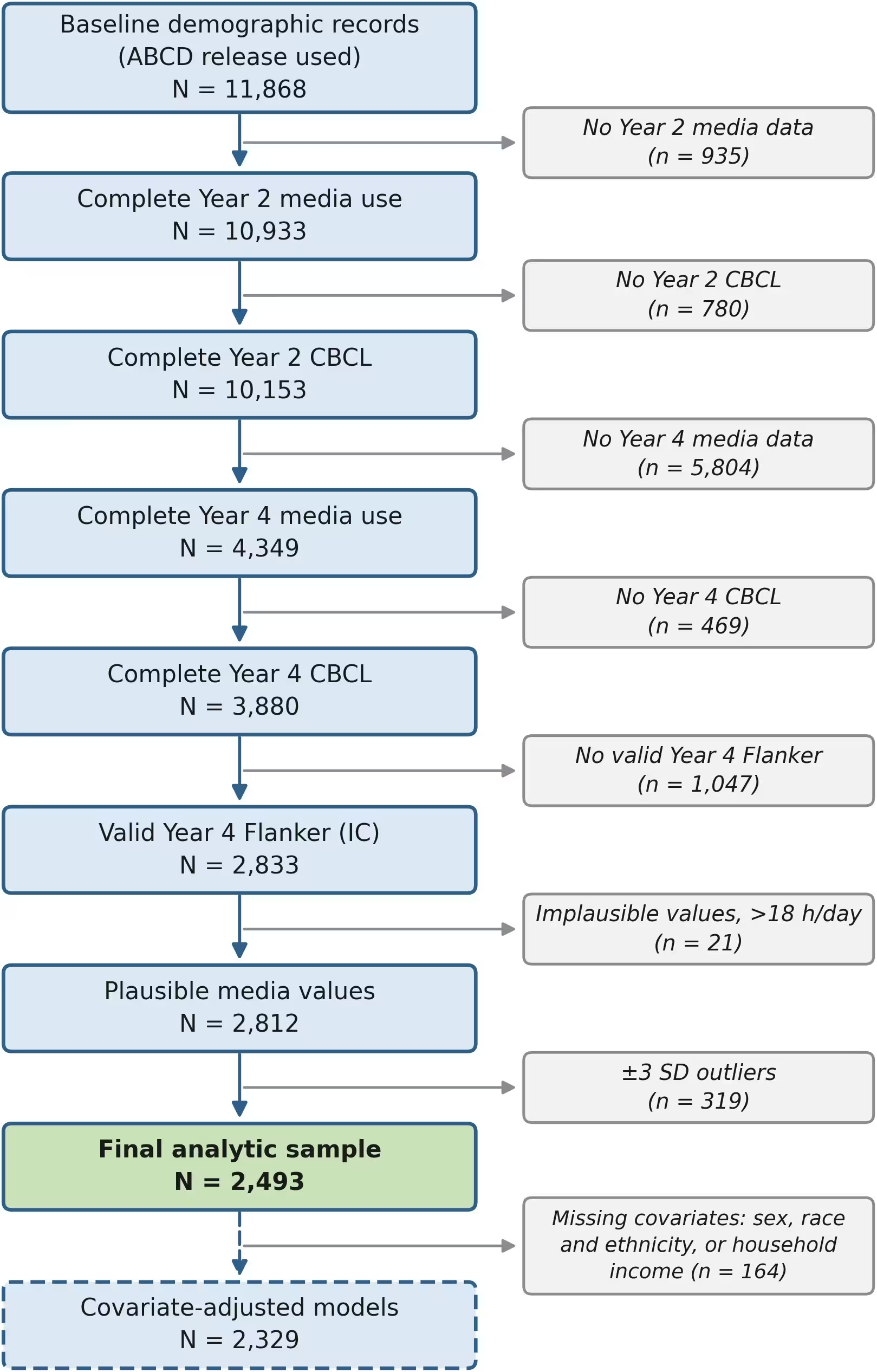
When 2,493 early adolescents were tracked across multiple years, researchers discovered that the mental health risks linked to social media use are not felt equally by everyone, hinging heavily on a specific brain-based skill called inhibitory control.
Adolescence brings rapid maturation in executive functioning alongside near-universal engagement with digital media. While researchers have long debated whether screen time harms teenagers, a new large-scale longitudinal investigation provides a more nuanced view by looking at individual differences in how youth process online environments. The research was published in PLOS One on November 18, 2026, drawing from the landmark Adolescent Brain Cognitive Development study.
How Brain-Based Self-Control Buffers Against Online Stress
The study, conducted by Colm Johnston, Marinka Gadzichowski, and Edward Shearin, followed participants from ages 11 to 12 up to ages 13 to 14. Inhibitory control, which is the cognitive capacity to suppress impulsive or maladaptive responses in favor of goal-directed behavior, was measured using the Flanker Inhibitory Control and Attention Test. In this task, adolescents must identify the direction of a central stimulus while ignoring distracting flanking images.
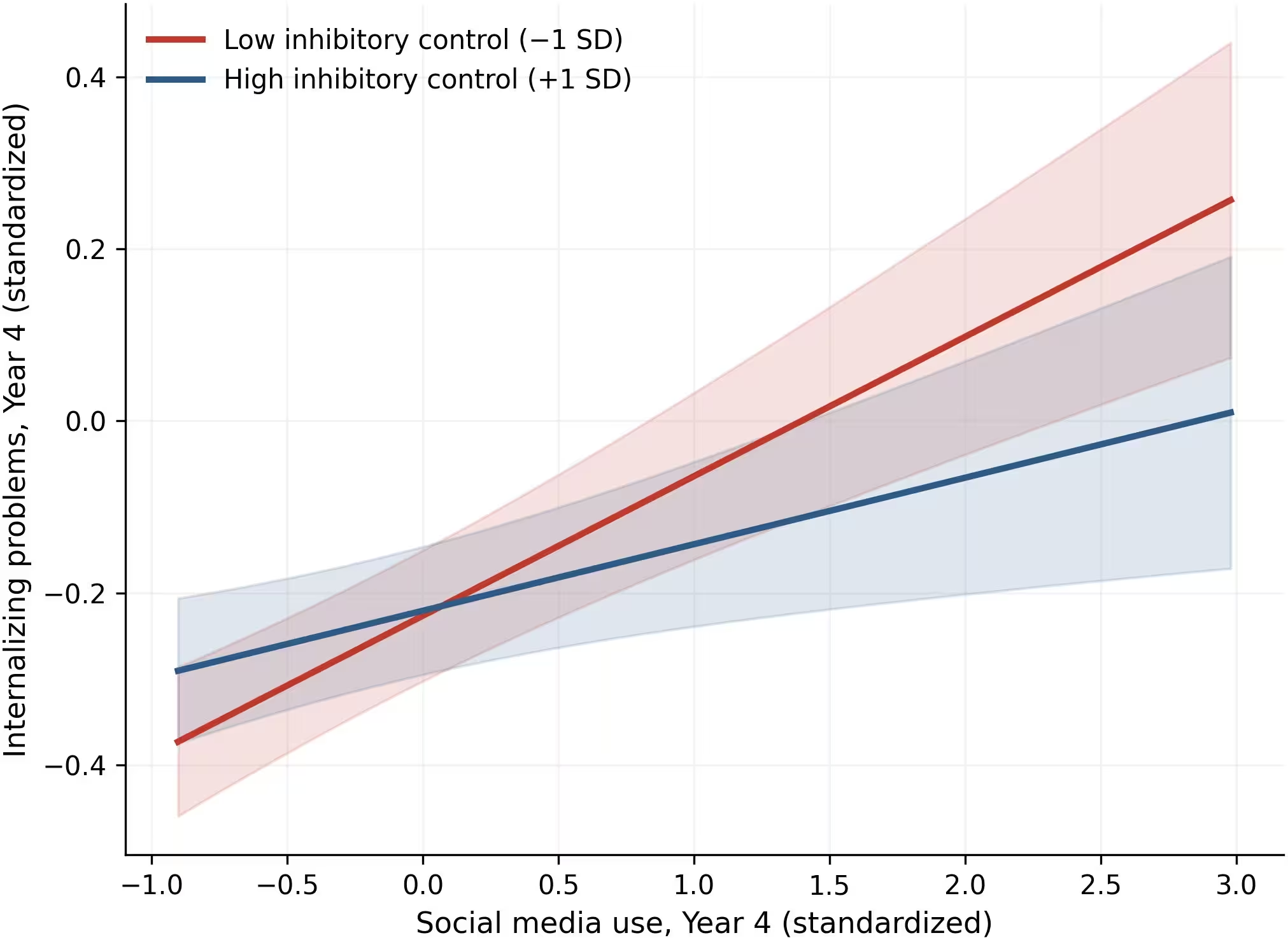
The analysis revealed that this regulatory capacity significantly moderated the association between social media use and internalizing problems, such as anxiety and depressive symptoms. Specifically, adolescents with weaker inhibitory control demonstrated a stronger positive association between heavy social media use and internalizing symptoms. For adolescents with stronger inhibitory control, that association was roughly half as strong.
The authors suggest that because social media routinely presents curated representations, social comparisons, and evaluative feedback, teenagers with lower regulatory skills may struggle more to disengage from negative social stimuli. Consequently, the same reported hours of screen time can translate into greater persistent negative affect.
Comparing Social Media and Video Game Impacts
The study also contrasted social media use with video game engagement to test whether different digital platforms carry distinct psychological correlates. Social media use showed robust positive associations with both internalizing and externalizing problems by mid-adolescence, even after adjusting for biological sex, race, ethnicity, and household income.
In contrast, video game associations were generally small and sensitive to statistical adjustments. An initial unadjusted negative association between gaming and internalizing problems at Year 4 reversed direction and became a positive association once demographic covariates were included, demonstrating that the apparent protective effect was simply a demographic confounding artifact driven largely by biological sex.
Furthermore, inhibitory control did not moderate video game associations for either internalizing or externalizing outcomes. Because video game content is less dominated by self-relevant social evaluation compared to social media, the cognitive capacity to disengage from social comparison has less purchase on gaming pathways.
Study Limitations and Important Caveats
The researchers emphasize that the observed effect sizes across all models were small, indicating that digital media use is not a primary or deterministic driver of adolescent psychopathology. Instead, digital engagement operates as one component within a broader constellation of developmental and environmental influences.
Several limitations should be noted. The design was observational, meaning causal inferences cannot be drawn directly. Additionally, inhibitory control was assessed concurrently with Year 4 mental health outcomes rather than prospectively predicting future changes from baseline scores, leaving open the possibility of bidirectional influences.
Finally, the analytic sample differed systematically from the broader national cohort by skewing toward higher-income households and lower baseline symptom burdens, which may limit generalizability to higher-risk populations. The findings suggest that future preventive efforts should focus less on blanket screen-time restrictions and more on supporting the development of self-regulatory capacities during the vulnerable adolescent transition.
The research was published in PLOS One on November 18, 2026.
This article has been fact checked for accuracy, with information verified against reputable sources. Learn more about us and our editorial process.
Last reviewed on .
Article history
- Latest version
Reference(s)
- Johnston, Colm., et al. “Navigating the adolescent digital playground: Executive function impacts mental health associations through digital media use in the ABCD Study.” PLOS One, vol. 21, no. 11, November 18, 2026, pp. e0360919 Public Library of Science (PLoS), doi: 10.1371/journal.pone.0360919. <https://doi.org/10.1371/journal.pone.0360919>.
- Posted by David Anderson