Giant Dinosaur Footprints in Mongolia Reveal a Lost Predator-And-Prey Scene Sealed Away for 120 Million Years
Ancient lakebed fossils reveal Early Cretaceous giants—both plant-eaters and predators—sharing the same prehistoric landscape.
A brief report from nearly seven decades ago described dinosaur footprints in Mongolia, but the scant two‑page note contained no photographs, precise coordinates, or detailed description, leaving later scientists with only the name “Saijrakh.”
Researchers have now relocated that long‑forgotten locality.
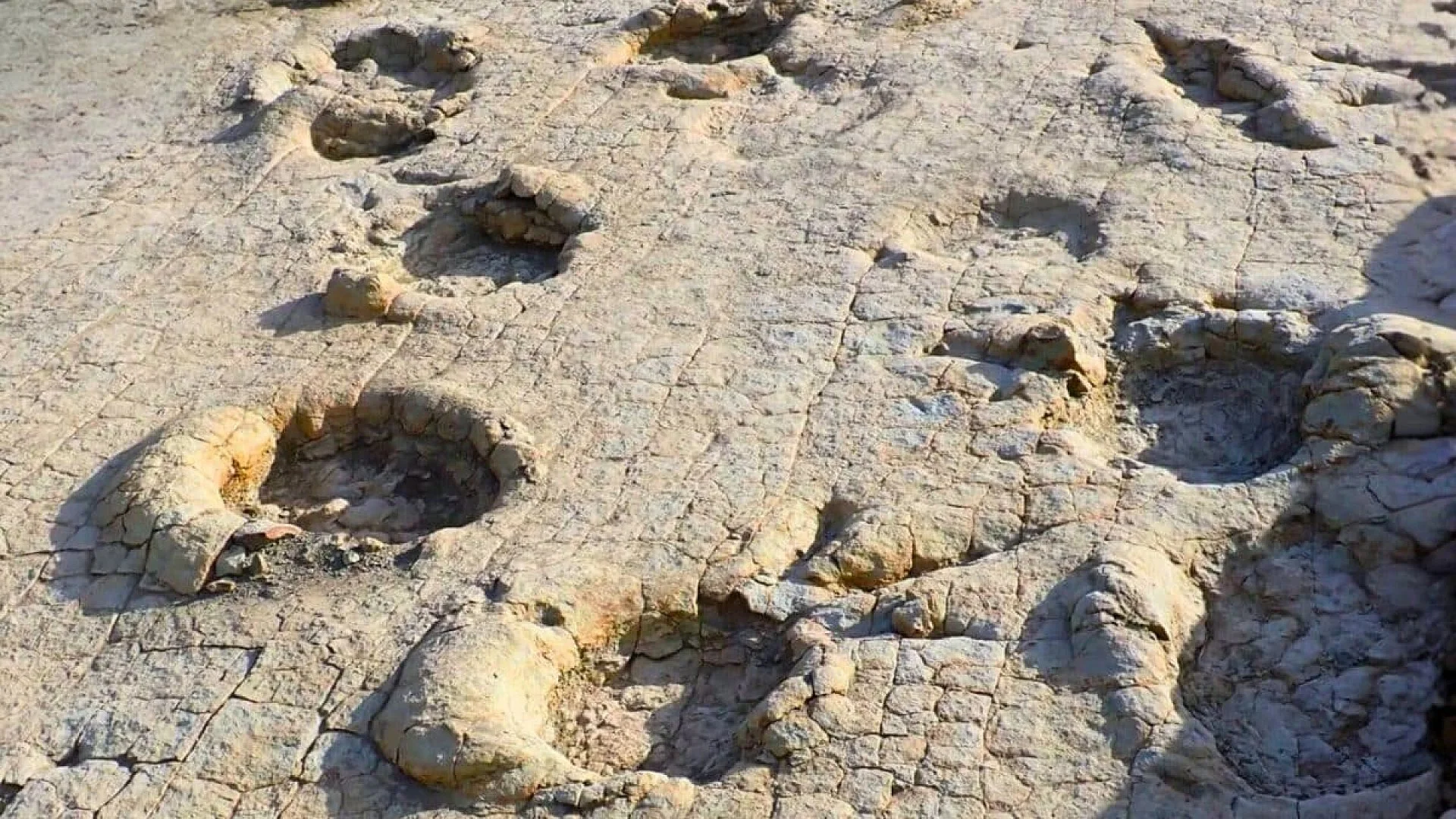
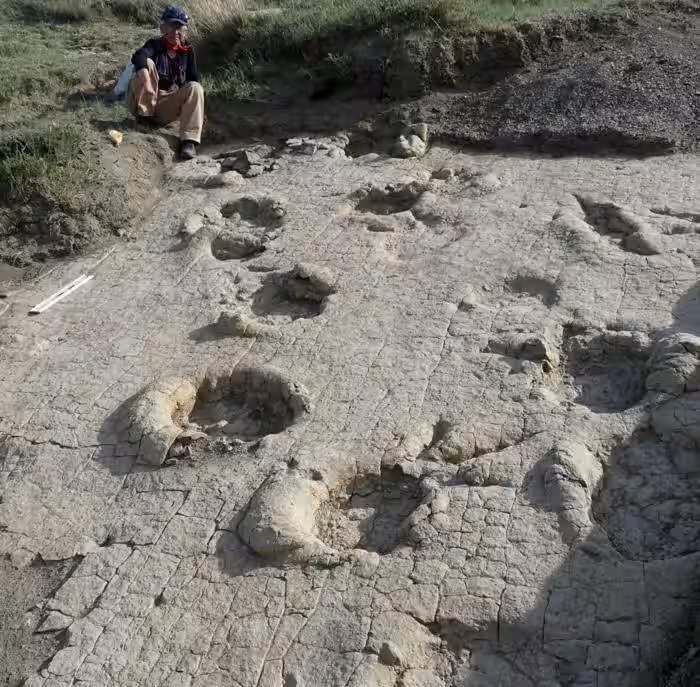
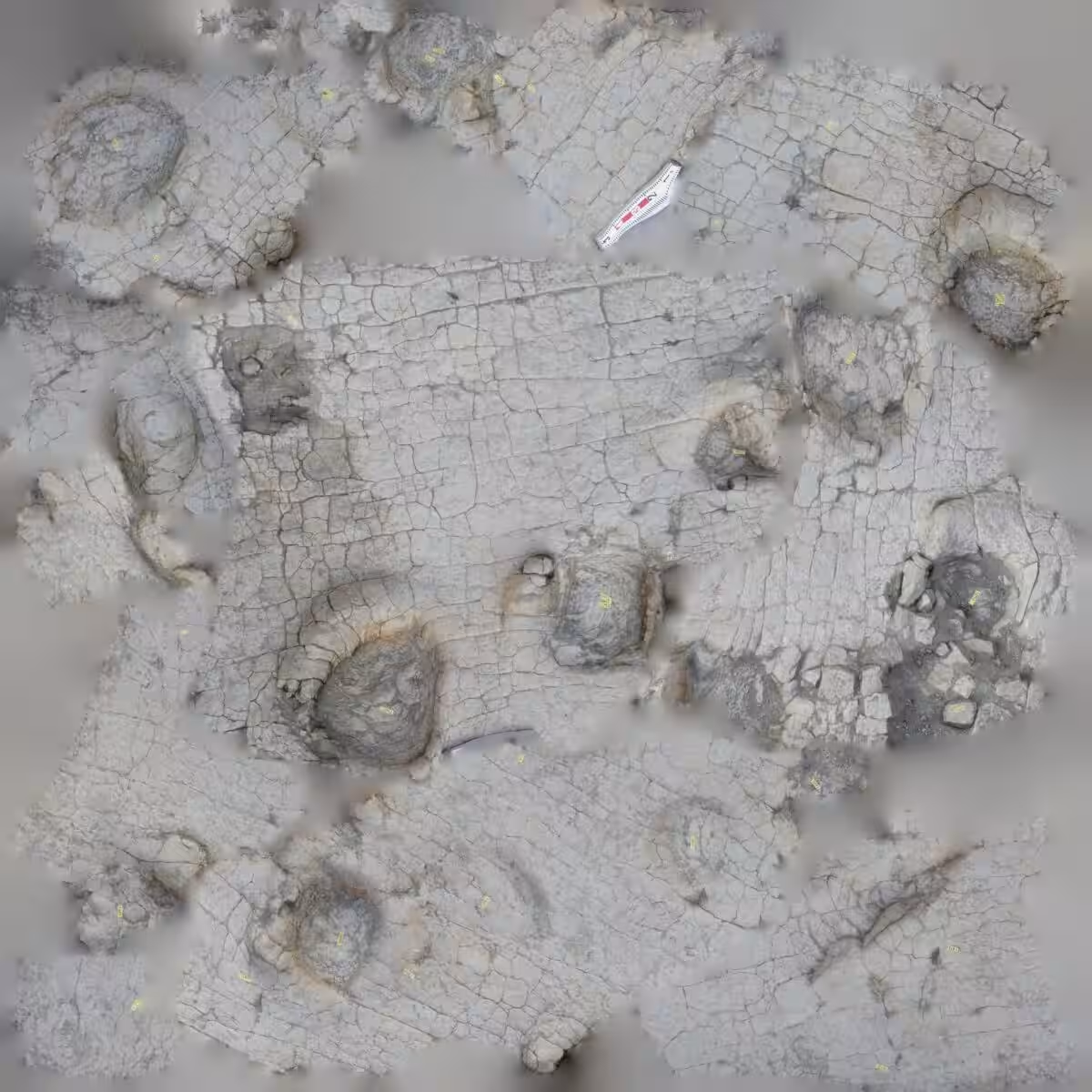
In the Saizhurakh region of northern Mongolia, a team uncovered 31 fossilized footprints preserved in a single sand layer dating to roughly 120 million years ago. Two sauropod trackways extend more than 15 metres across the former lakebed, while five distinct theropod trackways intersect the same surface.
A Missing Chapter in Mongolia’s Early Cretaceous Record
Mongolia ranks among the world’s top five sources of dinosaur fossils, yet the overwhelming majority originates from the Late Cretaceous, a window roughly 70 to 90 million years ago.
The Early Cretaceous interval, spanning about 100 to 120 million years ago, has yielded far fewer specimens, mostly limited to small‑ and medium‑sized taxa such as Harpymimus, Psittacosaurus and Choyrodon. Prior to this work, no Early Cretaceous tracksite had been confirmed within the country.
The omission mattered beyond national borders. During the Early Cretaceous, global temperatures were warm, flowering plants were diversifying, and Asian dinosaurs were dispersing toward North America. Mongolia lies directly along that migration corridor, making it a key reference point for comparing faunas across continents.
Without physical traces of large dinosaurs in the Mongolian segment of that pathway, scientists could not confidently infer which species occupied the area or how populations on either side were linked.
Lake Deposits Capture a Moment of Dinosaur Activity
The footprints are embedded within the Shinekhudag Formation, a sequence formed from sediments that settled in a vast Early Cretaceous lake. Most of the deposit consists of fine black clay, interspersed with thin sand layers that entered the basin when lake levels fell.
During periods of low water, stretches of wet sand and mud became exposed. Dinosaurs traversed these flats, imprinting their feet in the soft substrate. Subsequent sediment burial preserved the impressions, including the 31 prints recorded in a single sand horizon.
Two sauropod trackways stretch over 15 metres. Both individuals were similar in size, leaving hind footprints about 70 centimetres long. One trackway largely overlaps the other, leading researchers to infer that a second sauropod followed the same route at a slightly slower pace.
The authors compared the overlapping behaviour to that of modern elephants, which sometimes step into the tracks of a herd mate to follow an established route. The front‑foot impressions display a mix of traits, including a medially projecting first‑digit claw and a more advanced soft‑tissue pad. The wide‑gauge stance and overall morphology point toward titanosauriform sauropods, a diverse group of long‑necked herbivores known from several continents at that time.
Independent Crossings by Massive Theropods
Five theropod trackways share the same bedding plane as the sauropod prints. The largest single footprint measures 57 centimetres across, with widely spaced toes.
Based on footprint dimensions and track proportions, the researchers estimate that these carnivorous dinosaurs exceeded eight metres in length, making them the largest Early Cretaceous predators documented from the region.
The trackways diverge in direction, and no consistent alignment suggests coordinated movement. Instead, the pattern indicates that five large theropods crossed the site separately, likely within a brief interval before the mud hardened and new sediment sealed the prints.
Prior evidence of sizable Early Cretaceous theropods has emerged from China, South Korea and Japan. According to a study published in Ichnos (link), the Saizhurakh discovery extends that geographic range into northern Mongolia, filling a long‑standing gap across Mongolia and eastern Russia.
Nearby Sediments Hint at Possible Bone Finds
Beyond the tracksite itself, the team identified gravel‑bearing sand layers in adjacent outcrops, conditions that could preserve skeletal material.
Future fieldwork will target these deposits for bones, teeth or other body fossils belonging to the same dinosaurs that left the footprints, while additional surveys will seek further tracksites in the surrounding area.
This article has been fact checked for accuracy, with information verified against reputable sources. Learn more about us and our editorial process.
Last reviewed on .
Article history
- Latest version
Reference(s)
- Mainbayar, Buuvei., et al. “A dinosaur ichnofauna from the Lower Cretaceous Shinekhudag Formation, Mongolia.” Ichnos, vol. 33, no. 2, March 19, 2026, pp. 193-208. Informa UK Limited, doi: 10.1080/10420940.2026.2645024. <https://www.tandfonline.com/doi/abs/10.1080/10420940.2026.2645024>.
Cite this page:
- Posted by David Anderson