New Study Reveals Surprising Digital Divide Across German Newborn Intensive Care Units
Health

New Study Reveals Surprising Digital Divide Across German Newborn Intensive Care Units

While lab tests and imaging are largely electronic, everyday bedside documentation for vulnerable newborns still relies heavily on paper records.

By Sana Malik
Published:
Email this Article
New Study Reveals Surprising Digital Divide Across German Newborn Intensive Care Units
Photo by Heliao on Unsplash

A new nationwide assessment reveals that while advanced laboratory and imaging systems are standard in Germany, everyday bedside care for critically ill newborns still relies heavily on paper records. Neonatal intensive care units handle some of the most fragile patients in medicine, generating continuous physiological streams where tiny dosage or oxygen adjustments carry major consequences.

To map this critical digital landscape, researchers conducted a cross-sectional survey of neonatal intensive care units across Germany between June and September 2025. Out of 340 eligible hospital sites invited to participate, senior physicians from 124 units submitted analyzable profiles, providing a detailed look at hardware, software, and staff attitudes published in PLOS Digital Health.

Where Digital Infrastructure Thrives and Where It Stalls Out

The survey uncovered a stark operational divide across different clinical domains. While laboratory results, ultrasounds, and other imaging tools were digital or mostly digital in at least 87 percent of responding units, the core bedside workflow lagged significantly behind.
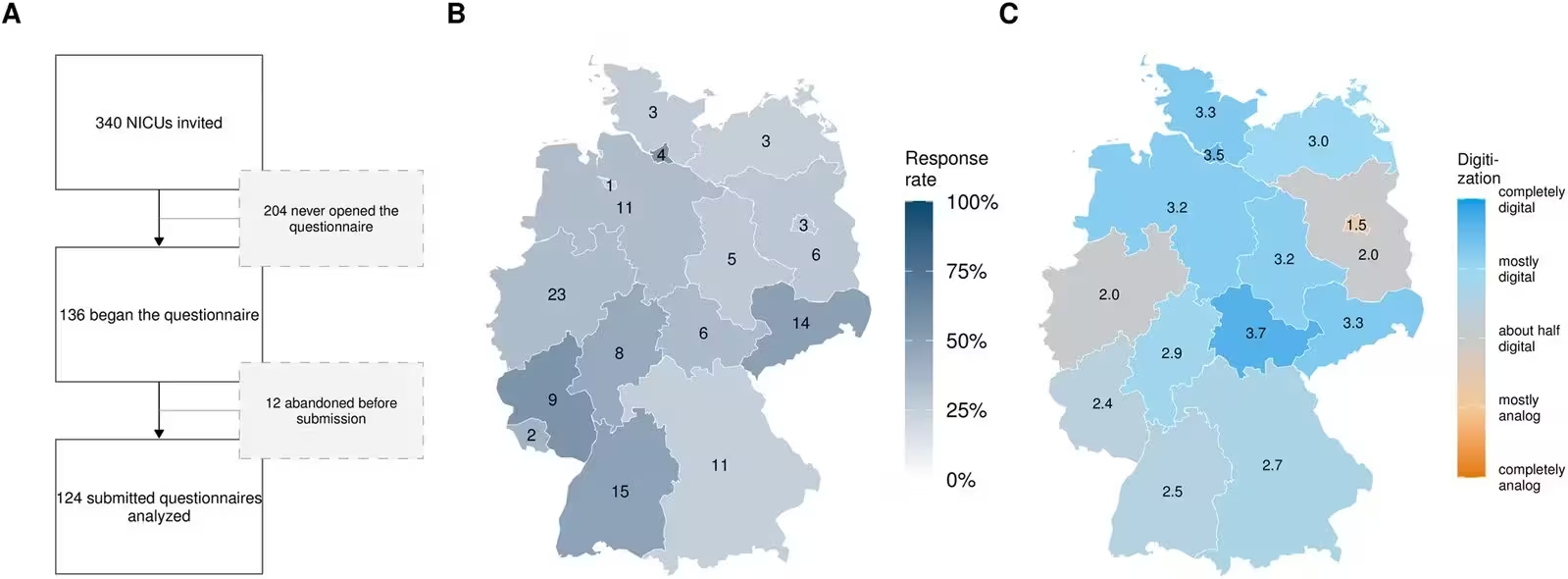
Fig 1: Participant flow, survey participation, and state-level digitization across German federal states. (A) Participant flow from the invited NICUs through those that began the questionnaire to the submitted questionnaires analyzed. (B) Response rate per state; color intensity is the proportion of invited units that responded, numbers are absolute responses. (C) State-level mean composite digitization score (0 = completely analog, 4 = completely digital); the orange-to-blue gradient (orange = low, blue = high) is the digitization scale used throughout. State-level maps of the three remaining composite scores are shown in S2 Fig. Several states contributed only a handful of units, and states with fewer than three respondents were merged with a neighbor for data protection (Bremen with Lower Saxony; Saarland with Rhineland-Palatinate), so the state means in panel C, and those in S2 Fig, rest on small and unequal denominators. These maps are descriptive; no spatial statistical test was perform
Participant flow, survey participation, and state-level digitization across German federal states. (A) Participant flow from the invited NICUs through those that began the questionnaire to the submitted questionnaires analyzed. (B) Response rate per state; color intensity is the proportion of invited units that responded, numbers are absolute responses. (C) State-level mean composite digitization score (0 = completely analog, 4 = completely digital); the orange-to-blue gradient (orange = low, blue = high) is the digitization scale used throughout. State-level maps of the three remaining composite scores are shown in S2 Fig. Several states contributed only a handful of units, and states with fewer than three respondents were merged with a neighbor for data protection (Bremen with Lower Saxony; Saarland with Rhineland-Palatinate), so the state means in panel C, and those in S2 Fig, rest on small and unequal denominators. These maps are descriptive; no spatial statistical test was perform Credit: Rudolf G Ascherl et al. / PLOS digital health

Documentation for vital signs, nursing notes, physician progress notes, medication orders, and infant nutrition remained completely or mostly analog in 28 to 45 percent of participating hospitals. Furthermore, only 33 percent of units operated a dedicated patient data management system at the bedside, meaning manual data transcription remains a widespread routine.

What Obstacles Stand in the Way of Modernization?

When asked about the barriers holding back further digital integration, 83 percent of respondents pointed to severe shortages of information-technology personnel. Financial hurdles followed close behind, with 62 percent citing high software acquisition costs and 54 percent pointing to expensive hardware.

Despite these steep roadblocks, 83 percent of the responding physicians expressed a strong desire for more digitization in their departments. Interestingly, units that currently lag behind digitally reported the highest demand for future upgrades, pointing to an unmet need rather than a lack of willingness among medical staff.
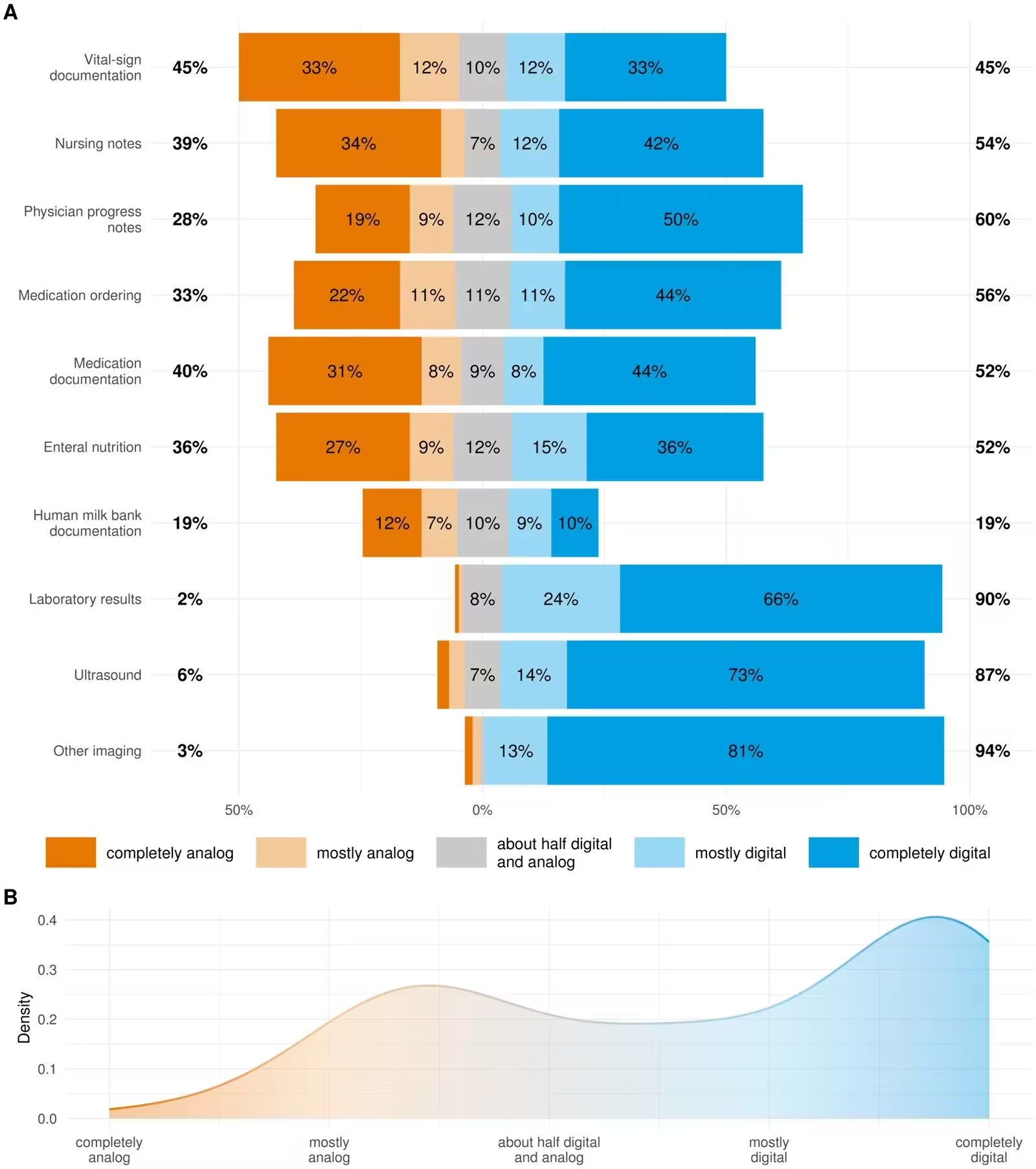
Fig 2: Digitization levels across clinical domains and distribution of the composite digitization score. (A) Digitization of ten clinical documentation and workflow domains (denominator: all 124 submitted questionnaires). Bars show the proportion of units rating each domain on a five-point scale from completely analog to completely digital; exactly one rating per domain was possible. Proportions not summing to 100% reflect items rated no answer. (B) Kernel density of the composite digitization score (range 0 to 4, n = 124), computed as the mean of the available item scores for each unit across the ten items in panel A (no answer treated as missing) using Silverman’s rule-of-thumb bandwidth. The distribution is apparently bimodal. Fill and line color follow the five-level gradient of panel A.
Digitization levels across clinical domains and distribution of the composite digitization score. (A) Digitization of ten clinical documentation and workflow domains (denominator: all 124 submitted questionnaires). Bars show the proportion of units rating each domain on a five-point scale from completely analog to completely digital; exactly one rating per domain was possible. Proportions not summing to 100% reflect items rated no answer. (B) Kernel density of the composite digitization score (range 0 to 4, n = 124), computed as the mean of the available item scores for each unit across the ten items in panel A (no answer treated as missing) using Silverman’s rule-of-thumb bandwidth. The distribution is apparently bimodal. Fill and line color follow the five-level gradient of panel A. Credit: Rudolf G Ascherl et al. / PLOS digital health

How Does Automated Vital Sign Recording Vary Across Hospitals?

The monitoring of continuous physiological data showed remarkable inconsistency from one hospital to the next. While parameters like heart rate and blood oxygen levels were automatically captured at least hourly in roughly 60 percent of units, specialized monitoring tools faced widespread documentation gaps.

For instance, near-infrared spectroscopy, a non-invasive method used to monitor tissue oxygenation, was not recorded at all in 39 percent of responding units. Researchers suggest that lacking standardization in device applications and artifact handling contributes to these recording gaps.
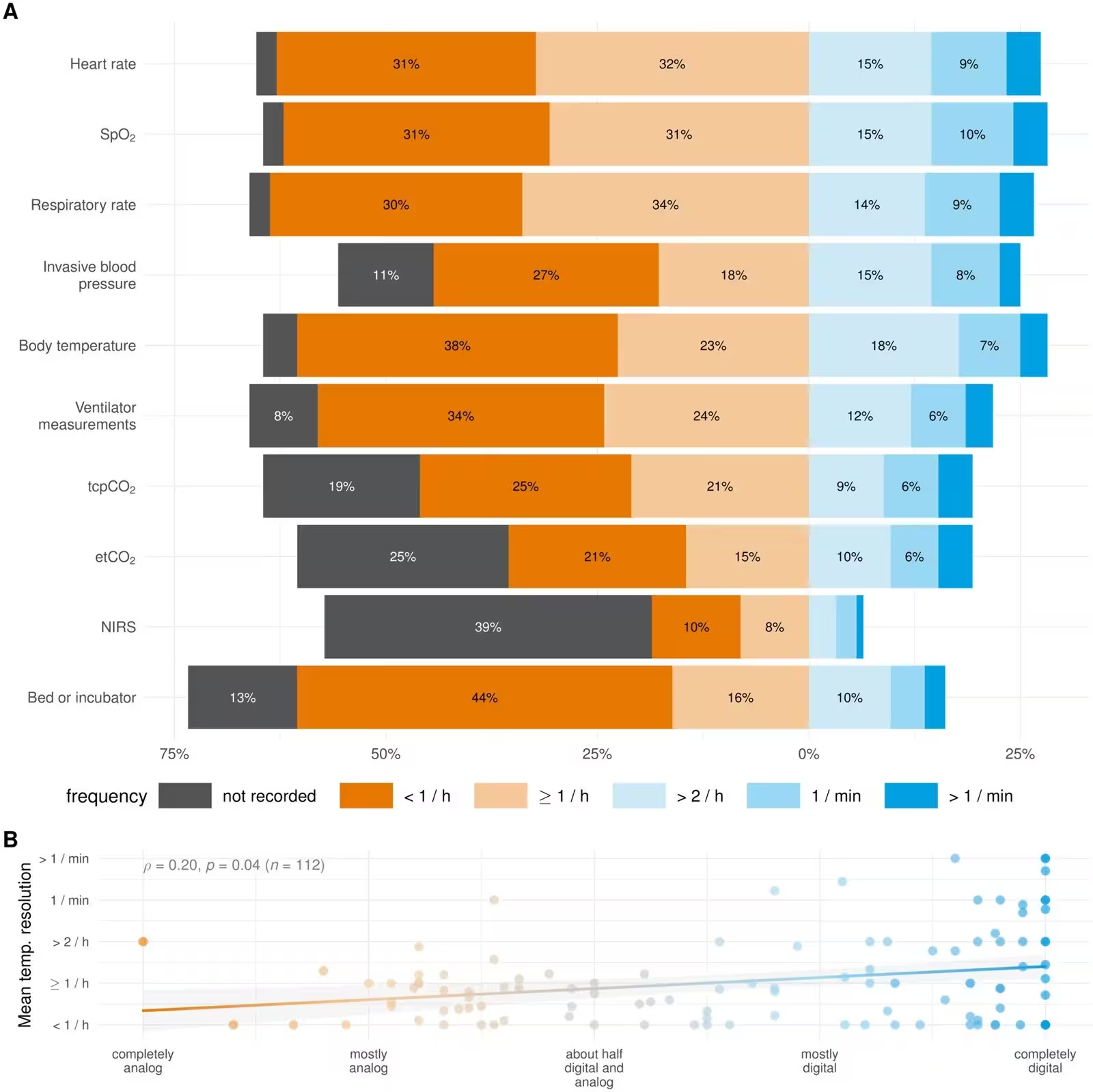
Fig 3: Frequency of automated data recording for monitoring parameters (denominator: all 124 submitted questionnaires). (A) Each bar shows the proportion of units recording the parameter at each frequency or not at all (not recorded); exactly one response per parameter was possible. Percentages to the left of each bar indicate the proportion of units that record the parameter below the arbitrary threshold > 2 / h and to the right the proportion above and including that threshold. Differences from 100% reflect units answering no answer for that parameter; such non-response ranged from 9 to 45 of 124 units across parameters and is tabulated in S2 Table. (B) Composite digitization score versus temporal-resolution score (both ranging from 0 to 4); each point is one unit and the line is a least-squares trend (n = units with both scores available).
Frequency of automated data recording for monitoring parameters (denominator: all 124 submitted questionnaires). (A) Each bar shows the proportion of units recording the parameter at each frequency or not at all (not recorded); exactly one response per parameter was possible. Percentages to the left of each bar indicate the proportion of units that record the parameter below the arbitrary threshold > 2 / h and to the right the proportion above and including that threshold. Differences from 100% reflect units answering no answer for that parameter; such non-response ranged from 9 to 45 of 124 units across parameters and is tabulated in S2 Table. (B) Composite digitization score versus temporal-resolution score (both ranging from 0 to 4); each point is one unit and the line is a least-squares trend (n = units with both scores available). Credit: Rudolf G Ascherl et al. / PLOS digital health

What Lies Ahead for Neonatal Intensive Care?

The findings emphasize that fifteen years after experts first envisioned a paperless environment for newborn intensive care, the physical bedside remains largely analog in many settings. The authors note that addressing IT staffing deficits and implementing structured interoperability standards will be essential if hospitals want to enable collaborative research and improve data sharing.

Because the survey relied primarily on self-reported questionnaires answered by senior physicians without nursing input, future investigations will need to evaluate bedside workflows from multiple professional perspectives. Establishing validated digital maturity metrics will ultimately help healthcare systems track modernization progress and ensure that vulnerable infants benefit equally from data-driven medical advances.

The research was published in PLOS digital health on November 16, 2026.

Fact Checked

This article has been fact checked for accuracy, with information verified against reputable sources. Learn more about us and our editorial process.

Last reviewed on .

Article history

  • Latest version

Reference(s)

  1. Ascherl, Rudolf G.., et al. “Digital health infrastructure and research priorities across neonatal intensive care units in Germany: A nationwide cross-sectional survey.” PLOS Digital Health, vol. 5, no. 11, November 16, 2026, pp. e0001833 Public Library of Science (PLoS), doi: 10.1371/journal.pdig.0001833. <https://doi.org/10.1371/journal.pdig.0001833>.

Cite this page:

Malik, Sana. “New Study Reveals Surprising Digital Divide Across German Newborn Intensive Care Units.” BioScience. BioScience ISSN 2521-5760, 17 November 2026. <https://www.bioscience.com.pk/en/subject/health/digital-health-infrastructure-and-research-priorities-across-neonatal-intensive-care-units-in-germany-a-nationwide-cross-sectional-survey>. Malik, S. (2026, November 17). “New Study Reveals Surprising Digital Divide Across German Newborn Intensive Care Units.” BioScience. ISSN 2521-5760. Retrieved November 17, 2026 from https://www.bioscience.com.pk/en/subject/health/digital-health-infrastructure-and-research-priorities-across-neonatal-intensive-care-units-in-germany-a-nationwide-cross-sectional-survey Malik, Sana. “New Study Reveals Surprising Digital Divide Across German Newborn Intensive Care Units.” BioScience. ISSN 2521-5760. https://www.bioscience.com.pk/en/subject/health/digital-health-infrastructure-and-research-priorities-across-neonatal-intensive-care-units-in-germany-a-nationwide-cross-sectional-survey (accessed November 17, 2026).
End of the article