Saliva RNA Sequencing Proves Viable for Pathogen Detection Despite Heavy Degradation
A systematic comparison of twenty-four molecular workflows reveals that library preparation chemistry matters more than extraction yield for viral recovery.

Researchers have discovered that library preparation methods matter far more than extraction kits when recovering viral RNA from challenging clinical specimens like saliva. Unbiased genomic sequencing offers a powerful way to identify emerging pathogens and track health outbreaks, but working with saliva presents major hurdles because ribonucleic acid molecules degrade quickly in environments rich in degrading enzymes.
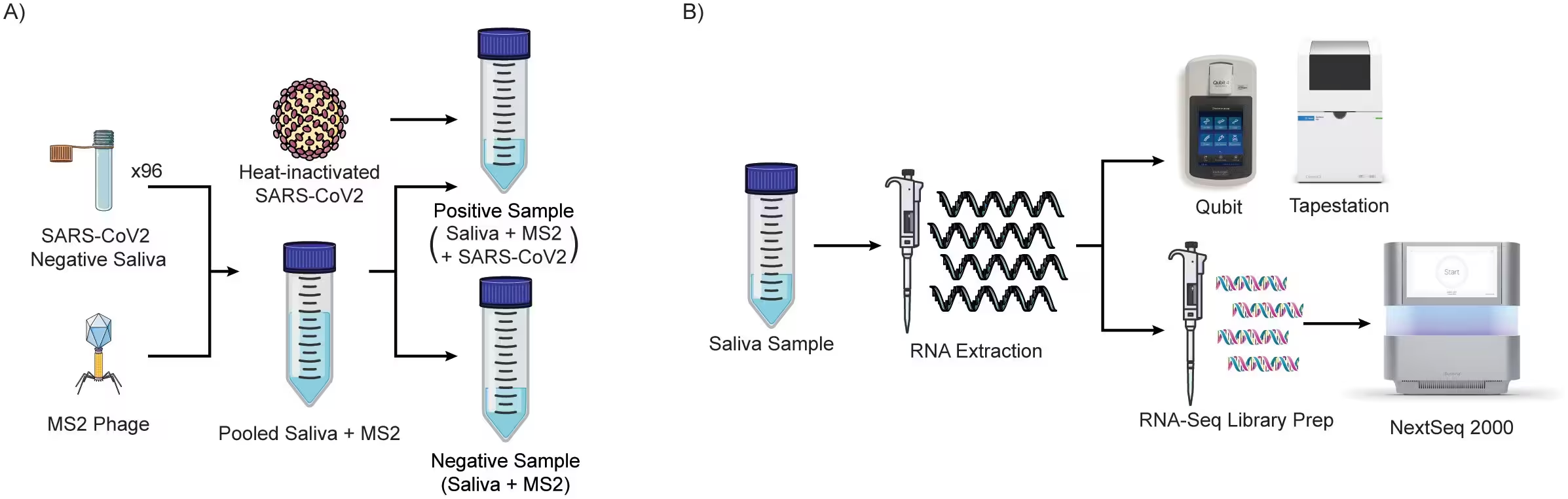
To pinpoint the most effective workflows, investigators tested twenty-four distinct combinations involving eight nucleic acid extraction methods and three ribonucleic acid sequencing library preparation kits. The evaluation used contrived saliva samples spiked with known quantities of SARS-CoV-2 and bacteriophage MS2, which serves as a standard quality control virus. The team evaluated these workflows to determine how well different protocols preserve viral sequences from complex biological backgrounds, as detailed in a study published in PLOS One.
Which Extraction Kits and Library Preparation Methods Recover the Most Pathogen Sequences?
The analysis revealed that pairing the Zymo Quick-RNA Magbead extraction kit with the Revelo RNA-Seq High Sensitivity library preparation kit yielded the highest percentage of spiked-in viral reads. Kenin Qian and colleagues at the University of California, Los Angeles, tested extraction platforms that are compatible with benchtop automation to ensure scalability for clinical laboratories. Among the extraction kits tested, the MagMAX mirVana Total RNA kit and the Zymo Quick-RNA Magbead kit consistently preserved the highest number of viral reads in the contrived specimens.
However, the choice of library preparation chemistry exerted a much larger influence on viral read preservation, genomic coverage, and distribution across the viral genome than the extraction method alone. While high sensitivity library kits successfully recovered targeted pathogen sequences, standard methods relying solely on poly-A tail priming struggled because the control bacteriophage lacked a poly-A tail. Incorporating random priming alongside oligo-dT primers proved essential for achieving stable, even coverage across the entire viral genome.
Why Do Traditional Quality Control Metrics Fail for Metagenomic Viral Detection?
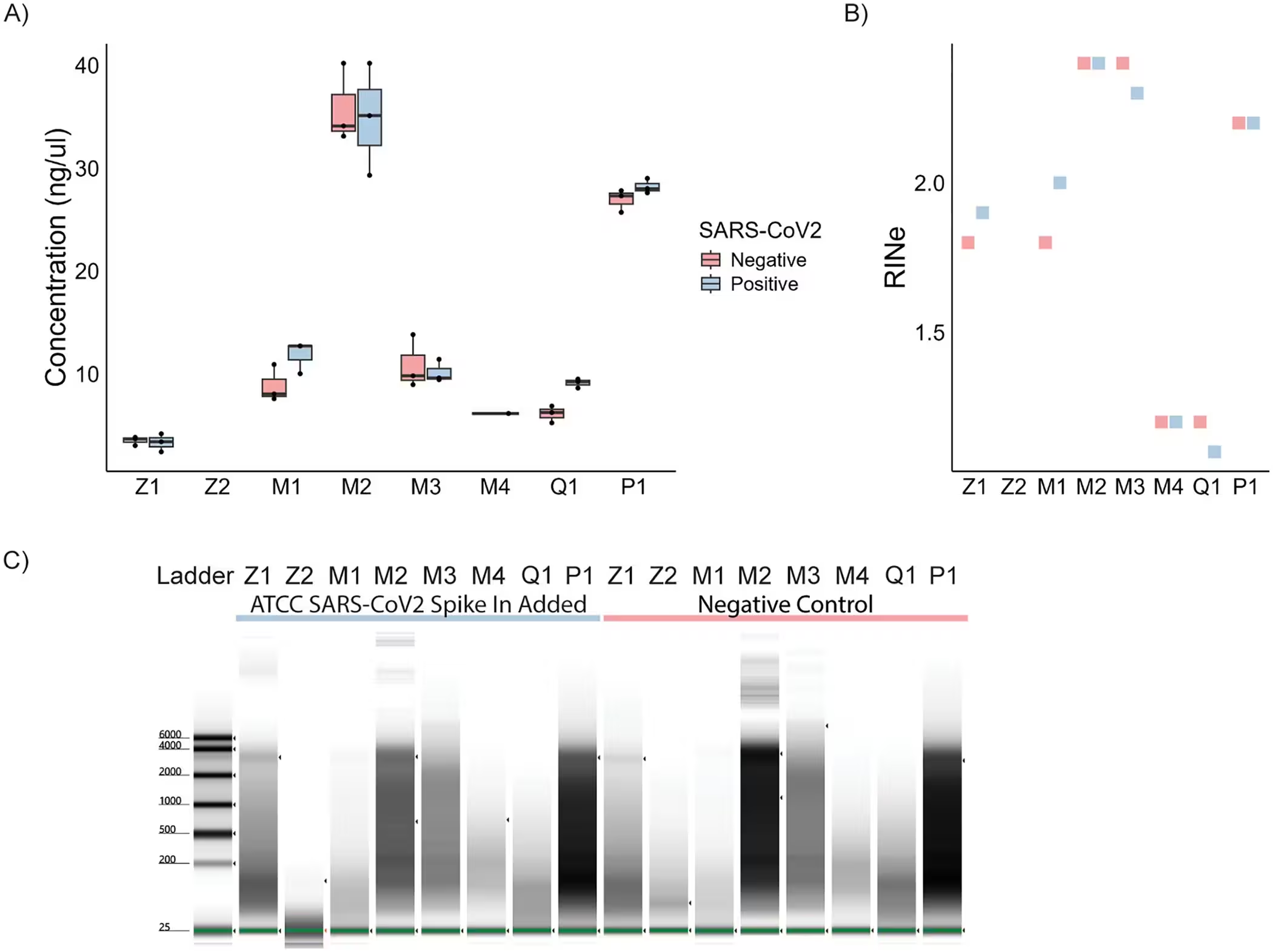
A surprising finding from the evaluation was that standard measures of ribonucleic acid quality showed no correlation with successful viral read recovery by sequencing. Across all evaluated extraction protocols, the RNA Integrity Number equivalent scores fell below three, indicating heavily degraded material that would normally be rejected for gene expression studies. Furthermore, total nucleic acid concentrations failed to predict how many viral reads would eventually be recovered from the sequencer.
The investigators found that samples yielding minimal measurable material on standard fluorometer and microfluidics platforms still produced high-complexity sequencing libraries capable of detecting the target pathogen. Because clinical saliva samples are dominated by human and bacterial genetic material, standard quantification tools measure the bulk degraded host background rather than the rare pathogen molecules of interest. This disconnect demonstrates that low integrity scores should not automatically disqualify a clinical specimen from metagenomic sequencing.
What Are the Main Trade-Offs Between Automation Scalability and Diagnostic Sensitivity?
Deploying sequencing assays in frontline clinical settings requires balancing high-throughput automation with analytical sensitivity. Methods featuring early barcoding during reverse transcription allow hundreds of samples to be pooled into a single tube, dramatically simplifying the workflow for large volumes of diagnostic tests. Yet, these streamlined protocols often sacrifice recovery efficiency for specific target sequences compared to full-transcriptome library preparation kits.
The study also highlights several limitations that must be addressed before routine clinical implementation. The experiments evaluated a single moderate viral load and focused primarily on enveloped viral pathogens suspended in saliva, leaving non-enveloped viruses, DNA viruses, fungi, and bacteria for future validation studies. As sequencing costs decline and automation becomes standard practice in public health laboratories, identifying robust internal controls like MS2 phage will remain vital for verifying assay performance and guiding clinical diagnostics.
The research was published in PLOS One on November 23, 2026.
This article has been fact checked for accuracy, with information verified against reputable sources. Learn more about us and our editorial process.
Last reviewed on .
Article history
- Latest version
Reference(s)
- Qian, Kenin., et al. “Systematic evaluation of 24 extraction and library preparation combinations for metagenomic sequencing of SARS-CoV-2 in saliva.” PLOS One, vol. 21, no. 11, November 23, 2026, pp. e0348386 Public Library of Science (PLoS), doi: 10.1371/journal.pone.0348386. <https://doi.org/10.1371/journal.pone.0348386>.
Cite this page:
- Posted by Faisal Qureshi