Blood Cancers Rewrite Their Sugar Metabolism to Evade Treatment and Fuel Rapid Growth
A comprehensive review reveals how malignant blood cells exploit glucose pathways to resist drugs and dodge the immune system.
Malignant blood cells completely rewrite their sugar metabolism to fuel rapid growth and evade medical treatments, revealing fresh vulnerabilities that researchers hope to exploit. Blood cancers such as leukemia, lymphoma, and multiple myeloma often become stubbornly resistant to standard drugs because their internal wiring shifts to consume massive amounts of glucose, bypassing normal cellular controls.
A comprehensive review published in Cancer Management and Research by Haijing Zhao and colleagues at the First Hospital of China Medical University details how these metabolic shifts drive tumor progression. While scientists once believed cancer cells merely burned sugar faster to feed their proliferation, recent investigations show that glucose metabolism reprogramming actively controls stemness, immune evasion, and survival against chemotherapy.
How Do Cancer Cells Remrew Their Energy Pathways?
Normal blood stem cells reside in the low-oxygen environment of the bone marrow, relying on tightly regulated metabolic balances to remain dormant and healthy. When malignant transformation occurs, this delicate balance breaks down entirely. The review outlines how tumor cells upregulate glucose transporters and key enzymes, accelerating aerobic glycolysis even when plenty of oxygen is available. This phenomenon, known as the Warburg effect, provides the building blocks required for unchecked cell division.
In acute and chronic leukemias, malignant cells establish highly efficient glycolytic cascades. Multiple myeloma plasma cells similarly abandon traditional mitochondrial respiration in favor of cytoplasmic aerobic glycolysis to generate the energy required for rapid protein synthesis. Beyond simple fuel generation, these metabolic changes produce intermediate molecules that activate pro-survival signaling pathways, protect cancer stem cells from dying, and help the tumors hide from the immune system.
What Controls This Complex Metabolic Network?
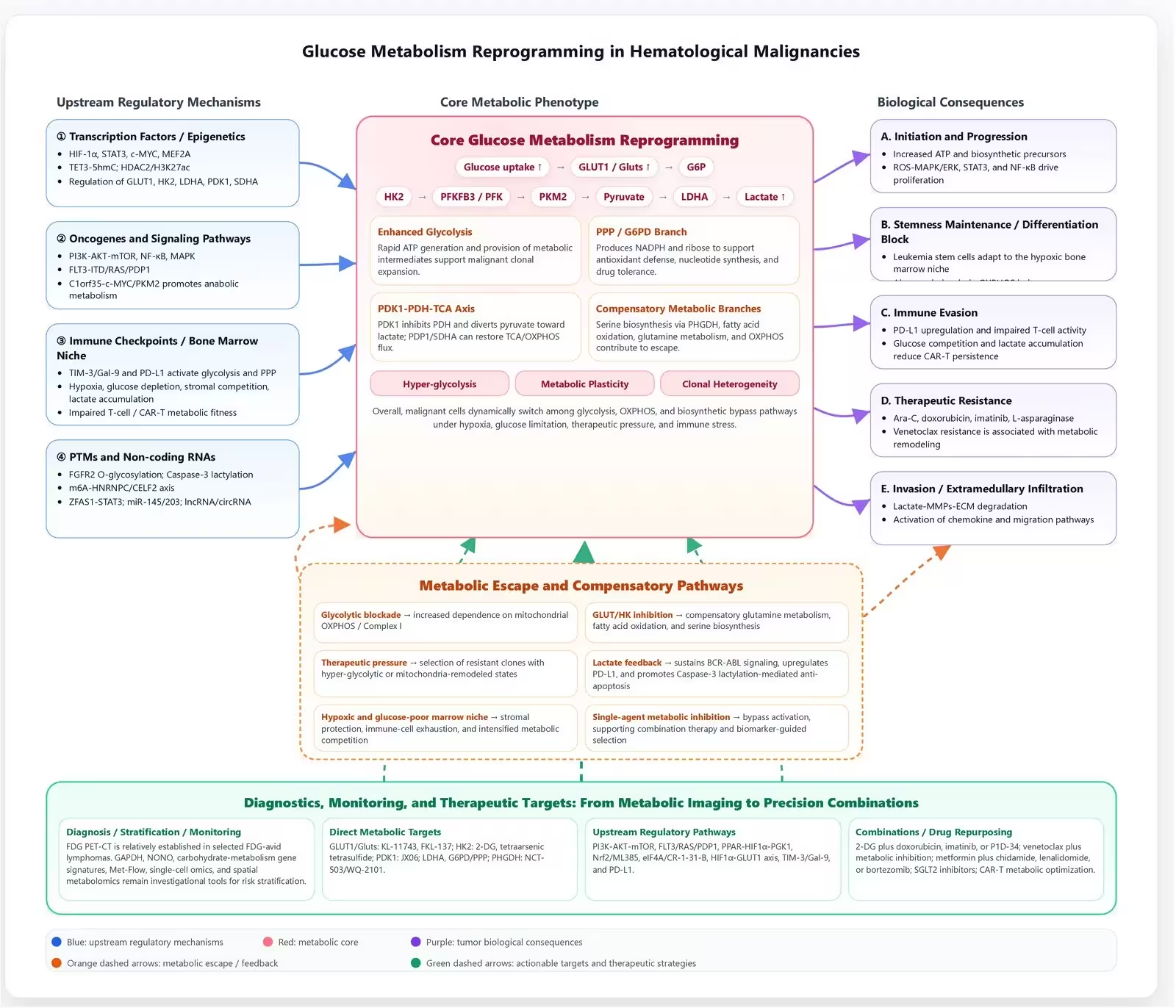
The researchers mapped a multi-dimensional regulatory network driving these metabolic changes across five distinct biological levels. Transcription factors like STAT3 act as core metabolic hubs in glucose-restricted microenvironments, while epigenetic regulators such as the enzyme TET3 maintain chemical marks on DNA that boost the activity of key glucose metabolism genes. Oncogenes including c-MYC and hyperactive signaling pathways like PI3K/AKT/mTOR further cement this metabolic rewiring.
Immune checkpoints also play a direct role in reshaping cancer metabolism. When checkpoint proteins interact with their cellular ligands, they rapidly increase the activity of glucose-processing enzymes in leukemia cells. This metabolic hyperactivity creates fierce competition for nutrients in the bone marrow, starving beneficial immune cells such as CAR-T cells of the glucose they need to function and survive.
Can Existing Drugs or New Inhibitors Block This Process?
Translating these biological discoveries into clinical treatments remains an active area of investigation. While metabolic imaging using FDG PET scans is widely established for staging and monitoring specific lymphomas, most targeted therapies are still in preclinical or early testing phases. Small-molecule inhibitors designed to block key glycolytic enzymes or upstream regulatory pathways have shown promise in laboratory models by triggering energy shortages that kill cancer cells.
Researchers are also exploring the repurposing of common diabetes medications to treat blood cancers. Combining the diabetes drug metformin with specific targeted therapies has demonstrated synergistic anti-tumor effects in laboratory models of multiple myeloma. Similarly, sodium-glucose cotransporter 2 inhibitors have shown direct activity against refractory adult T-cell leukemia by cutting off glucose uptake and halting cell division.
What Are the Major Challenges Facing Metabolic Therapies?
Despite compelling preclinical evidence, significant hurdles remain before these strategies can become standard medical care. Normal, healthy tissues, including active immune cells and normal blood-forming stem cells, also rely heavily on glucose metabolism to survive. Consequently, broad metabolic inhibition risks causing unwanted toxicity and damaging normal tissue repair.
Furthermore, cancer cells possess extensive metabolic backup systems. If researchers block glycolysis, malignant clones can often compensate by switching to alternative pathways like fatty acid oxidation or mitochondrial respiration. Future clinical success will depend on careful patient selection, biomarker validation, and rationally designed combination therapies that outsmart tumor flexibility without harming healthy organs.
The research was published in Cancer management and research on November 17, 2026.
This article has been fact checked for accuracy, with information verified against reputable sources. Learn more about us and our editorial process.
Last reviewed on .
Article history
- Latest version
Reference(s)
- Zhao, Haijing., et al. “Glucose Metabolism Reprogramming in Hematological Malignancies: Research Progress on Molecular Regulatory Networks and Clinical Translation.” Cancer Management and Research, vol. Volume 18, November 1, 2026, pp. 1-14. Informa UK Limited, doi: 10.2147/CMAR.S636252. <https://doi.org/10.2147/CMAR.S636252>.
Cite this page:
- Posted by Elizabeth Taylor