New Genomic Mapping System Achieves Up To 274-Fold Speedups By Replacing Expensive Graph Traversals With Memory Lookups
Researchers introduce a topology-aware algorithm and hardware co-design that uses recurring subgraph motifs to eliminate redundant computations in genome graph analysis.

Mapping sequenced DNA fragments to complex reference graphs becomes dramatically faster through a topology-aware hardware and software system called Motivo, bypassing the heavy computational bottlenecks that traditionally slow down genomic data analysis.
Genome sequence analysis examines an organism’s genetic information by matching short pieces of sequenced DNA, called reads, against a known reference genome. While traditional reference genomes use a single linear sequence, modern pangenomics relies on genome graphs to represent the genetic diversity of an entire population through alternative paths. However, the immense size and complexity of these graphs make sequence-to-graph mapping a major computational hurdle. Software tools and hardware accelerators often perform redundant operations, such as exhaustive graph traversals and dynamic programming on candidate paths that ultimately lead nowhere. Researchers have sought efficient solutions for years to accelerate these workflows without sacrificing precision.
How Do Recurring Structural Topologies Speed Up Genomic Mapping?
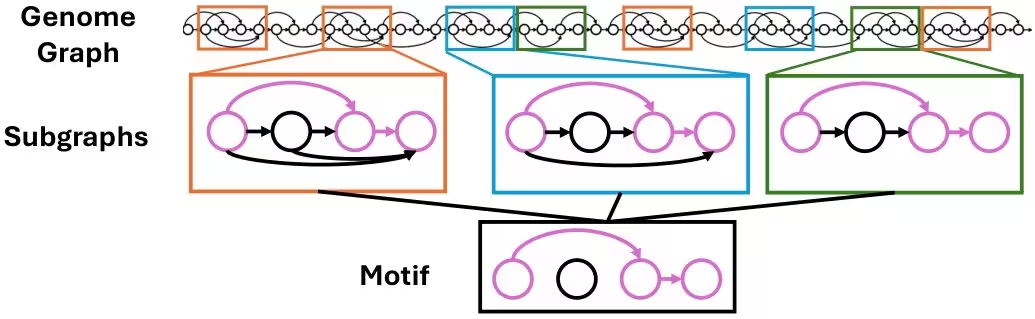
The research team led by Eirini Maria Tzermpou and colleagues at ETH Zürich observed that genome graphs consist of small subgraphs sharing a limited set of recurring topologies, which they term motifs. Most genetic variations, such as single-nucleotide polymorphisms and small insertions or deletions, form brief branches that diverge and rejoin the main sequence within just a few nodes. By analyzing these recurring patterns, the investigators found that subgraphs of up to seven nodes cover almost every variation encountered during sequence-to-graph mapping.
To leverage this insight, the authors developed Motivo, which is available in arXiv as a preprint study detailing its design. The system introduces a compact index that stores precomputed motifs and node properties, allowing the software to retrieve candidate paths via a single memory lookup instead of traversing the graph dynamically. Furthermore, the algorithm uses motif topologies and node base compositions to calculate lower bounds on edit distances, rapidly discarding unpromising paths using simple arithmetic operations before alignment begins.
What Performance Gains Do Hardware Accelerators Deliver?
The investigators implemented their algorithm across multiple platforms, including conventional CPUs, GPUs, and a dedicated application-specific integrated circuit accelerator known as Motivo-ASIC. When evaluated on human genome graphs from the Genome in a Bottle project and the Human Pangenome Reference Consortium, Motivo-CPU achieved speedups ranging from 2.1-fold to over 300-fold compared to established software baselines. Meanwhile, the dedicated hardware accelerator delivered dramatic improvements in both raw throughput and energy efficiency.
Specifically, Motivo-ASIC provided up to 274-fold speedups over state-of-the-art CPU-based tools for long reads, and significantly outperformed prior hardware accelerators in throughput per watt and per square millimeter. The authors report that mapping accuracy remained high, achieving between 96.8 percent and 99.7 percent across short and long read sets. These results indicate that replacing expensive dynamic programming with motif-based memory lookups can effectively eliminate redundant computations in pangenomic analysis.
The study was posted to the arXiv preprint server on November 22, 2026.
This article has been fact checked for accuracy, with information verified against reputable sources. Learn more about us and our editorial process.
Last reviewed on .
Article history
- Latest version
Reference(s)
- Tzermpou, Eirini. “Motivo: A Motif-Based Algorithm-Architecture Co-Design for Fast and Energy-Efficient Graph-Based Genome Analysis.” arXiv.org <http://arxiv.org/abs/2611.29410v1>.
Cite this page:
- Posted by Faisal Qureshi