NASA’s X-59 Just Cleared a Major Milestone on Its Quest to Silence the Sonic Boom
NASA’s X-59 has cleared 25 flight tests, moving one step closer to its historic mission of proving that quiet supersonic flight is finally possible.
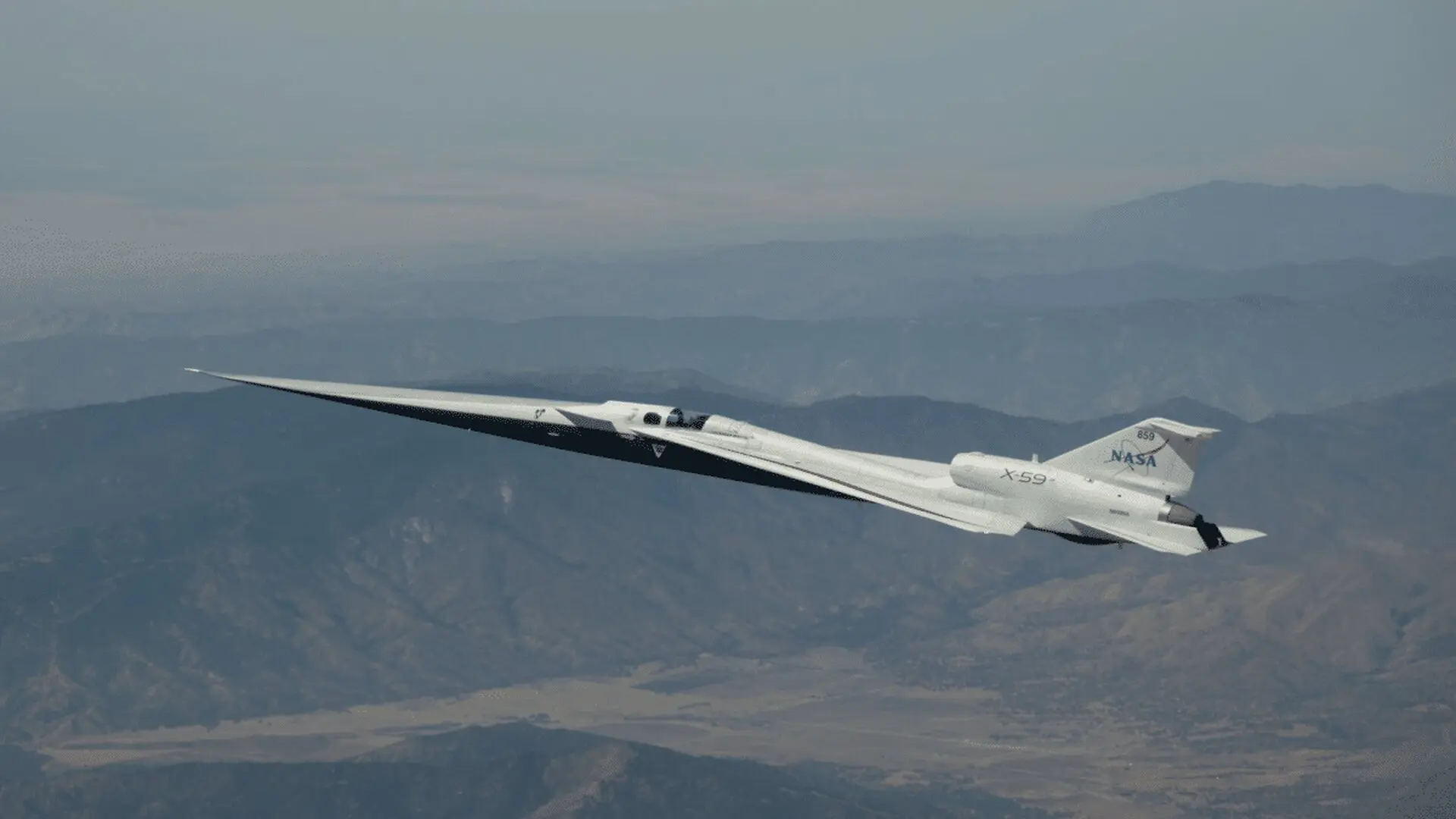
NASA’s experimental X-59 aircraft has officially cleared a significant hurdle, completing its 25th flight as the team prepares for the critical acoustic trials that will define the future of high-speed travel. With two dozen missions behind it, the jet has consistently met its performance benchmarks, proving that its unique airframe—designed to transform the jarring sonic boom into a muffled thump—behaves exactly as predicted by years of ground-based computer models and wind-tunnel data.
Data-Driven Success in the Skies
The 25th milestone, achieved on August 21 at NASA’s Armstrong Flight Research Center, saw the aircraft reach 49,000 feet and Mach 1.2 during a 72-minute sortie. While chase planes accompanied the flight, NASA clarified that these early tests are focused on aerodynamic stability and system integrity rather than acoustic measurement. By comparing real-time flight data against a real-time digital twin, engineers have confirmed that the aircraft’s stability, control margins, and structural loads align with their pre-flight simulations.
For test pilot Nils Larson, the experience has been notably steady. He describes the flights as “exciting but uneventful”—a high compliment in the world of experimental aviation, where predictability is the ultimate goal. Project manager Cathy Bahm emphasized that this methodical approach has bolstered the team’s confidence, confirming that the X-59 is performing as expected before the program transitions into its primary mission: validating its quiet supersonic signature.
NASA’s X-59 progresses through its 25th flight, continuing to pass performance marks as the team advances closer toward the upcoming acoustic validation phase!
— NASA Armstrong (@NASAArmstrong) September 4, 2026
A major step toward the future of over-land supersonic travel. https://t.co/Ypv83i7TVrpic.twitter.com/ls24l9Dxtt
Engineering for a Quieter Sonic Experience
The X-59’s unconventional, needle-like silhouette is not merely for aesthetics; it is an acoustic instrument. By manipulating how pressure waves propagate away from the airframe, designers aim to prevent the shockwaves from merging into a traditional, disruptive sonic boom. The propulsion system, centered on a top-mounted GE F414 engine, is integrated into this geometry, ensuring that the entire craft functions as a cohesive unit to dampen noise. Having already reached its cruise target of Mach 1.4 at 55,000 feet, the X-59 has demonstrated that its design holds up under the rigorous stresses of supersonic travel.
Iterative Refinement Between Missions
The flight campaign relies heavily on the work performed on the ground between sorties. When telemetry reveals minor anomalies—such as nuisance alerts or the need for control software tweaks—the team addresses them before pushing the envelope further. This iterative cycle of flight testing and data analysis has been vital, ensuring that each new maneuver is grounded in a verified understanding of the aircraft’s handling characteristics. This technical rigor ensures that the X-59 is not just a high-speed jet, but a precise research tool.
The Next Frontier: Proving the Acoustic Signature
As the program moves into its next phase, the focus shifts from basic airworthiness to the core objective of the Quesst mission: proving that supersonic flight over land can be socially acceptable. Researchers are set to deploy an array of ground-based and airborne sensors to capture the “sonic thump” signature, testing the hypothesis that the X-59 can effectively silence the thunderous booms that have long kept supersonic travel restricted to oceanic routes.
“Building and flying a brand-new aircraft is an extraordinary accomplishment, but the next phase is where the real research begins,” noted Larry Cliatt, the mission’s acoustic validation technical lead. According to Cliatt, the upcoming data collection will do more than just test this specific aircraft; it will provide a foundational blueprint for the design of future commercial supersonic transports.
This article has been fact checked for accuracy, with information verified against reputable sources. Learn more about us and our editorial process.
Last reviewed on .
Article history
- Latest version
Reference(s)
- Margetta, Robert. “NASA’s X-59 Aircraft Builds Momentum Through 25th Flight - NASA.”, September 4, 2026 NASA <https://www.nasa.gov/blogs/quesst/2026/09/04/nasas-x-59-aircraft-builds-momentum-through-25th-flight/>.
- <https://www.nasa.gov/centers-and-facilities/armstrong/what-is-a-digital-twin/>.
- “https://go.nasa.gov/4gBuQwv.” <https://t.co/Ypv83i7TVr>.
- “https://twitter.com/NASAArmstrong/status/2095905492807602657/photo/1.” <https://t.co/ls24l9Dxtt>.
- “Quesst.”, March 6, 2023 NASA <https://www.nasa.gov/mission/quesst/>.
Cite this page:
- Posted by Elizabeth Taylor