Burned Plastic Debris Triggers Massive Carbon Leaching in Waterways
Extreme heat alters polymer chemistry and accelerates toxic runoff from common plastics near fire sites.
When common plastic pipes undergo extreme thermal stress during fires, they break down in ways that cause dissolved carbon leaching to surge up to fifteenfold, reshaping how aquatic ecosystems handle chemical pollutants. A team of environmental scientists recently discovered that heat exposure fundamentally alters the chemical structure of plastic debris, transforming ordinary materials into long-lasting reservoirs of carbon pollution that drain into nearby waterways.
The research team, led by investigators at Oklahoma State University and the University of New Mexico, analyzed two widely used polymers: polyvinyl chloride, commonly known as PVC, and polyethylene terephthalate, which is frequently used for beverage bottles. The researchers evaluated these plastics after exposing them to temperatures of 100 and 250 degrees Celsius for 24 hours to simulate conditions found near structural fires, open burning sites, and wildland-urban interface fires. Their findings were published in ACS ES&T Water, detailing how different polymer backbones react to thermal stress.
Chemical Breakdown and Structural Shifts in Plastics
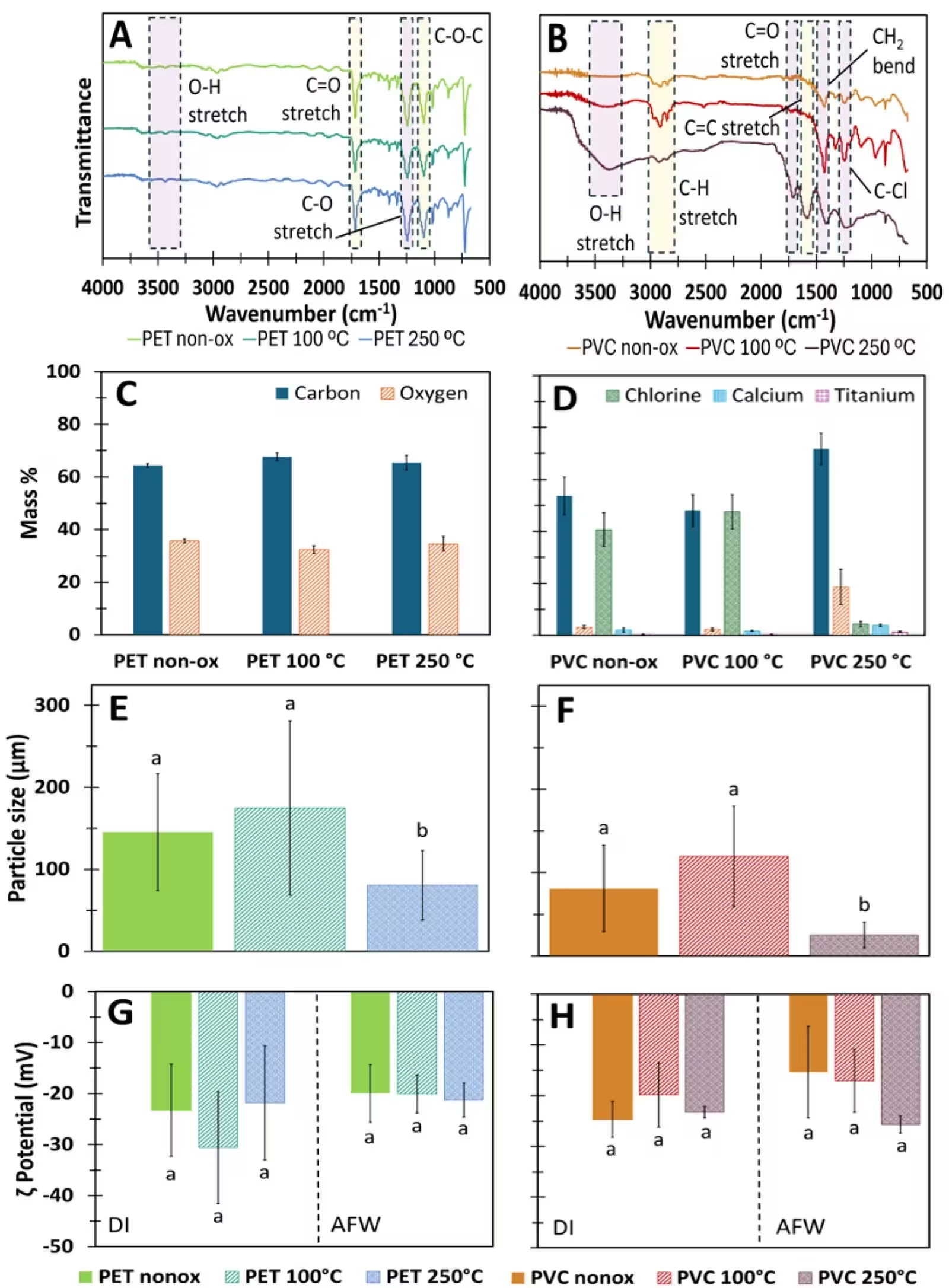
The experiments revealed a stark contrast between the two materials following heat exposure. Polyethylene terephthalate maintained strong structural integrity, showing minimal changes in its chemical fingerprint and negligible carbon leaching across all test conditions. In contrast, polyvinyl chloride underwent severe degradation, losing roughly 96 percent of its chlorine content at the highest temperature due to dehydrochlorination reactions. This thermal breakdown fragmented the polymer chains, reduced the average particle size from 81 micrometers down to 25 micrometers, and vastly expanded the surface area available for chemical release.
The release of total dissolved carbon from heat-treated polyvinyl chloride jumped dramatically. While non-oxidized polyvinyl chloride released 2.8 milligrams of carbon per liter, samples heated to 250 degrees Celsius leached 14.0 milligrams per liter into deionized water. Furthermore, the chemical nature of the leachate changed entirely. Unheated and moderately heated samples released carbon almost exclusively as dissolved inorganic carbon from calcium carbonate fillers. Samples heated to 250 degrees Celsius, however, shifted to releasing dissolved organic carbon as the polymer backbone itself degraded into smaller, highly soluble fragments.
Kinetic Modeling and Long-Term Environmental Risks
To understand how these pollutants enter aquatic systems over time, the researchers fitted their leaching data to five mathematical models. The biphasic model emerged as the most reliable predictor, indicating that carbon release occurs in two distinct stages. An initial fast-release phase discharges surface-available additives almost instantly, while a slower, matrix-controlled phase provides a chronic, long-term input of carbon into the surrounding water.
The authors note that these thermally altered particles create an overlooked pollution pathway near burn sites. By acting as high-capacity, slow-release carbon reservoirs, weathered microplastics can influence local microbial activity, nutrient availability, and water chemistry for months or years after a fire event. Future research will need to characterize the exact molecular structures of these leached compounds to fully determine their toxicity and biological impacts on aquatic life.
The research was published in ACS ES&T water on October 12, 2026.
This article has been fact checked for accuracy, with information verified against reputable sources. Learn more about us and our editorial process.
Last reviewed on .
Article history
- Latest version
Reference(s)
- McGuire-Diemer, Karen., et al. “Thermal Oxidation Increases Dissolved Carbon Leaching through Altered Microplastic Structural Chemistry and Accelerated Release Kinetics.” ACS ES&T Water, vol. 6, no. 11, October 12, 2026, pp. 7380-7393. American Chemical Society (ACS), doi: 10.1021/acsestwater.6c00842. <https://doi.org/10.1021/acsestwater.6c00842>.
Cite this page:
- Posted by William Moore