Graphene Breakthrough Paves the Way for Cheaper Sodium Batteries
A comprehensive review reveals how engineered carbon architectures and heteroatom doping overcome sluggish ion kinetics to rival lithium storage.
Sodium ions are larger and heavier than lithium ions, which creates a major hurdle for energy storage by causing severe volume expansion and sluggish diffusion in standard battery materials. A comprehensive review published in RSC Advances examines how integrating graphene can transform sodium-ion batteries into viable, cost-effective alternatives to conventional lithium technology.
Why Graphene Overcomes the Limits of Traditional Graphite
While graphite dominates lithium-ion systems due to its layered structure, its interlayer spacing of only 0.335 nanometers is too narrow to comfortably accommodate incoming sodium ions, which require at least 0.374 nanometers. This tight fit leads to rapid degradation and poor capacity in untreated graphite hosts. Graphene steps in as a single-atom-thick sheet of carbon arranged in a hexagonal lattice, offering high electrical conductivity, exceptional mechanical strength, and a massive specific surface area of roughly 2,630 square meters per gram.
The authors outline how pristine graphene alone still struggles with low sodium affinity, making chemical modification essential. By engineering defects, introducing pores, or doping the carbon framework with heteroatoms such as nitrogen, sulfur, or phosphorus, researchers can create active storage sites and widen interlayer pathways. These modifications lower diffusion barriers and enhance sodium-ion adsorption, turning a previously weak host into a high-performance battery component.
How Porous Architectures and Heteroatom Doping Boost Performance
Recent studies highlighted in the review demonstrate that structural regulation yields remarkable electrochemical gains. For instance, activated porous graphene boasting specific surface areas up to 3,100 square meters per gram achieved an initial coulombic efficiency of 99 percent in specific ether-based electrolytes without forming a visible solid electrolyte interphase layer. Similarly, nitrogen and sulfur co-doped carbon nanosheets demonstrated a specific capacity of 326.1 milliampere-hours per gram along with an impressive rate capability and stable cycling over 3,000 cycles.
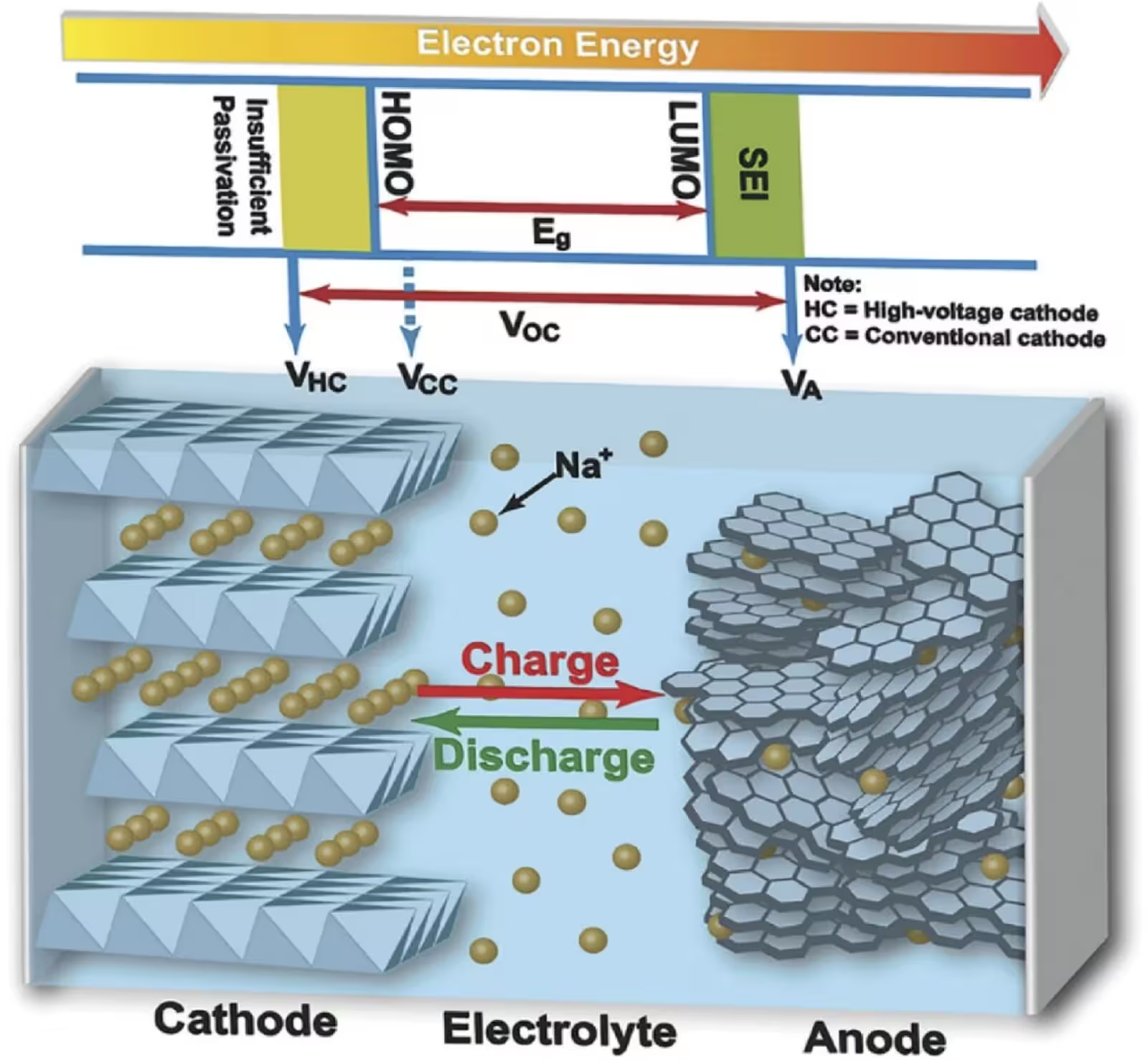
When combined with conversion or alloying materials such as transition metal oxides, sulfides, and phosphides, graphene acts as a robust conductive scaffold. This network cushions the intense volume fluctuations that typically pulverize battery anodes during rapid charge and discharge cycles. Furthermore, the incorporation of graphene improves low-temperature performance by maintaining low internal resistance and accelerating electron movement when standard battery conductivity usually plummets.
Current Obstacles Facing Commercial Scale-Up
Despite these promising laboratory metrics, several barriers continue to restrict commercial applications. Bulk graphene production remains difficult and costly, while high surface areas can sometimes aggravate parasitic side reactions if the solid electrolyte interphase and binders are poorly controlled. The authors emphasize that future research must prioritize standardized testing protocols in balanced full cells and pouch cells, moving beyond standard half-cell metrics to validate these advanced carbon architectures under realistic operational loads.
The research was published in RSC advances on November 16, 2026.
This article has been fact checked for accuracy, with information verified against reputable sources. Learn more about us and our editorial process.
Last reviewed on .
Article history
- Latest version
Reference(s)
- Worku, Ababay Ketema., et al. “Advancement in graphene-based anode materials for high-performance sodium-ion batteries.” RSC Advances, January 1, 2026 Royal Society of Chemistry (RSC), doi: 10.1039/d6ra09929g. <https://doi.org/10.1039/d6ra09929g>.
Cite this page:
- Posted by William Moore