Aging Brains Show Widespread Connectivity Declines Across Networks
Longitudinal fMRI data reveal that neural coupling steadily weakens over time rather than simply reorganizing.

Brain imaging data from 231 adults followed over a four-year window reveal that communication lines between specialized neural circuits steadily weaken as people grow older. Rather than reorganizing into less distinct functional units, the brain experiences a widespread attenuation of neural coupling across both internal and cross-network connections.
As humans age, cognitive and sensory functions often experience gradual declines that alter daily life quality. Scientists have long debated whether these shifts stem from general brain network breakdown or more targeted reorganization, but most prior insights relied on cross-sectional snapshots that could conflate generational cohort differences with real aging processes. To untangle these factors, researchers examined resting-state fMRI scans from 53 younger adults with an average age of 22.77 years and 127 older adults with an average age of 70.44 years, tracking 45 of the older participants across a second scanning wave approximately four years later.
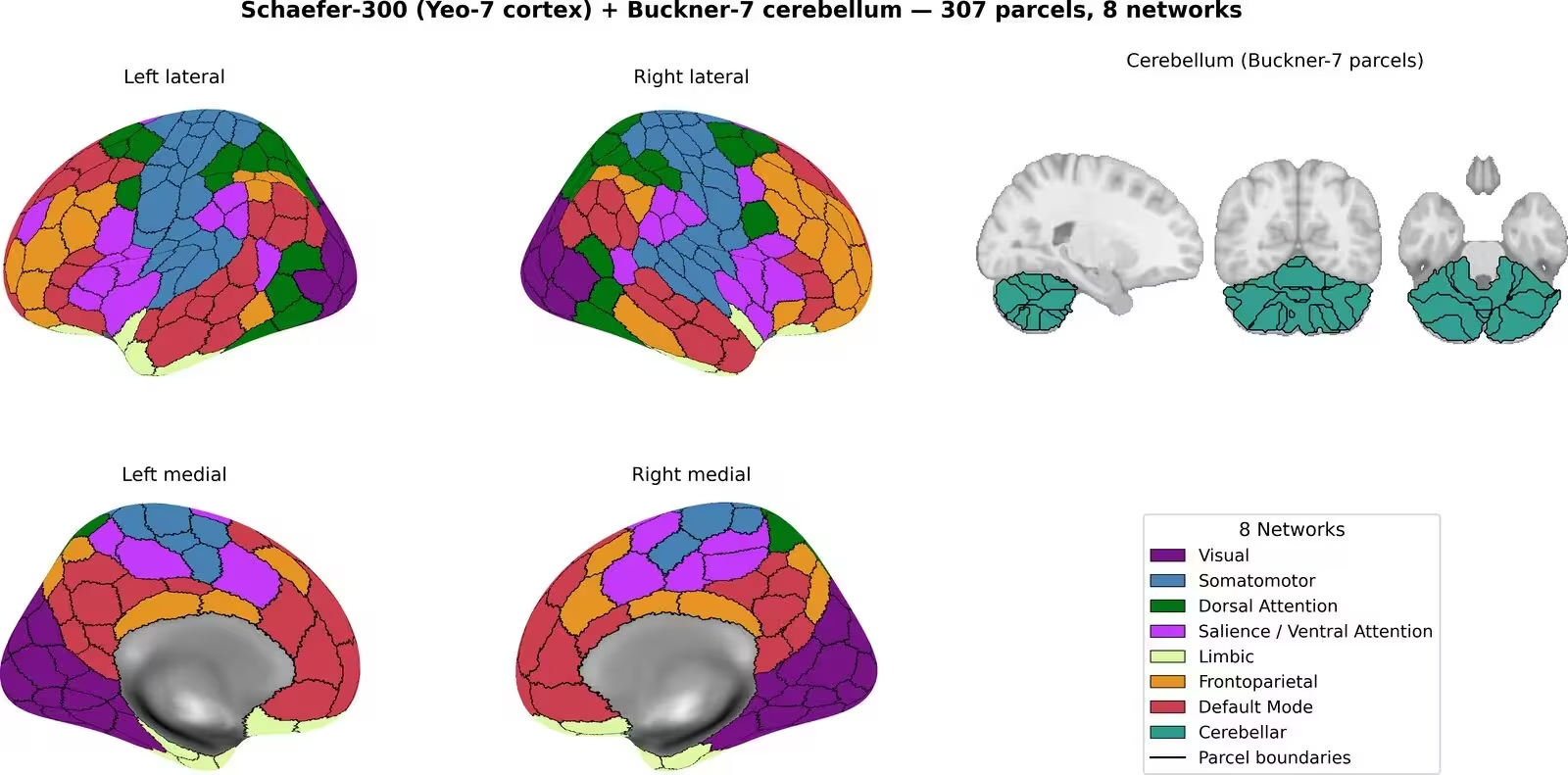
The study, published in Imaging Neuroscience, utilized linear mixed-effects models to separate cross-sectional age differences from longitudinal within-person changes across eight large-scale functional networks comprising 307 regions of interest. By tracking participants over time, the team could isolate genuine within-person aging trajectories from external background variables.
Widespread Reductions in Neural Synchronization
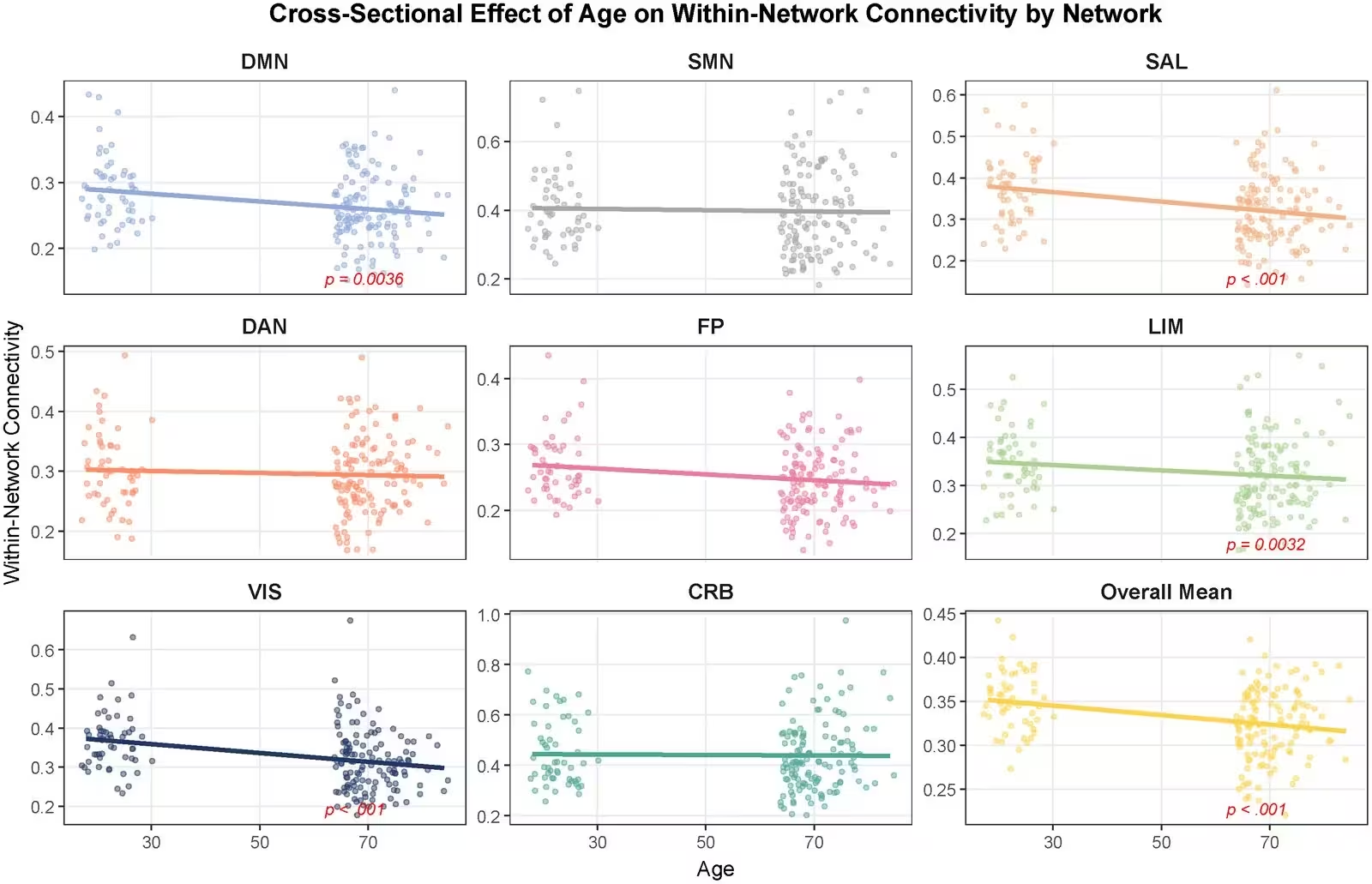
When analyzing the functional scans, the authors found significant longitudinal declines in both within-network and between-network connectivity. Specifically, within-network connectivity dropped significantly over time, with a negative trajectory appearing across seven of the eight tested networks. Similarly, between-network connectivity showed reliable longitudinal reductions across all eight large-scale networks.
These coupling decreases were especially prominent within specific brain circuits. The Default Mode Network, which handles resting-state introspection and memory processing, and the Salience Network, which helps detect important environmental stimuli and allocate attention, showed the most consistent vulnerability to aging across both cross-sectional and longitudinal analyses.
Challenging the Traditional Brain Dedifferentiation Model
Neuroscience theories have long suggested that aging causes brain networks to dedifferentiate, meaning that internal communication weakens while cross-network communication increases, leading to a loss of network segregation. However, the new longitudinal data challenge this traditional framework. Instead of observing rising cross-network chatter, researchers documented simultaneous declines in both internal and external connectivity paths.
Because network segregation represents a mathematical ratio comparing within-network strength to between-network strength, the index remained relatively stable over time. Within-network coupling declined at a slightly faster proportional rate of roughly 0.18 percent per year compared to a 0.15 percent annual drop for between-network coupling, causing minor downward drift in the ratio without showing true structural reorganization.
Methodological Nuances and Future Research Directions
The authors note several important limitations that accompany these findings. The study cohort featured a restricted age range with a gap in middle adulthood, and the older participant group possessed high educational attainment averaging 16.8 years, which may limit generalizability. Furthermore, head motion artifacts remain a persistent challenge in neuroimaging older populations, though the team applied rigorous spike regression and controlled for framewise displacement in all statistical models.
Ultimately, the results point to a general attenuation of brain connectivity rather than a selective redistribution of neural signals in later life. Future investigations featuring broader age brackets, continuous midlife sampling, and longer scan durations will help clarify individual trajectories and uncover how these broad neurobiological shifts connect to specific cognitive changes.
The research was published in Imaging neuroscience (Cambridge, Mass.) on November 16, 2026.
This article has been fact checked for accuracy, with information verified against reputable sources. Learn more about us and our editorial process.
Last reviewed on .
Article history
- Latest version
Reference(s)
- Zhou, Quan., et al. “Age-related changes in brain connectivity: Cross-sectional and longitudinal effects.” Imaging Neuroscience, vol. 4, November 16, 2026 MIT Press, doi: 10.1162/IMAG.a.1456. <https://doi.org/10.1162/IMAG.a.1456>.
- Posted by Hassan Raza