Wild Bats Shift Toward Social Spacing When Confronted With Obstacles
Behavioral tracking and computational modeling reveal how gray bats renegotiate navigational cues when flying through cluttered environments.
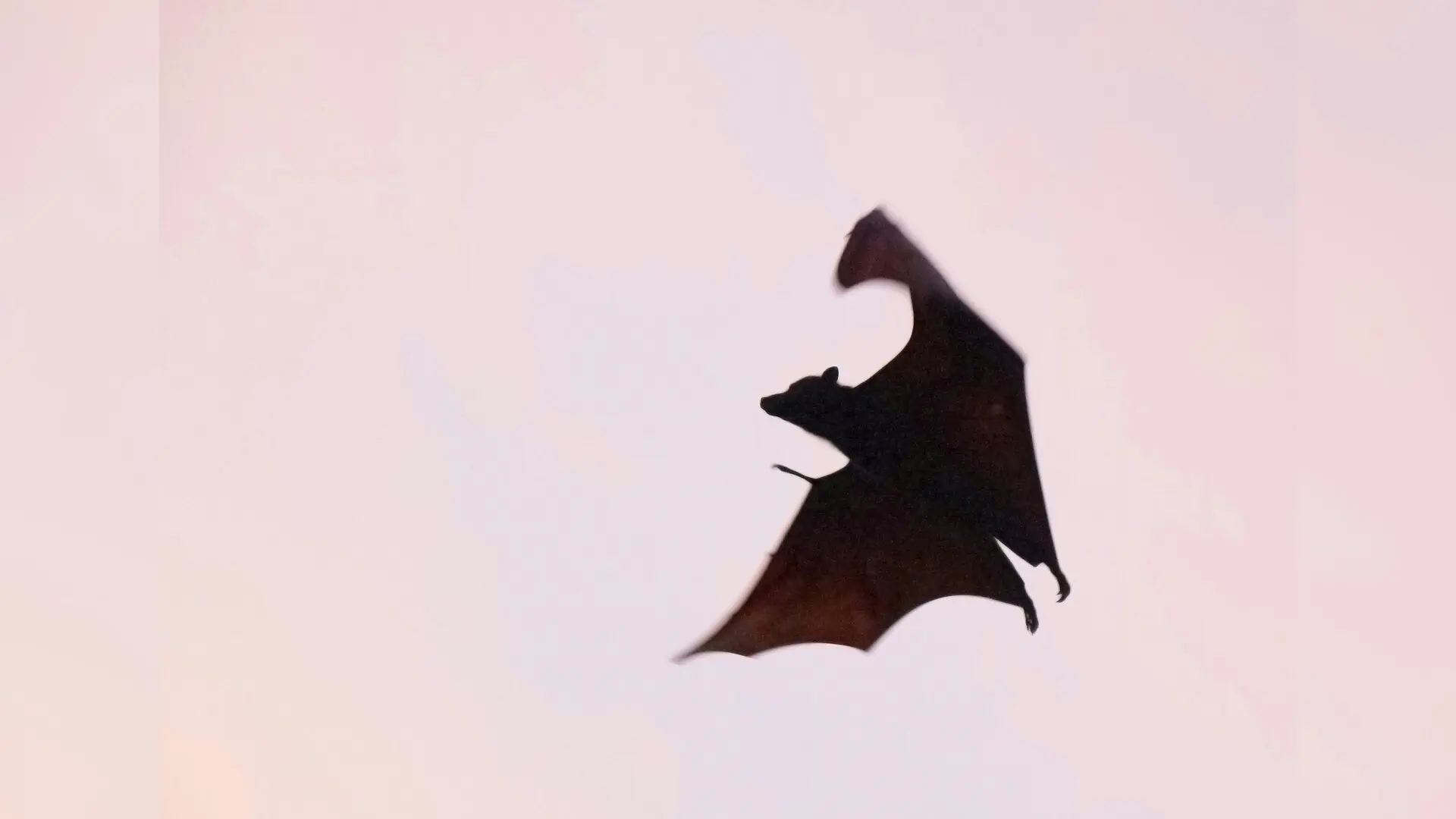
Gray bats alter their flight paths and rely more heavily on social cues when they encounter unfamiliar obstacles in their environment, according to a recent computational and behavioral analysis. Researchers tracked wild gray bats (Myotis grisescens) emerging from a culvert in Bristol, Virginia, and discovered that adding physical barriers to their flight path causes them to shift from standard wall-following habits toward stronger social spacing and avoidance maneuvers.
How Wild Bats Navigate Cluttered Environments
Animals moving in groups must constantly balance social signals with environmental information. When fish rely too much on their school, they miss external dangers, but focusing entirely on the environment can cause a group to fragment. For bats, this challenge is magnified by high flight speeds and the use of echolocation, an active sensory system where animals emit acoustic calls and listen for returning echoes. When many bats fly together, their echoes can overlap and create acoustic clutter, forcing them to find a balance between avoiding physical objects and maintaining coordination with neighbors.
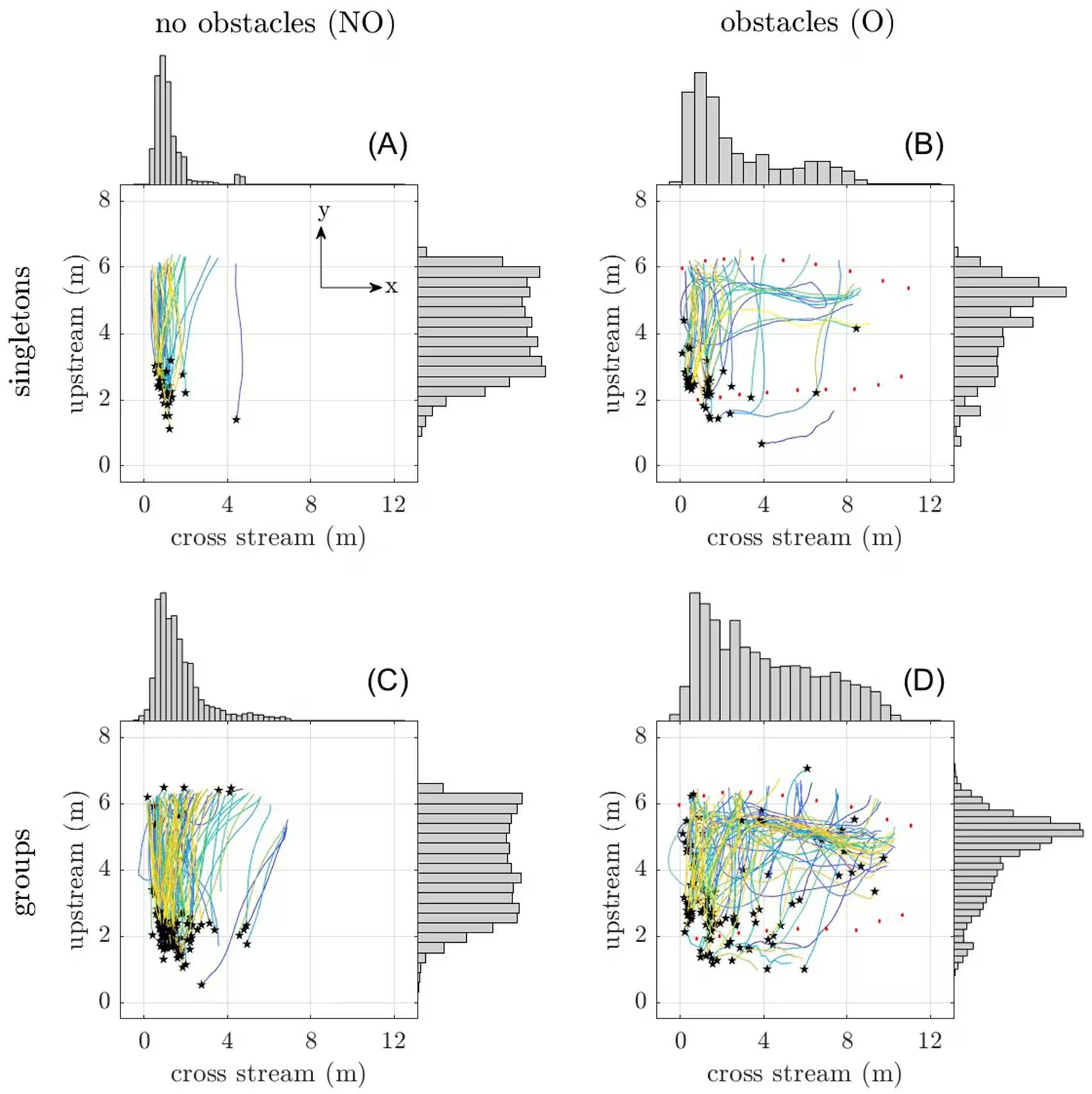
In 2022, researchers filmed a maternal colony of approximately 10,000 gray bats using infrared-sensitive cameras. Data were gathered across two consecutive nights. On the first night, the bats flew through their natural, unobstructed creek environment. On the second night, researchers placed two obstacle arrays made of foam pool noodles across the creek on nylon ropes to test how the animals adapted to novel clutter. The tracking data covered an imaged volume approximately 14 meters across the stream, 6 meters upstream, and 3 meters deep, capturing flight speeds, trajectories, and social groupings.
Statistical Insights Into Group Flight and Velocity
Analysis of the video data, published in PLOS Computational Biology, revealed distinct changes in flight dynamics when obstacles were introduced. A two-way analysis of variance showed significant effects of the experimental condition on all three velocity components. Singleton bats without obstacles tended to fly straight and stayed close to the left wall of the creek, a behavior known as thigmotaxis or wall-hugging. In contrast, bats flying in groups spread out significantly further across the stream, averaging 1.8 meters from the wall compared to 1.2 meters for singletons.
When obstacles were present, the bats reduced their median flight speed from 7 meters per second down to 5 meters per second, giving them more time to process sensory information. Linear mixed models showed that attraction and repulsive interactions between neighbors were present in both conditions, but flocking alignment was not statistically significant when obstacles cluttered the space. The findings indicate that obstacle avoidance is primarily expressed through horizontal motion changes in the cross-stream and upstream directions.
Testing Social Rules With Agent-Based Modeling
To understand how bats weigh these competing cues, researchers developed a two-dimensional agent-based model focusing on three core rules: channel-following, social repulsion from the nearest neighbor, and obstacle avoidance. The model was simulated with agents representing bats of 0.28-meter wingspans navigating a 14-meter-wide channel. By comparing simulated trajectories against experimental data using energy distance metrics, the team optimized the behavioral weights for both unobstructed and obstructed conditions.
The optimized parameters demonstrated a clear shift in priorities. In the open channel, channel-following behavior dominated social repulsion by an order of magnitude. When obstacles were introduced, the weight associated with social repulsion increased substantially, while channel-following decreased. This indicates that bats pay closer attention to social cues when navigating complex environments, utilizing spatial segregation to mitigate sensory noise and avoid collisions.
Limitations and Future Directions
While the study provides new insight into collective bat navigation, the authors note several limitations. The data were collected from a single colony over just two nights, meaning the observations reflect specific local conditions. Additionally, group-flight datasets involved contemporaneous individuals, creating a nested data structure where observations may not be entirely independent. Future work involving multiple colonies and expanded three-dimensional tracking will help test the broader robustness of these navigational models.
The research was published in PLOS Computational Biology on November 19, 2026.
This article has been fact checked for accuracy, with information verified against reputable sources. Learn more about us and our editorial process.
Last reviewed on .
Article history
- Latest version
Reference(s)
- Aung, Eighdi., et al. “Gray bats heighten their response to social cues when navigating group flight in environments with obstacles.” PLOS Computational Biology, vol. 22, no. 11, November 19, 2026, pp. e1014900 Public Library of Science (PLoS), doi: 10.1371/journal.pcbi.1014900. <https://doi.org/10.1371/journal.pcbi.1014900>.
- Posted by Priya Sharma