Why Male Amphibians Cram All Their Genetic Crossovers Into Chromosome Tips
A comparative analysis of 97 species suggests centromere position dictates where male and female chromosomes exchange DNA.
Amphibians pack their genetic reshuffling almost exclusively into the extreme ends of their chromosomes during male meiosis, leaving vast interior regions untouched. This peculiar pattern, known as spatial heterochiasmy, means that male and female frogs package their DNA in radically different ways before passing it on to the next generation. While female amphibians distribute their genetic crossovers evenly across entire chromosome arms, male amphibians concentrate theirs tightly near the telomeres, or chromosome tips.
To understand why this happens on a global scale, researchers recently compiled and analyzed cytogenetic data for 97 amphibian species, including 20 anuran and four non-anuran families. The team, consisting of Ezgi Unal, Paris Veltsos, and Wen-Juan Ma from the Vrije Universiteit Brussel in Belgium, available on the arXiv preprint server, evaluated how chromosome architecture shapes these sex-specific differences. Their comparative synthesis reveals that chromosome structure plays a decisive role in governing where genetic exchanges can physically take place.
What Drives Male Chromosomes to Crossover Only at the Tips?
For decades, biologists debated whether this extreme spatial restriction was an ancient trait or something that evolved repeatedly across different lineages. By reconstructing the evolutionary history of male chiasma location using a time-calibrated phylogenetic tree, the authors found that ancestral amphibians likely featured more interstitial recombination, with crossovers scattered along the middle of chromosomes. Over millions of years, terminal restriction evolved independently in multiple frog lineages, though the trait remains strongly structured by evolutionary relatedness.
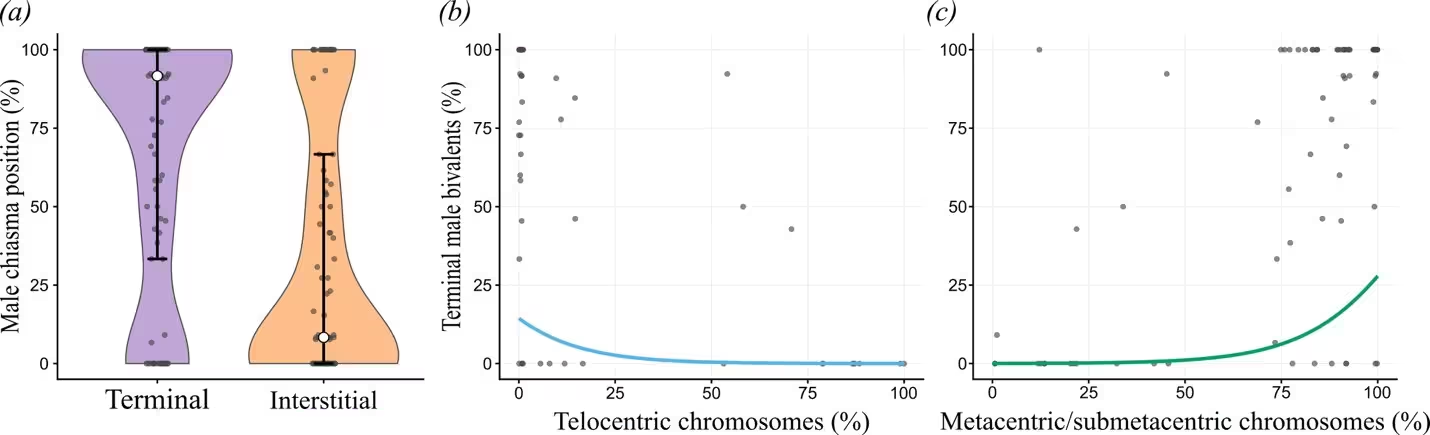
The researchers discovered that the strongest predictor of where male crossovers occur is chromosome morphology, specifically centromere position. Using phylogenetic generalized linear mixed models, they tested various genomic features across the 97 species. Species with a high proportion of telocentric chromosomes, which feature a centromere at the very edge of the chromosome, tend to retain interstitial male chiasmata. Conversely, karyotypes rich in metacentric or submetacentric chromosomes, which feature centrally positioned centromeres, show much stronger terminal localization.
How Does Chromosome Architecture Restrict Genetic Shuffling?
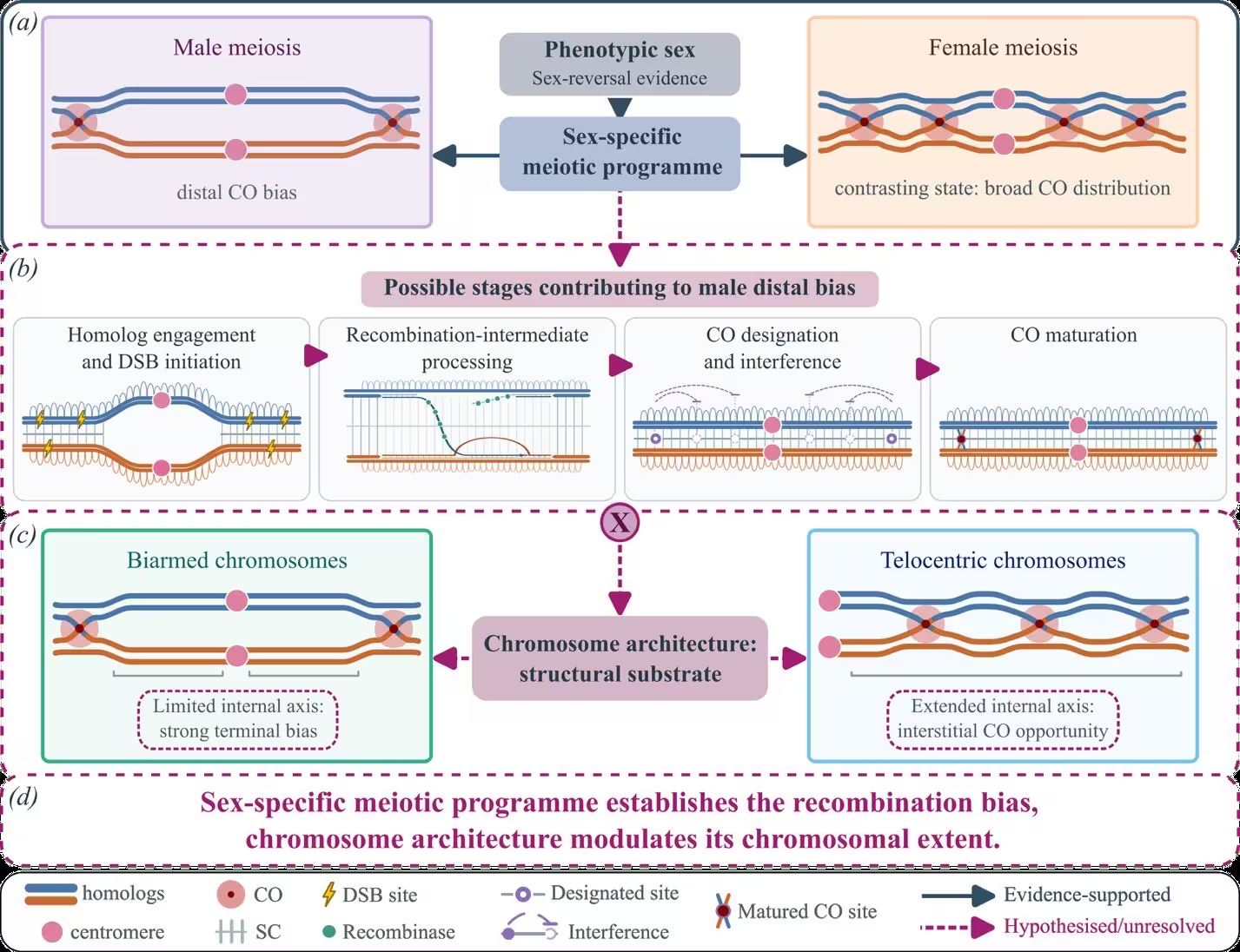
The authors propose a sequential model where a sex-specific meiotic program establishes an initial bias for crossover placement, while physical chromosome architecture modulates its final extent. When a centromere sits right in the middle of a biarmed chromosome, it divides the axis into two shorter arms and creates a central zone where crossover formation is suppressed. Combined with mechanical interference from distal events near the tips, this leaves little room for internal genetic exchanges, forcing male crossovers into the extreme ends.
By contrast, a telocentric chromosome provides one long, uninterrupted arm that can accommodate internal exchanges outside the interference zone of any terminal crossover. Interestingly, the team found no significant association between male chiasma localization and genome size, mean chromosome size, or haploid chromosome number once chromosome morphology was accounted for. Furthermore, comparisons across 40 species with characterized sex-determination systems revealed no statistical difference between male-heterogametic and female-heterogametic systems.
Why Do Phenotypic Sex Reversals Change Recombination Rules?
Evidence from species experiencing natural or artificial sex reversal indicates that spatial heterochiasmy follows phenotypic rather than genotypic sex. In species like the common frog, genetically male individuals that develop as females show broadly distributed recombination typical of normal females, whereas sex-reversed males show restricted terminal recombination. This suggests that the underlying sex-specific meiotic environment dictates the rules, while chromosome architecture simply dictates the physical boundaries.
These dynamics have profound implications for sex chromosome evolution. Pre-existing recombination landscapes can dictate how much of a chromosome becomes sex-linked when a new sex-determining locus arises. However, occasional sex reversal can also allow sex-linked regions to recombine during female meiosis, potentially rescuing degenerating chromosomes and maintaining homomorphy over evolutionary time scales.
The study was posted to the arXiv preprint server on November 25, 2026.
This article has been fact checked for accuracy, with information verified against reputable sources. Learn more about us and our editorial process.
Last reviewed on .
Article history
- Latest version
Reference(s)
- Unal, Ezgi. “The evolution of extreme spatial heterochiasmy in amphibians: interactions between sex-specific meiotic program and chromosome architecture.” arXiv.org <http://arxiv.org/abs/2611.33634v1>.
Cite this page:
- Posted by Linda Wilson