New Mathematical Framework Tracks Cell Birth and Death Across Tissues
Researchers develop a discrete transport model that successfully prevents cell proliferation from being misidentified as migration.

When tracking how cell populations evolve and multiply over time, traditional mathematical models often struggle because standard techniques assume total cell numbers remain constant. A team of researchers has developed a new mathematical framework called discrete Wasserstein-Fisher-Rao, or WFR, which explicitly accounts for cell birth and death alongside cell state transitions across discrete networks.
To reconstruct continuous time population dynamics from sparse snapshot observations without destroying individual cells during data collection, mathematicians must solve complex transport problems. While optimal transport models map how masses shift from one configuration to another, they typically preserve total mass. The study, published on the arXiv preprint server by Junda Ying, Xinyu Wang, Peijie Zhou, and Lei Zhang from Peking University, introduces an unbalanced transport extension that handles mass creation and destruction directly on graphs and discrete spaces.
How Does Discrete WFR Capture Cell Birth and Death?
The authors extended the dynamic Wasserstein-Fisher-Rao problem to discrete spaces by building on concepts from discrete flow matching. Instead of just moving existing cells around a network, the framework introduces state-dependent growth rates that reflect local proliferation and cell death. By analyzing travelling Dirac paths, which represent individual transport routes combined with mass adjustments, the researchers derived a closed-form solution for discrete WFR.
For exceptionally large state spaces where direct calculations become intractable, the team proposed an unbalanced discrete conditional flow matching objective. This numerical approximation method allows researchers to train neural networks against tractable conditional targets, learning the underlying Markovian reconstruction of the optimal flow without directly solving massive integrals.
Why Is Accounting for Growth Essential in Cellular Dynamics?
In biological tissues, cells constantly divide or die while shifting their gene expression profiles. To test the necessity of the WFR approach over balanced transport models, the authors evaluated both methods on a synthetic four-state system where one state underwent pure cell death and another experienced pure growth.
The analysis revealed that while balanced optimal transport managed to connect the snapshot observations, it did so by misinterpreting changes in total mass as massive amounts of spurious transport, assigning more than eighty percent of its interval flows to incorrect edges. In contrast, the WFR framework successfully isolated the true transport path with virtually zero false edge flows, proving that modeling growth rates prevents mathematical artifacts.
Can This Method Accurately Reconstruct Real Organism Development?
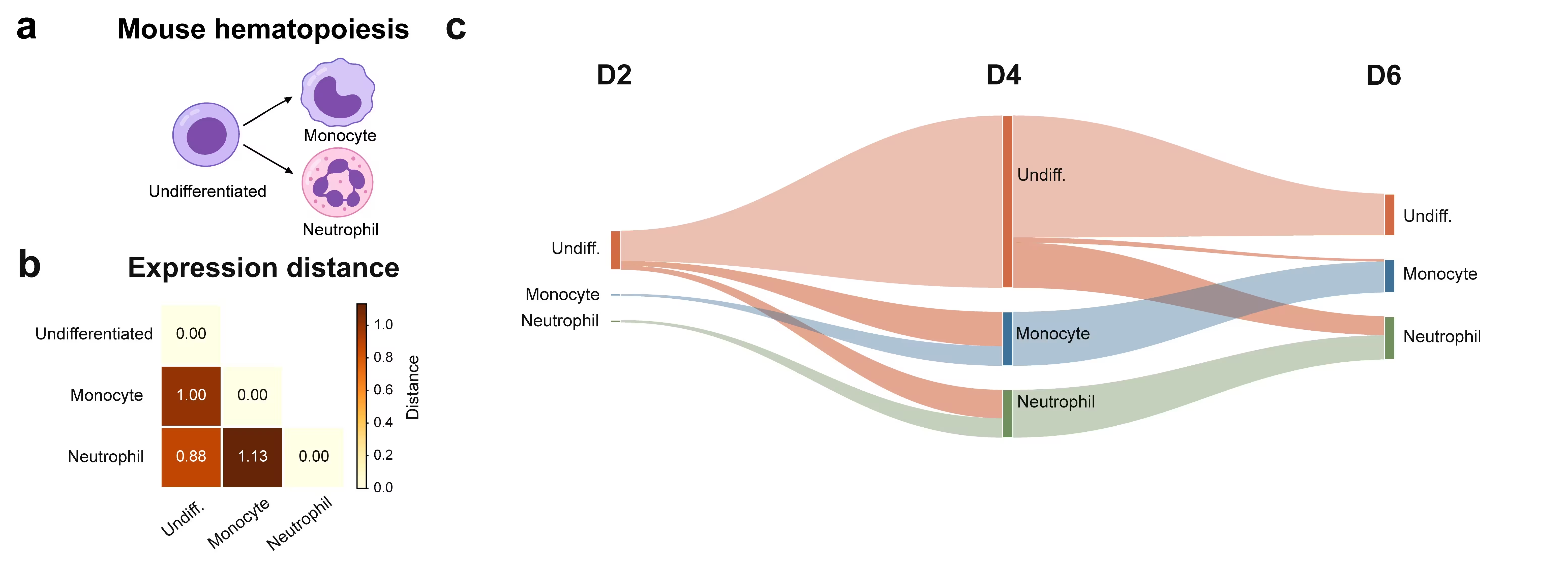
The research team put their algorithm, known as WFR-DFM, to the test across three biological datasets. When analyzing a mouse hematopoietic differentiation dataset containing over ninety-six thousand cells sampled across three time points, the model successfully recovered the known biological branching pattern where undifferentiated progenitors differentiate into monocytes and neutrophils.
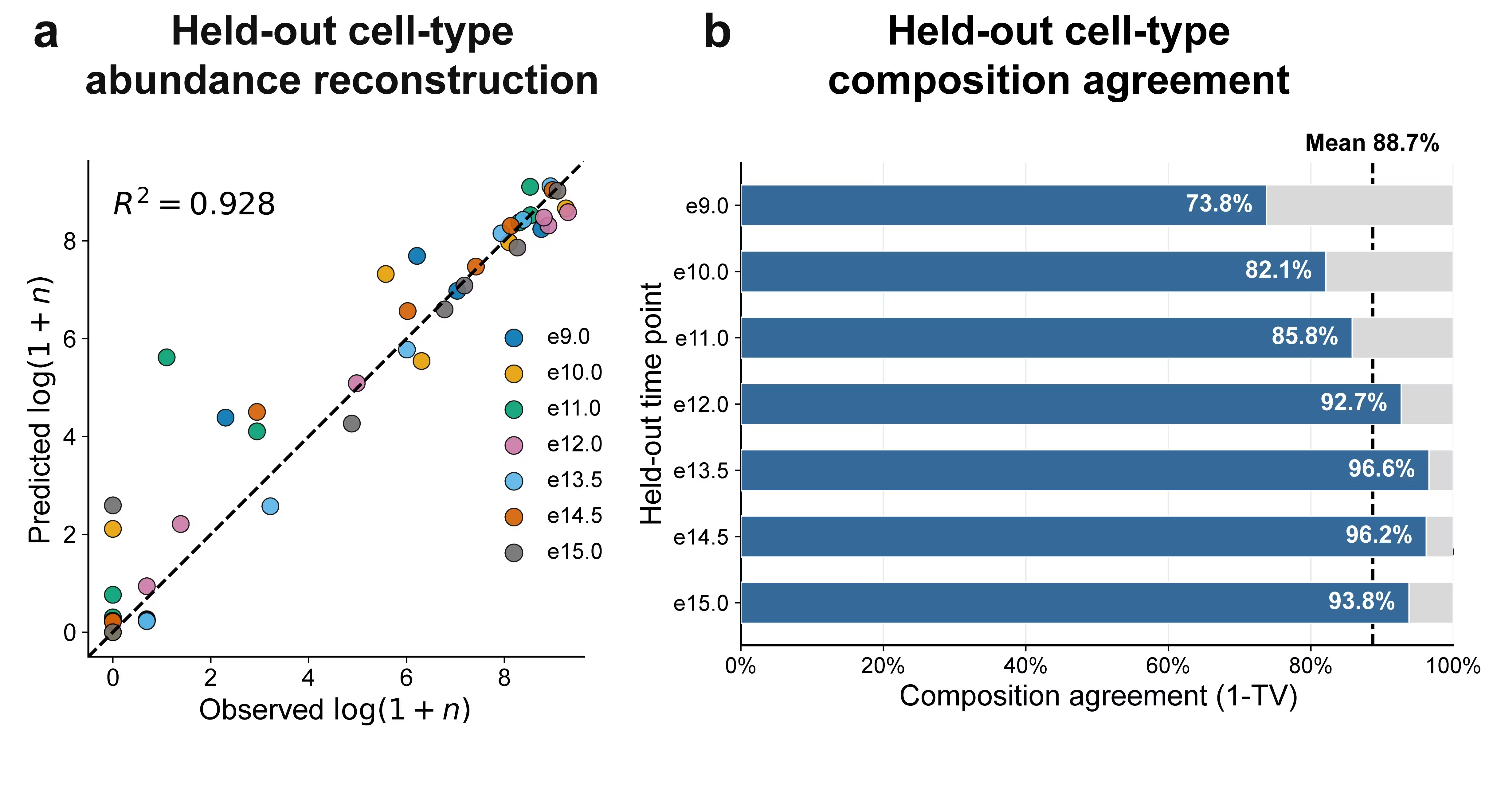
Furthermore, tests on a developing mouse brain dataset involving over one hundred twenty thousand cells demonstrated the model capability to perform temporal interpolation. By holding out entire observation time points, the framework accurately predicted cell type abundances and maintained high composition agreement with the actual observed data. The authors also established mathematical proofs showing that the discrete WFR framework remains stable and consistent under state aggregation, ensuring robustness even when cell annotations shift between fine and coarse resolutions.
The study was posted to the arXiv preprint server on November 25, 2026.
This article has been fact checked for accuracy, with information verified against reputable sources. Learn more about us and our editorial process.
Last reviewed on .
Article history
- Latest version
Reference(s)
- Ying, Junda. “Wasserstein-Fisher-Rao Reconstruction of Discrete space Population Dynamics.” arXiv.org <http://arxiv.org/abs/2611.33923v1>.
Cite this page:
- Posted by Omar Mirza