Vineyard Forest Edges Support Songbird Populations By Boosting Large Beetle Prey
A Napa Valley study reveals that woody borders and diverse local habitats drive insect-eating bird abundance indirectly through protein-rich prey.

Forest edges near vineyards play a vital role in supporting insect-eating birds by boosting the abundance of large beetles and flies that breeding parents desperately need to feed their hungry nestlings. A team of researchers discovered that while songbirds such as foliage-gleaning warblers and sparrows thrive near woody borders and diverse local plantings, their numbers are largely driven by the availability of protein-rich prey rather than the habitats alone.
How Vineyard Habitats Shape Bird Communities
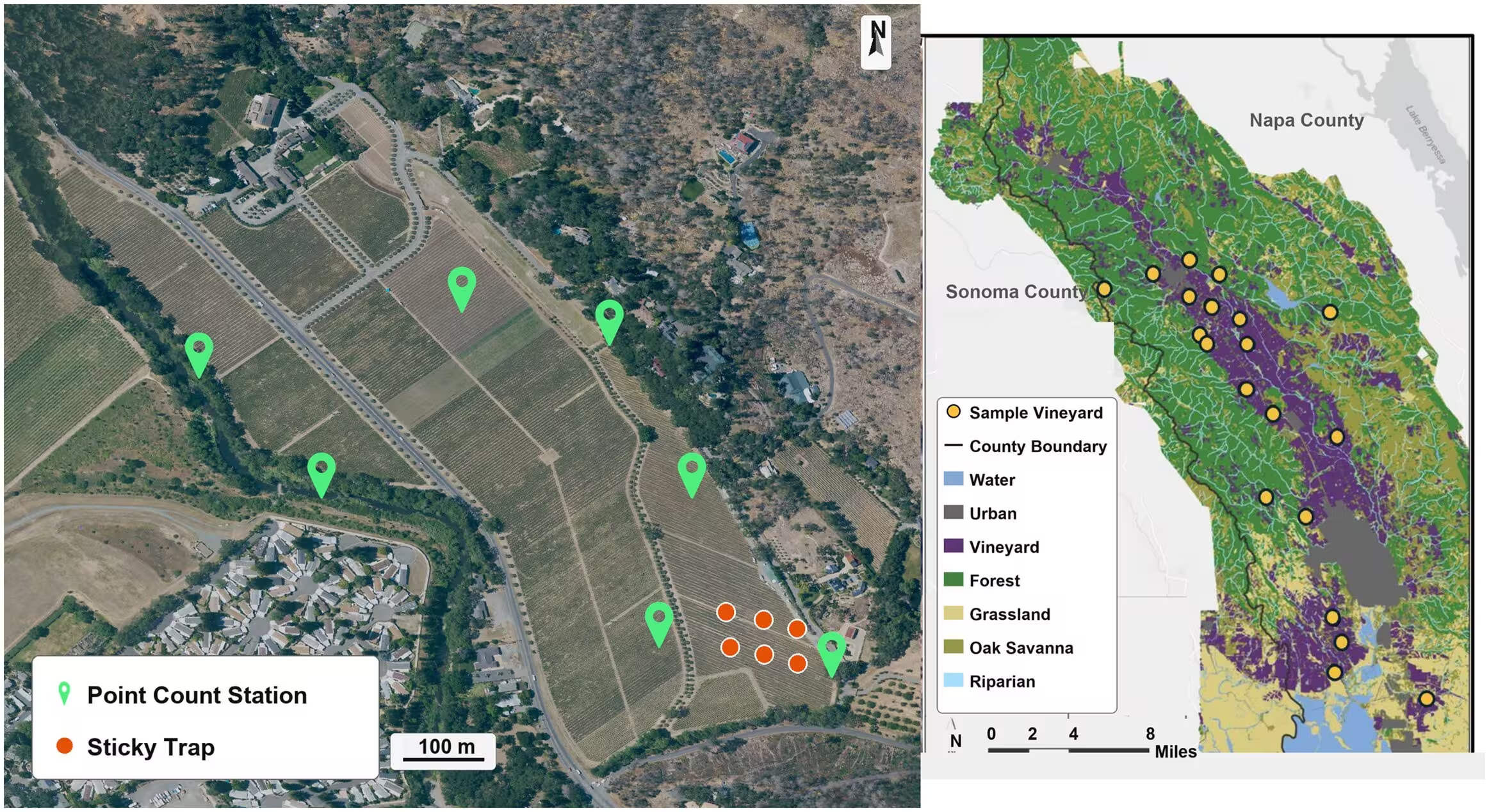
Agricultural conversion often simplifies natural landscapes, replacing diverse forests and grasslands with uniform crop monocultures that leave little room for wildlife. In California’s Napa Valley, researchers investigated whether local vineyard management and surrounding natural habitats influence both insect-eating birds and the arthropod communities they rely on. They paired bird surveys with sticky insect traps across 20 organic or near-organic vineyards during the spring and summer breeding seasons. The work is published in PLOS One.
The field surveys recorded 5,735 individual birds across 89 species during the monitoring period. Among these, breeding season insectivores accounted for nearly 4,000 detections, divided into aerial hunters and foliage-bark gleaners. The results revealed that foliage-bark gleaning birds were roughly 56 percent less abundant at survey points far from forests and riparian areas compared to points located close to those natural features. Furthermore, a one-unit increase in local habitat heterogeneity within a 50-meter radius was associated with an estimated 53 percent increase in expected gleaner abundance.
The Hidden Prey Connection Behind Bird Success
To understand why birds cluster near these complex habitats, the study analyzed nearly 160,356 individual arthropods captured on traps across the agricultural landscape. Thrips dominated the trap collections at 65.1 percent of individuals, followed by flies, true bugs, wasps, and beetles. When the scientists examined specific prey sizes, they found that forest proximity significantly boosted the numbers of large beetles and large flies, which generally offer higher caloric and biomass returns for foraging birds.
Advanced structural equation modeling confirmed that forest proximity did not act directly on the birds through mere spatial attraction. Instead, the habitat features operated indirectly by supporting large beetle populations, which subsequently drove up bird numbers. A similar indirect pathway linked broader landscape heterogeneity across a 1,000-meter radius to bird abundance through the increased availability of large flies.
Why Aerial Hunters Tell a Different Story
In contrast to foliage-gleaning birds, aerial insectivores such as swallows and swifts showed no clear statistical responses to the measured local habitat features or cover crop diversity. The researchers noted that aerial hunters forage across much wider airspaces that frequently extend well beyond standard point count boundaries. Their movements and hunting success are governed heavily by weather shifts, atmospheric conditions, and temporary insect swarms rather than fixed local vegetation structures.
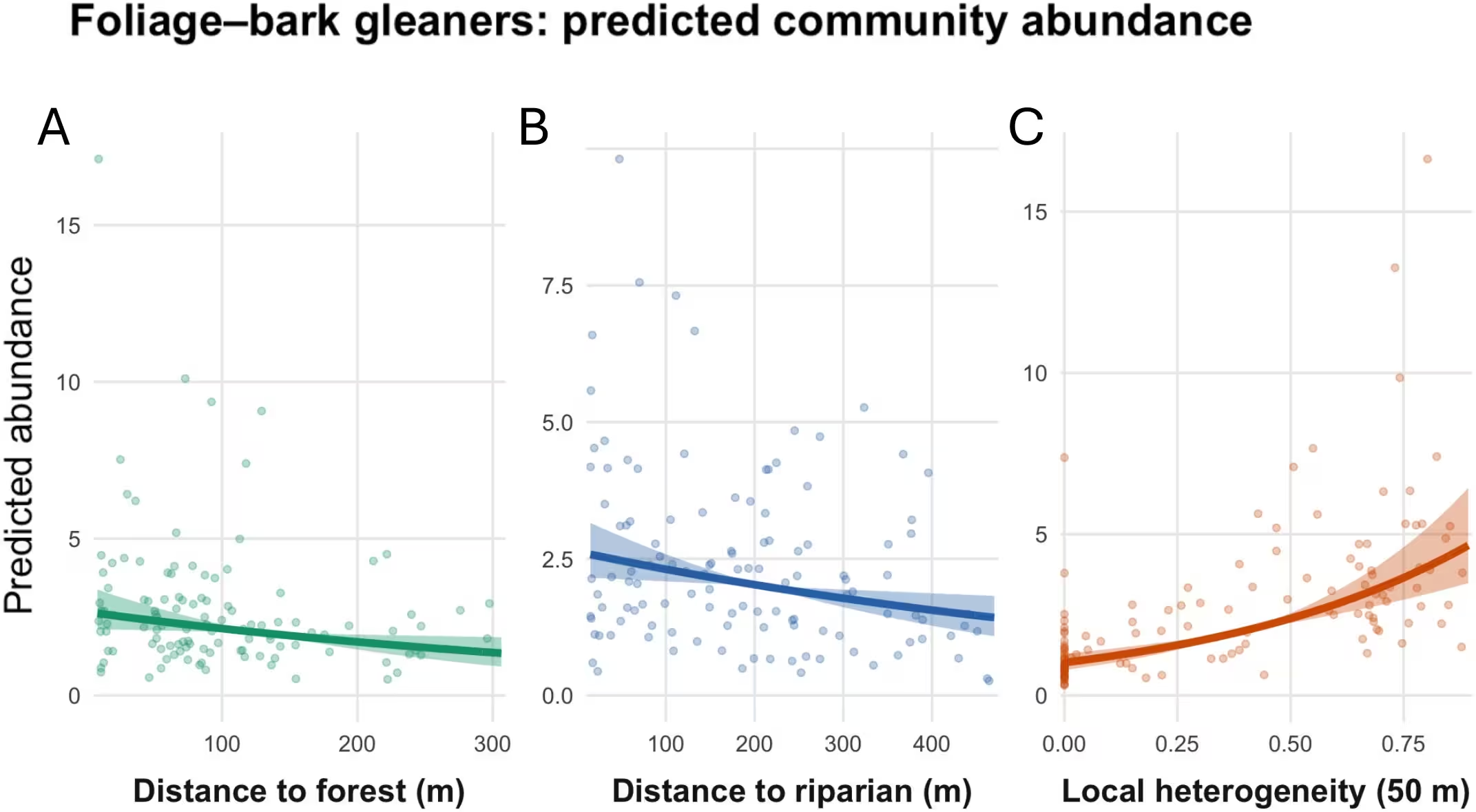
The cover crop diversification index, which measured inter-row vegetation height, composition, and extent, displayed weak main effects on canopy-dwelling arthropods and birds in this analysis. Because the sticky cards were mounted at vine cordon height, they primarily sampled canopy insects rather than ground-dwelling soil arthropods that might benefit more directly from complex groundcovers.
What These Findings Mean for Farmers
Vineyard managers often worry that maintaining natural habitats or woody edges will encourage crop-damaging wildlife, but previous research in the region indicates that proximity to uncultivated lands does not necessarily increase grape damage. Protecting riparian corridors, retaining shrubby borders, and fostering local structural diversity can help sustain beneficial arthropod communities while supporting insectivorous birds that may contribute to natural pest suppression.
The research was published in PLOS One on November 20, 2026.
This article has been fact checked for accuracy, with information verified against reputable sources. Learn more about us and our editorial process.
Last reviewed on .
Article history
- Latest version
Reference(s)
- MacDonald, Eleanor K.., et al. “Forest proximity and habitat heterogeneity support insectivorous birds and arthropods in California vineyards.” PLOS One, vol. 21, no. 11, November 20, 2026, pp. e0363054 Public Library of Science (PLoS), doi: 10.1371/journal.pone.0363054. <https://doi.org/10.1371/journal.pone.0363054>.
Cite this page:
- Posted by Linda Wilson