Environmental Noise Drives Rapid Respiratory Virus Evolution In Humans
Ecology

Environmental Noise Drives Rapid Respiratory Virus Evolution In Humans

New mathematical models reveal that external biological fluctuations shape viral genetics inside the host better than traditional population bottlenecks.
By Linda Wilson
Published:
Email this Article
Environmental Noise Drives Rapid Respiratory Virus Evolution In Humans
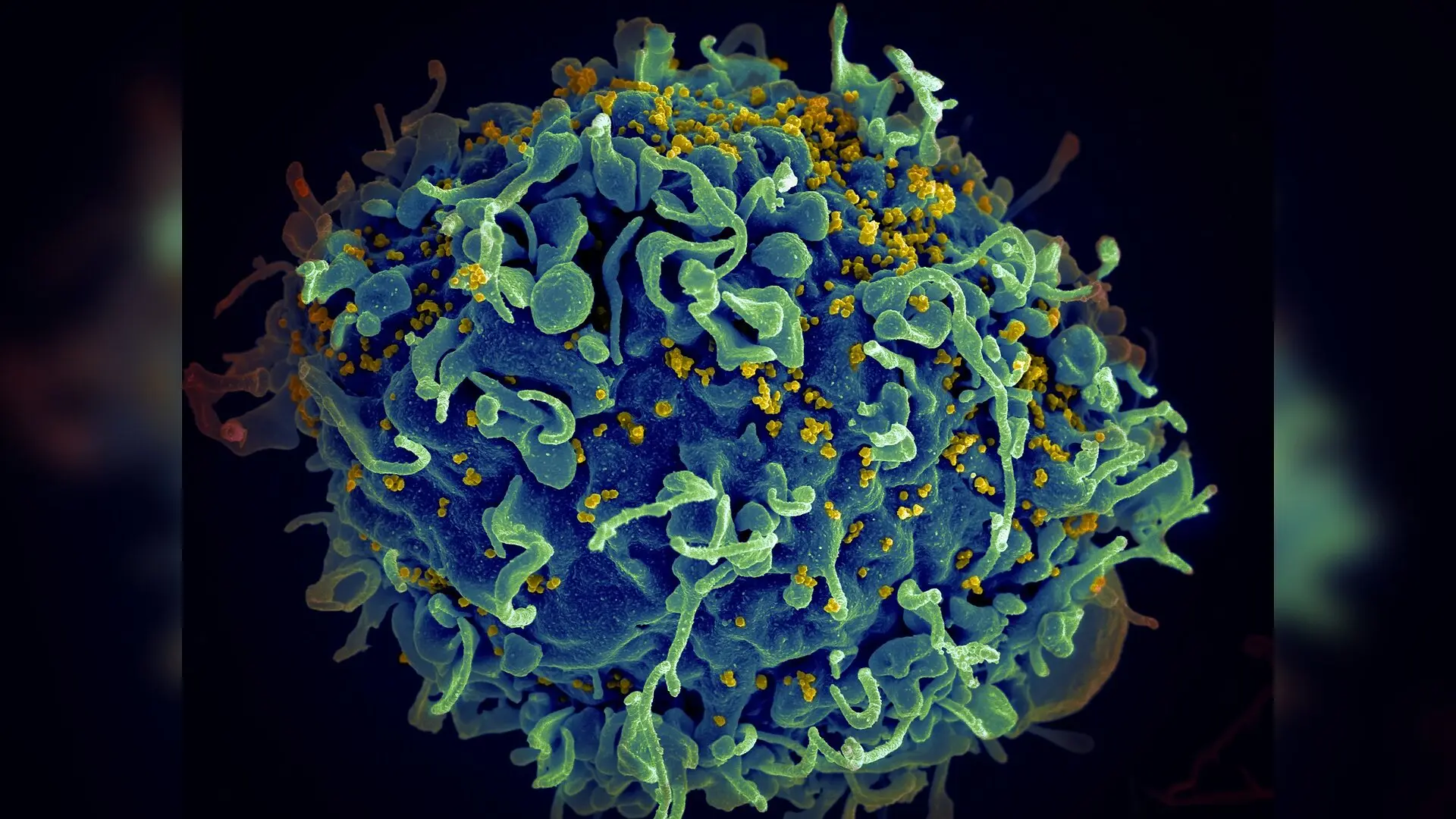
Photo by National Cancer Institute on Unsplash

When respiratory viruses like influenza and coronavirus multiply inside a human host, their genetic makeup shifts dramatically over the course of just a few days. Researchers have long debated why these genetic variants fluctuate so wildly, traditionally blaming random demographic drift in small populations. A team of scientists at Emory University now suggests that environmental noise, rather than population size bottlenecks, drives these rapid evolutionary changes during acute respiratory infections.

The study, published in Virus Evolution, tackles a long-standing puzzle in viral genetics. While mathematical models traditionally assume that genetic drift stems from demographic stochasticity, meaning random births and deaths in small populations, viral populations inside an infected person are actually massive. Census sizes scale up by orders of magnitude during an infection, making demographic drift an unlikely explanation for erratic gene shifts.

How Environmental Noise Reshapes Viral Populations

To solve this mismatch, researchers Wenfei F. Xiao, Mireille Farjo, Anice C. Lowen, and Katia Koelle developed new mathematical models incorporating environmental stochasticity. This type of noise stems from external physical and biological variables, such as mucus density, temperature variations, immune cell timing, and local interferon concentrations, which alter viral growth and clearance rates. When these environmental pressures fluctuate and affect circulating viral strains unevenly, allele frequencies can swing wildly within hours or days.
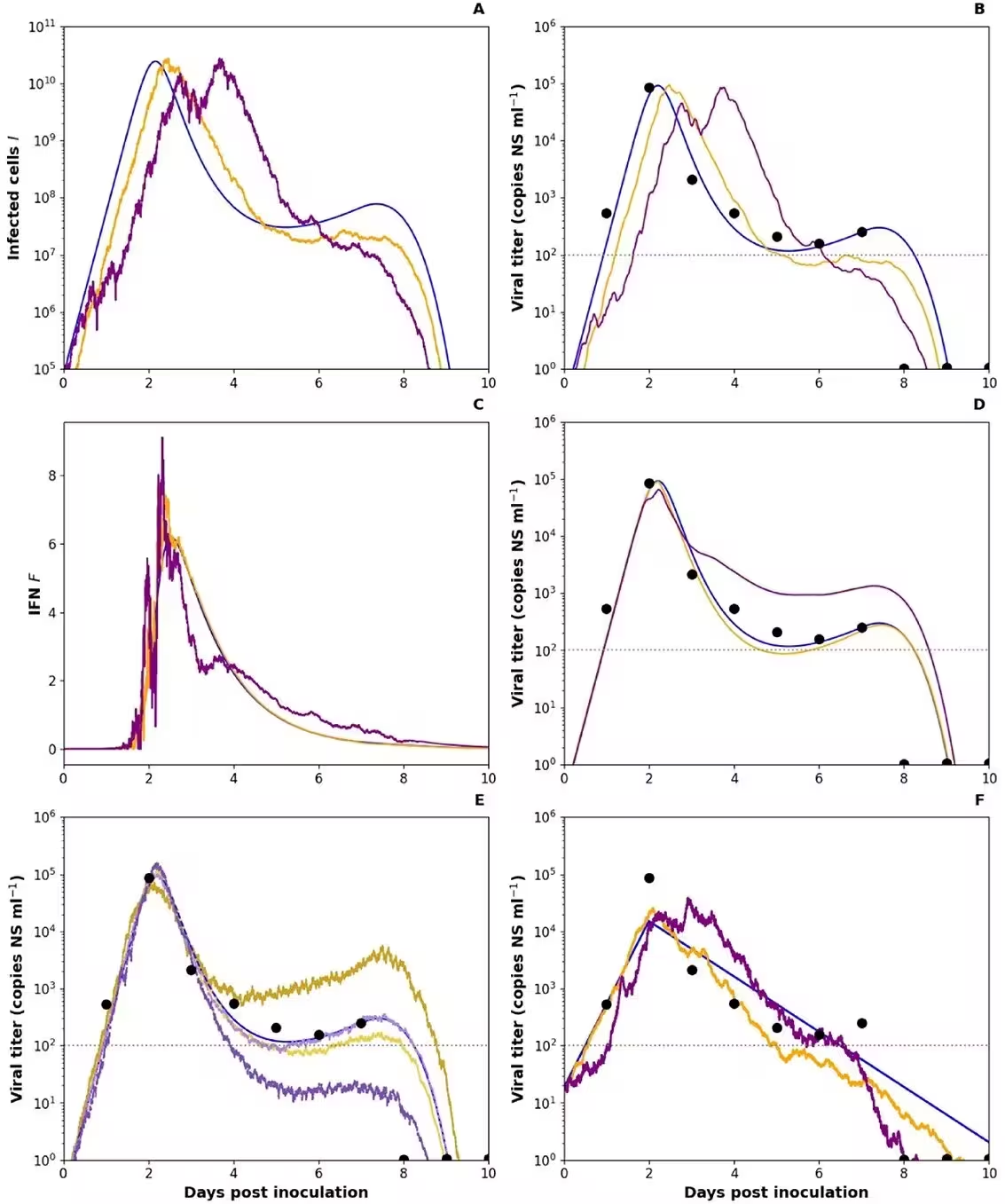
Figure 1: Simulated viral dynamics incorporating environmental stochasticity. (A) Simulated infected cell dynamics of the within-host model, implemented with environmental stochasticity in viral entry of target cells. The blue line has \documentclass[12pt]{minimal} \usepackage{amsmath} \usepackage{wasysym} \usepackage{amsfonts} \usepackage{amssymb} \usepackage{amsbsy} \usepackage{upgreek} \usepackage{mathrsfs} \setlength{\oddsidemargin}{-69pt} \begin{document} $\epsilon _\beta = 0.0$\end{document} (no noise). The orange line has \documentclass[12pt]{minimal} \usepackage{amsmath} \usepackage{wasysym} \usepackage{amsfonts} \usepackage{amssymb} \usepackage{amsbsy} \usepackage{upgreek} \usepackage{mathrsfs} \setlength{\oddsidemargin}{-69pt} \begin{document} $\epsilon _\beta = 5 \times 10^{-7}$\end{document} (low noise). The purple line shows a simulation has \documentclass[12pt]{minimal} \usepackage{amsmath} \usepackage{wasysym} \usepackage{amsfonts} \usepackage{amssymb} \usepackage{amsbsy} \usepack
Simulated viral dynamics incorporating environmental stochasticity. (A) Simulated infected cell dynamics of the within-host model, implemented with environmental stochasticity in viral entry of target cells. The blue line has \documentclass[12pt]{minimal} \usepackage{amsmath} \usepackage{wasysym} \usepackage{amsfonts} \usepackage{amssymb} \usepackage{amsbsy} \usepackage{upgreek} \usepackage{mathrsfs} \setlength{\oddsidemargin}{-69pt} \begin{document} $\epsilon _\beta = 0.0$\end{document} (no noise). The orange line has \documentclass[12pt]{minimal} \usepackage{amsmath} \usepackage{wasysym} \usepackage{amsfonts} \usepackage{amssymb} \usepackage{amsbsy} \usepackage{upgreek} \usepackage{mathrsfs} \setlength{\oddsidemargin}{-69pt} \begin{document} $\epsilon _\beta = 5 \times 10^{-7}$\end{document} (low noise). The purple line shows a simulation has \documentclass[12pt]{minimal} \usepackage{amsmath} \usepackage{wasysym} \usepackage{amsfonts} \usepackage{amssymb} \usepackage{amsbsy} \usepack Credit: Wenfei F Xiao et al. / Virus evolution

The team tested their theoretical framework by analyzing deep-sequencing data from human influenza A virus patients and severe acute respiratory syndrome coronavirus 2 (SARS-CoV-2) patients. By converting longitudinal variant frequencies into a dimensionless log-ratio variable, the authors created a Brownian motion diffusion model that tracks evolutionary changes independently of total viral titers.

Why Environmental Models Outperform Traditional Genetic Drift

The statistical analysis revealed that the environmental noise model matched empirical observations from human influenza and coronavirus infections significantly better than the classic Wright-Fisher model of demographic drift. When the researchers compared the probability distributions of variant frequency changes using Kolmogorov-Smirnov tests, the environmental stochasticity model showed no significant statistical difference from real patient data.

Furthermore, the team incorporated measurement noise into their framework to account for sequencing errors. Their simulations showed that even when measurement error was high, the model successfully recovered true environmental noise parameters without biasing the results.
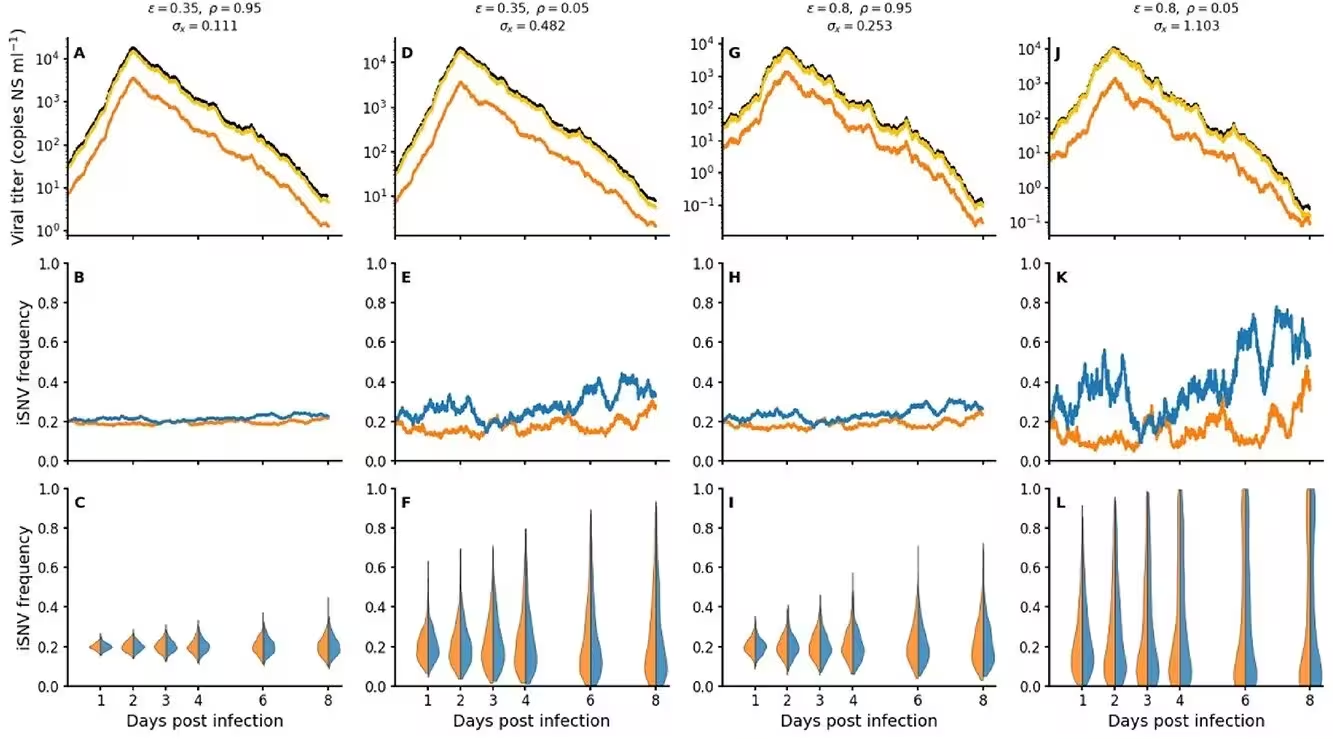
Figure 2: Simulated two-strain viral population dynamics and evolutionary dynamics. Columns correspond to different ε and ρ parameterizations. (A,D,G,J) Viral titers from simulations of the two-strain piecewise exponential model. Titers are shown separately for the two strains (strain 1 in yellow and strain 2 in orange) as well as overall (in black, \documentclass[12pt]{minimal} \usepackage{amsmath} \usepackage{wasysym} \usepackage{amsfonts} \usepackage{amssymb} \usepackage{amsbsy} \usepackage{upgreek} \usepackage{mathrsfs} \setlength{\oddsidemargin}{-69pt} \begin{document} $V_{1} + V_{2}$\end{document}). Parameter values for ε and ρ are shown in the panel titles. (B,E,H,K) Frequency changes of strain 2, calculated from corresponding panels (A,D,G,J) using equation (9) (orange lines), alongside frequency changes of strain 2 from a simulation of the Brownian motion model (equation (12); blue lines) with the same initial condition, using \documentclass[12pt]{minimal} \usepackage{amsmath} \usepacka
Simulated two-strain viral population dynamics and evolutionary dynamics. Columns correspond to different ε and ρ parameterizations. (A,D,G,J) Viral titers from simulations of the two-strain piecewise exponential model. Titers are shown separately for the two strains (strain 1 in yellow and strain 2 in orange) as well as overall (in black, \documentclass[12pt]{minimal} \usepackage{amsmath} \usepackage{wasysym} \usepackage{amsfonts} \usepackage{amssymb} \usepackage{amsbsy} \usepackage{upgreek} \usepackage{mathrsfs} \setlength{\oddsidemargin}{-69pt} \begin{document} $V_{1} + V_{2}$\end{document}). Parameter values for ε and ρ are shown in the panel titles. (B,E,H,K) Frequency changes of strain 2, calculated from corresponding panels (A,D,G,J) using equation (9) (orange lines), alongside frequency changes of strain 2 from a simulation of the Brownian motion model (equation (12); blue lines) with the same initial condition, using \documentclass[12pt]{minimal} \usepackage{amsmath} \usepacka Credit: Wenfei F Xiao et al. / Virus evolution

Can Natural Selection Still Occur Amidst Environmental Chaos?

A critical question raised by the new model is whether natural selection can still function when random environmental noise is so intense. To find out, the authors extended their framework into an Arithmetic Brownian Motion model incorporating fitness advantages and disadvantages.

The simulations demonstrated that beneficial variants with a growth rate advantage of one day can still rise in frequency over a three-day window, despite high environmental noise. Similarly, deleterious variants typically decline, meaning purifying selection remains fully operational. However, high environmental noise reduces the probability that rare advantageous mutations will cross detection thresholds, helping explain why positive selection is often difficult to spot in natural acute infections.

The research was published in Virus evolution on November 17, 2026.

Fact Checked

This article has been fact checked for accuracy, with information verified against reputable sources. Learn more about us and our editorial process.

Last reviewed on .

Article history

  • Latest version

Reference(s)

  1. Xiao, Wenfei F., et al. “Environmental stochasticity can account for patterns of within-host respiratory virus evolution.” Virus Evolution, vol. 12, no. 1, November 17, 2026 Oxford University Press (OUP), doi: 10.1093/ve/veag065. <https://doi.org/10.1093/ve/veag065>.

Cite this page:

Wilson, Linda. “Environmental Noise Drives Rapid Respiratory Virus Evolution In Humans.” BioScience. BioScience ISSN 2521-5760, 21 November 2026. <https://www.bioscience.com.pk/en/subject/ecology/environmental-stochasticity-can-account-for-patterns-of-within-host-respiratory-virus-evolution>. Wilson, L. (2026, November 21). “Environmental Noise Drives Rapid Respiratory Virus Evolution In Humans.” BioScience. ISSN 2521-5760. Retrieved November 21, 2026 from https://www.bioscience.com.pk/en/subject/ecology/environmental-stochasticity-can-account-for-patterns-of-within-host-respiratory-virus-evolution Wilson, Linda. “Environmental Noise Drives Rapid Respiratory Virus Evolution In Humans.” BioScience. ISSN 2521-5760. https://www.bioscience.com.pk/en/subject/ecology/environmental-stochasticity-can-account-for-patterns-of-within-host-respiratory-virus-evolution (accessed November 21, 2026).
End of the article