Shaoyang University Researchers Simulate Alloy Nanoffluid Flow, And Reveal How Magnetic Fields Alter Heat Transfer
An integrated neural network and numerical model shows how alloy nanoparticles and magnetic fields reshape fluid dynamics.
Researchers led by Liaqat Ali at Shaoyang University have simulated the magnetic and thermal behavior of a specialized hybrid fluid composed of AA 7072 and AA 7075 aluminum alloy nanoparticles suspended in water, uncovering how magnetic fields and surface stretching alter heat transfer efficiency by up to 47.6%.
The study examines magnetohydrodynamic fluid dynamics, a field that studies how magnetic fields influence electrically conducting liquids. In industrial manufacturing, cooling systems must rapidly dissipate extreme heat during metal extrusion and thermal processing. Traditional fluids often struggle to maintain uniform temperatures under high-stress conditions. By introducing metallic nanoparticles into a base liquid, engineers create what is known as a nanofluid, which significantly boosts thermal conductivity. Mixing two different nanoparticle types creates a hybrid fluid with cooperative thermal properties.
For years, engineers relied solely on standard numerical solvers to predict how these complex fluids move across stretching surfaces and through porous boundaries. Now, the research team has integrated artificial neural networks to map out flow profiles and thermal responses almost instantly, matching traditional physics calculations with an error rate below 0.5%. The findings were published in Discover Nano.
How Magnetic Fields Slow Down Fluid Velocity
When an electrically conducting liquid flows past a stretching cylinder under a magnetic field, it encounters a retarding force known as the Lorentz force. The authors observed that increasing the magnetic parameter from 1 to 4 reduced fluid velocity while driving up surface skin friction by roughly 44.0% for mono fluids and 47.6% for hybrid mixtures. This occurs because the magnetic field interacts with the charged particles within the fluid, generating internal resistance that dampens momentum.
The team also evaluated the Weissenberg number, a dimensionless metric used to describe the elasticity of non-Newtonian liquids that experience changes in viscosity under shear stress. Raising this parameter from 0.01 to 0.04 produced a velocity surge of 114.9% for mono nanofluids and 109.4% for hybrid variants. The physical elasticity of the fluid allows it to store and release mechanical energy, counteracting some of the drag imposed by surface friction.
Controlling Thermal Profiles With Heat Sources and Suction
Temperature distribution within the boundary layer depends heavily on internal heat generation and fluid suction rates. When internal heat generation was positive, the thermal energy added to the system created a more uniform temperature profile and lowered the overall temperature gradient. Conversely, negative heat generation removed thermal energy and sharpened temperature gradients across the cylinder interface.
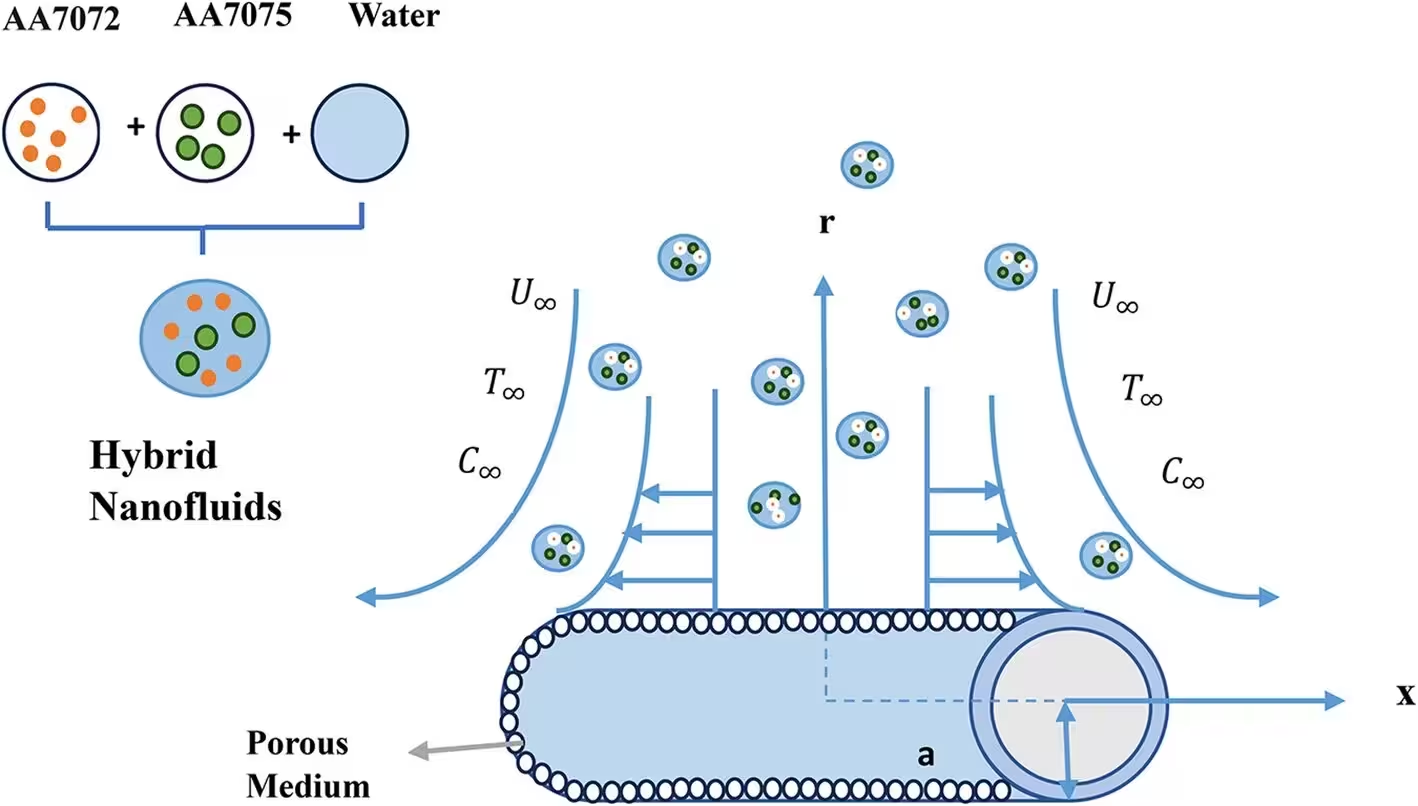
Fluid suction, represented by positive values of the suction parameter, drew the moving liquid closer to the cylinder wall. This action reduced the thickness of the thermal boundary layer and altered the convective heat transfer coefficient. The authors noted that higher Prandtl numbers, which measure the ratio of momentum diffusivity to thermal diffusivity, consistently lowered fluid temperatures by restricting heat diffusion.
Validating Predictions With Artificial Neural Networks
To bypass the heavy computational demands of solving intricate differential equations repeatedly, the investigators trained a feed-forward back-propagation neural network. Using a Levenberg-Marquardt algorithm, the network learned the nonlinear relationships governing the system from a dataset generated by the bvp4c numerical solver. The architecture utilized 10 hidden neurons with sigmoid activation functions and achieved a high degree of correlation.
The trained model successfully approximated skin friction coefficients, Nusselt numbers representing heat transfer rates, and Sherwood numbers representing mass transfer rates without repeatedly executing the primary differential equations. The authors note that while the neural network offers a rapid predictive tool, its accuracy remains bound to the parameter ranges of the original training data. Future investigations could expand these models by incorporating experimental datasets and additional physical variables such as radiative heat transfer.
The research was published in Discover nano on November 26, 2026.
This article has been fact checked for accuracy, with information verified against reputable sources. Learn more about us and our editorial process.
Last reviewed on .
Article history
- Latest version
Reference(s)
- Ali, Liaqat., et al. “Neural network driven analysis investigates the MHD tangent hyperbolic hybrid nanofluid AA7072 and AA7075 flow over a stretching cylinder under the impact of suction and heat source.” Discover Nano, vol. 21, no. 1, November 26, 2026 Springer Science and Business Media LLC, doi: 10.1186/s11671-026-05150-z. <https://doi.org/10.1186/s11671-026-05150-z>.
Cite this page:
- Posted by Michael Ellison