Researchers Calculate Missing Bear Bone Offsets, And Reveal How Wild Diets Leave Chemical Clues
By analyzing 205 wild brown bears and ancient remains, scientists bypassed captive feeding trials to calculate missing bone isotope offsets.
Ecologists studying the remote forests of Hokkaido Island have calculated missing chemical offsets for wild brown bears, measuring values of 5.2‰ for carbon and 3.6‰ for nitrogen in bone tissue. Jun Matsubayashi and colleagues at Fukui Prefectural University published their findings in Ecology and Evolution, offering a novel mathematical approach for large mammals where controlled laboratory feeding trials are practically impossible.
Why Is Measuring Bear Diets So Difficult?
Stable isotope analysis relies on comparing the chemical signatures found in an animal body with the foods it consumes. Researchers measure ratios of carbon and nitrogen isotopes, which are variant forms of chemical elements, to reconstruct what creatures eat over long periods. Bone collagen is especially valuable because it turns over very slowly, preserving a multi-year dietary history in skeletal remains. However, organic tissues do not match food signatures perfectly. The chemical offset between a diet and a specific body part is known as a trophic discrimination factor.
For decades, scientists calculated these conversion factors by keeping captive animals on strict, unchanging diets for years. For massive, dangerous carnivores like the brown bear (Ursus arctos), housing individuals under such controlled laboratory conditions is logistically unfeasible. As a result, bone collagen offset values for large wild omnivores remained largely unknown. This forced archaeologists and wildlife biologists to rely on generic conversion numbers borrowed from completely different animal species.
How Did Researchers Bypass Laboratory Feeding Trials?
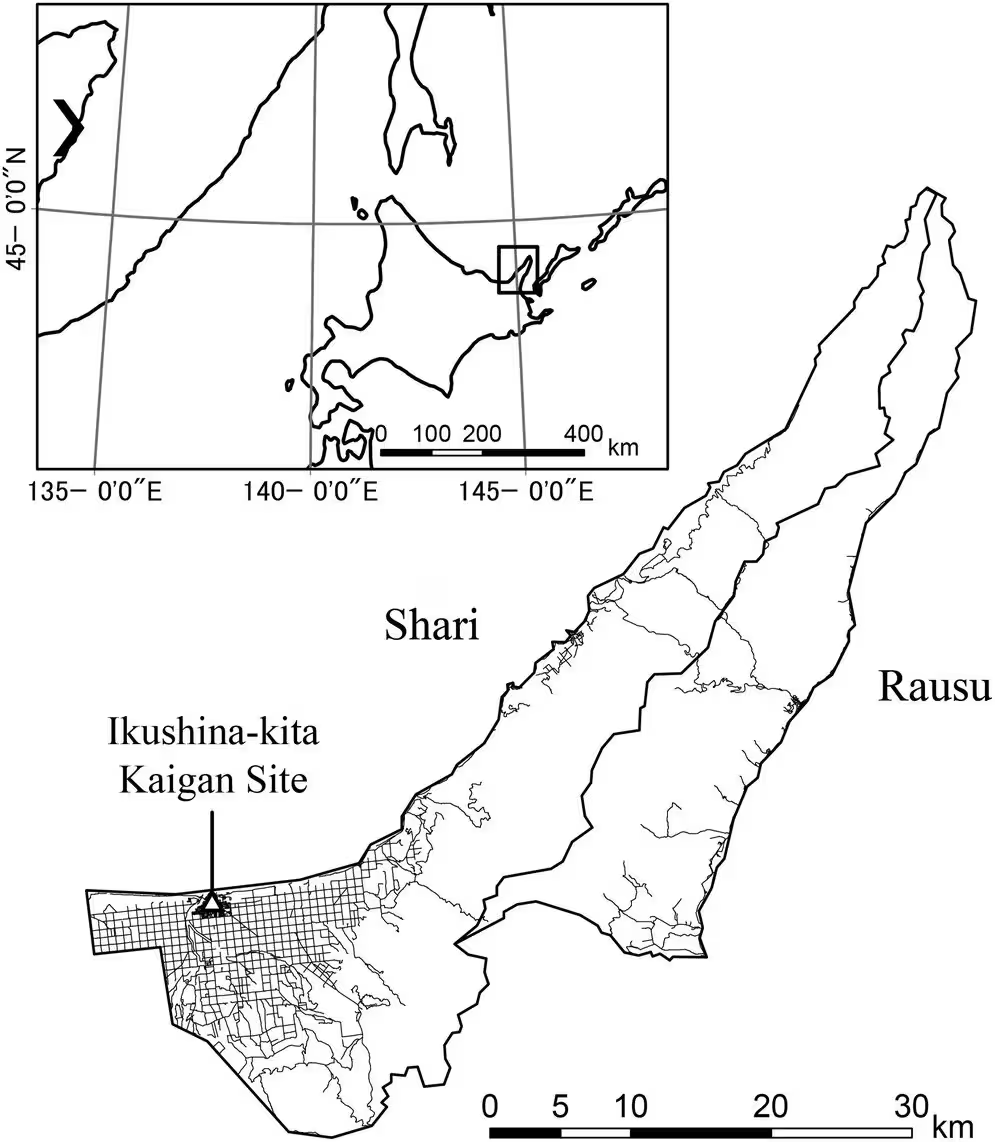
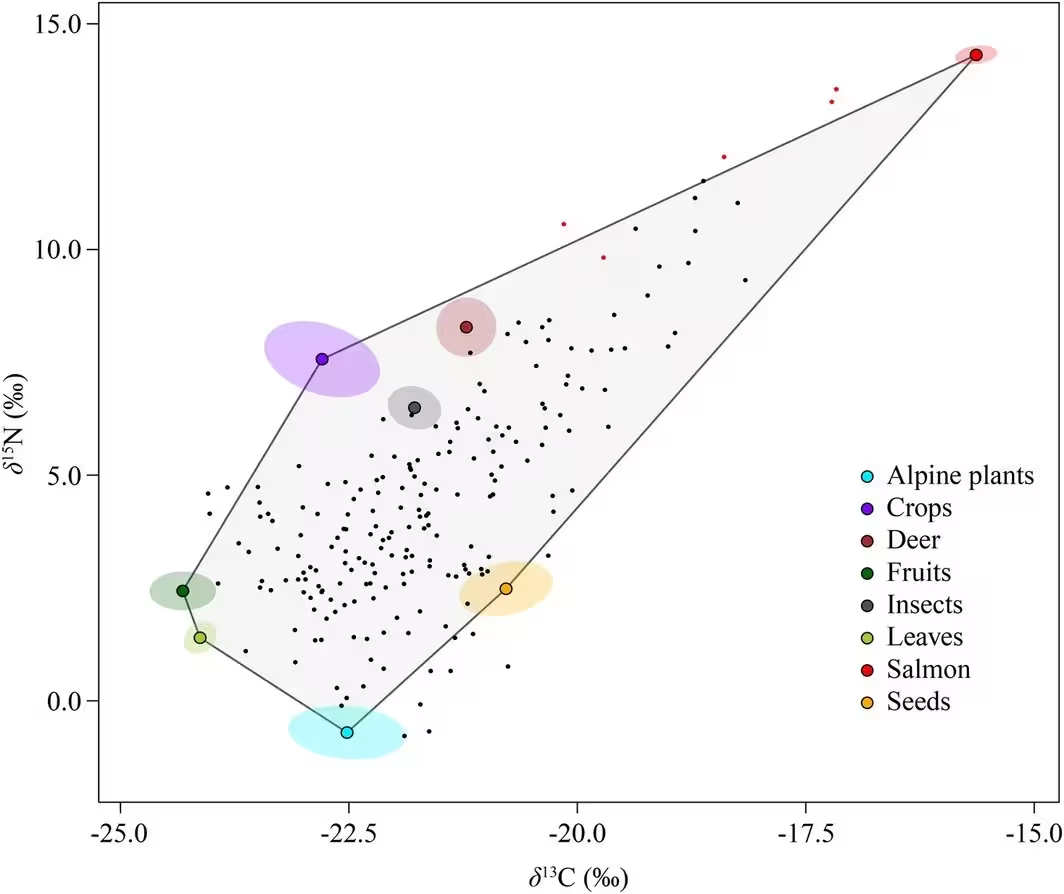
To solve the data gap, the team turned to a wild population of 205 brown bears from the Shiretoko Peninsula in Japan. The dataset combined modern bone samples collected between 1989 and 2012 with five ancient specimens excavated from an archaeological site dated to around AD 1600. These historical remains expanded the outer boundary of the isotopic data because ancient bears fed more heavily on marine resources like salmon. Stomach contents from 190 nuisance-control bears helped identify eight primary food categories in the region.
The research team built a two-dimensional mathematical mixing space mapping the isotopic signatures of local food sources, including salmon, deer, insects, crops, leaves, fruits, seeds, and alpine plants. By using a Bayesian framework combined with 100,000 Monte Carlo simulations, the authors repeatedly shifted the dietary source polygon to find the exact mathematical translation that best aligned with the wild bear bone measurements. This optimization method constrained the missing offset values without requiring a single captive animal.
What Do The New Chemical Offsets Reveal?
The resulting calculations yielded point estimates of 5.18‰ for carbon and 3.61‰ for nitrogen. The empirical 95% quantile intervals ranged from 4.29‰ to 5.67‰ for carbon and 2.32‰ to 4.30‰ for nitrogen. These figures fall comfortably within previously documented mammalian ranges, such as isotopic offsets recorded in giant pandas and experimental pigs. The relatively high carbon discrimination value reflects how bone collagen is built primarily from dietary protein rather than whole-diet bulk consumption.
To test the reliability of their mathematical model, the authors ran 10,000 simulated datasets across various dietary scenarios. The computer models showed that recovery accuracy depends heavily on the specific geometric distribution of consumer data relative to the food source space. Because the Shiretoko bear population included specialized individuals occupying extreme isotopic boundaries, the field data provided enough structural tension to narrow down plausible offset values effectively.
What Are The Limits of Field-Based Isotope Models?
While the new method offers a practical alternative to captive feeding trials, certain methodological constraints must be considered. The resource isotope data were compiled from multiple field surveys spanning different years, creating minor temporal mismatches with the bear collection dates. Furthermore, broad plant categories had to be grouped together due to coarse taxonomic resolution in stomach-content records. The model also assumes a single shared offset across all individuals, ignoring potential variations driven by individual metabolic differences or changing physiological states.
The research was published in Ecology and evolution on November 26, 2026.
This article has been fact checked for accuracy, with information verified against reputable sources. Learn more about us and our editorial process.
Last reviewed on .
Article history
- Latest version
Reference(s)
- Matsubayashi, Jun., et al. “Field‐Based Estimation of Bone Collagen Trophic Discrimination Factors in Brown Bears.” Ecology and Evolution, vol. 16, no. 12, November 26, 2026 Wiley, doi: 10.1002/ece3.74796. <https://doi.org/10.1002/ece3.74796>.
Cite this page:
- Posted by Michael Ellison