Seoul National University Researchers Build Janus Membrane That Reaches 83.7 Degrees And Desalinates Seawater, But Can It Scale Up?
A novel bilayer membrane combines carbon nanomaterials and hydrogels to achieve rapid solar evaporation and remove over 99 percent of dissolved ions.
Seoul National University researchers developed a bilayer membrane that reaches 83.7 °C under solar illumination and desalinates seawater by rejecting over 99 percent of dissolved ions. Water scarcity driven by climate change and industrial expansion requires sustainable purification technologies that capture solar energy efficiently without losing heat to bulk water.
Solar photothermal conversion relies on localized interfacial heating, where thermal energy is confined at the evaporation surface rather than dissipating into the liquid below. However, combining efficient light harvesting, continuous water transport, and strong structural support in a single scalable membrane has remained difficult. The study, published in ACS Omega, introduces a casting-derived Janus membrane featuring distinct hydrophilic and hydrophobic layers.
How Do Different Materials Form the Bilayer Membrane Architecture?
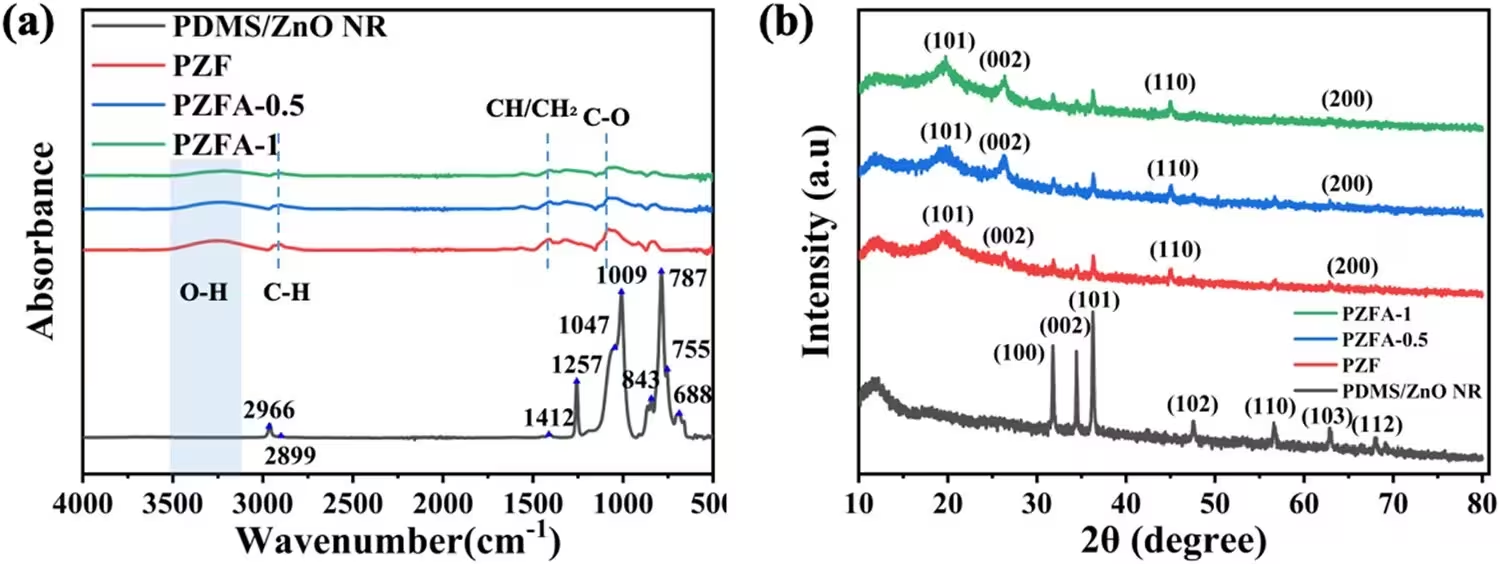
The team created the device by integrating an upper photothermal layer with a lower supporting layer using simple solution casting. The upper layer consists of a poly(vinyl alcohol) matrix embedded with carbon-coated iron-cobalt nanoparticles, multiwalled carbon nanotubes, and acid-treated carbon nanotubes. Meanwhile, the lower supporting layer uses polydimethylsiloxane embedded with zinc oxide nanorods.
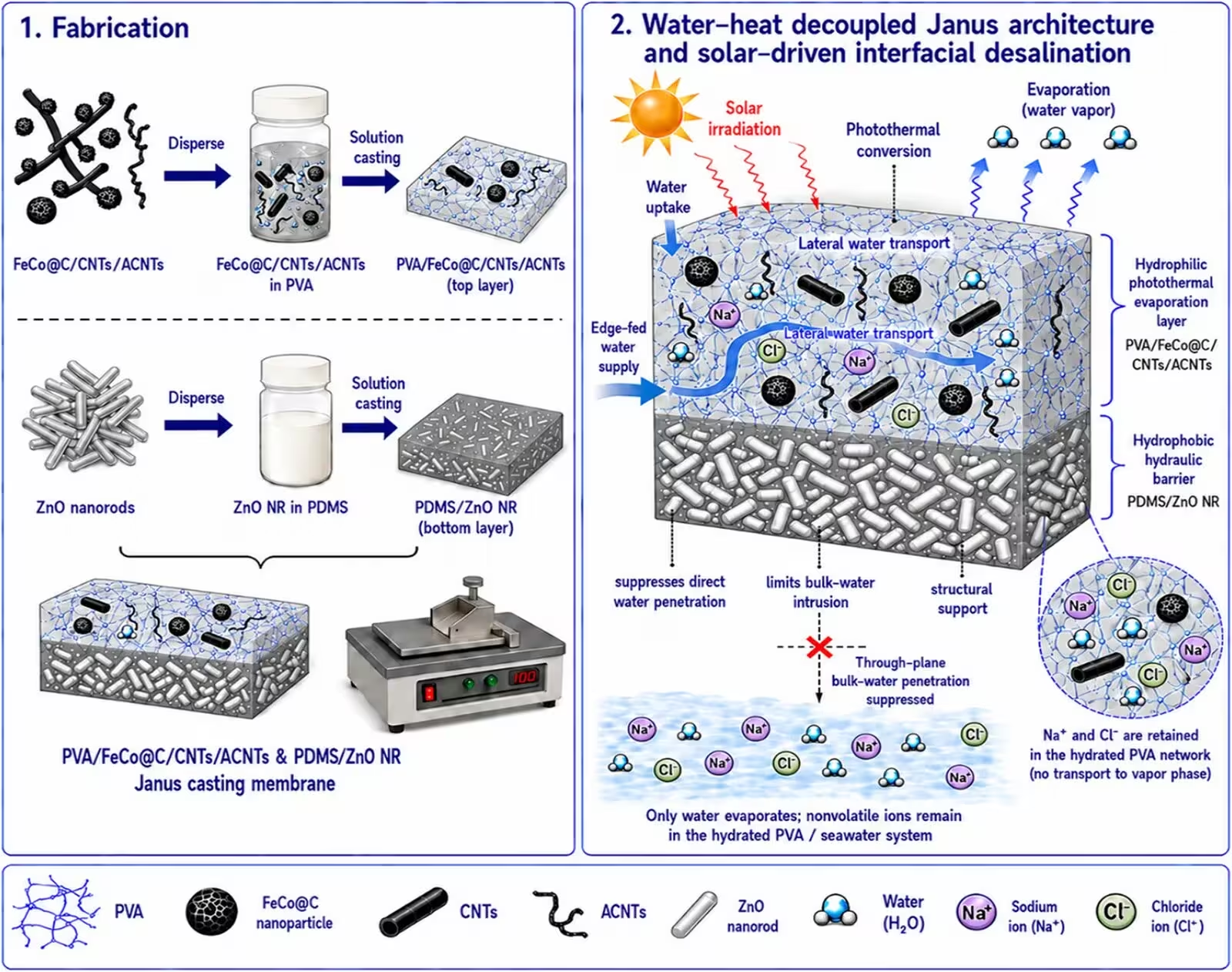
The multicomponent carbon network provides broadband solar absorption across ultraviolet, visible, and near-infrared regions. The zinc oxide nanorods in the lower layer enhance mechanical strength, increasing tensile strength from 1.79 megapascals to 2.32 megapascals without reducing elasticity. This structural asymmetry ensures that water moves upward while preventing unnecessary heat conduction downward.
What Drives the High Evaporation Rate and Heat Retention?
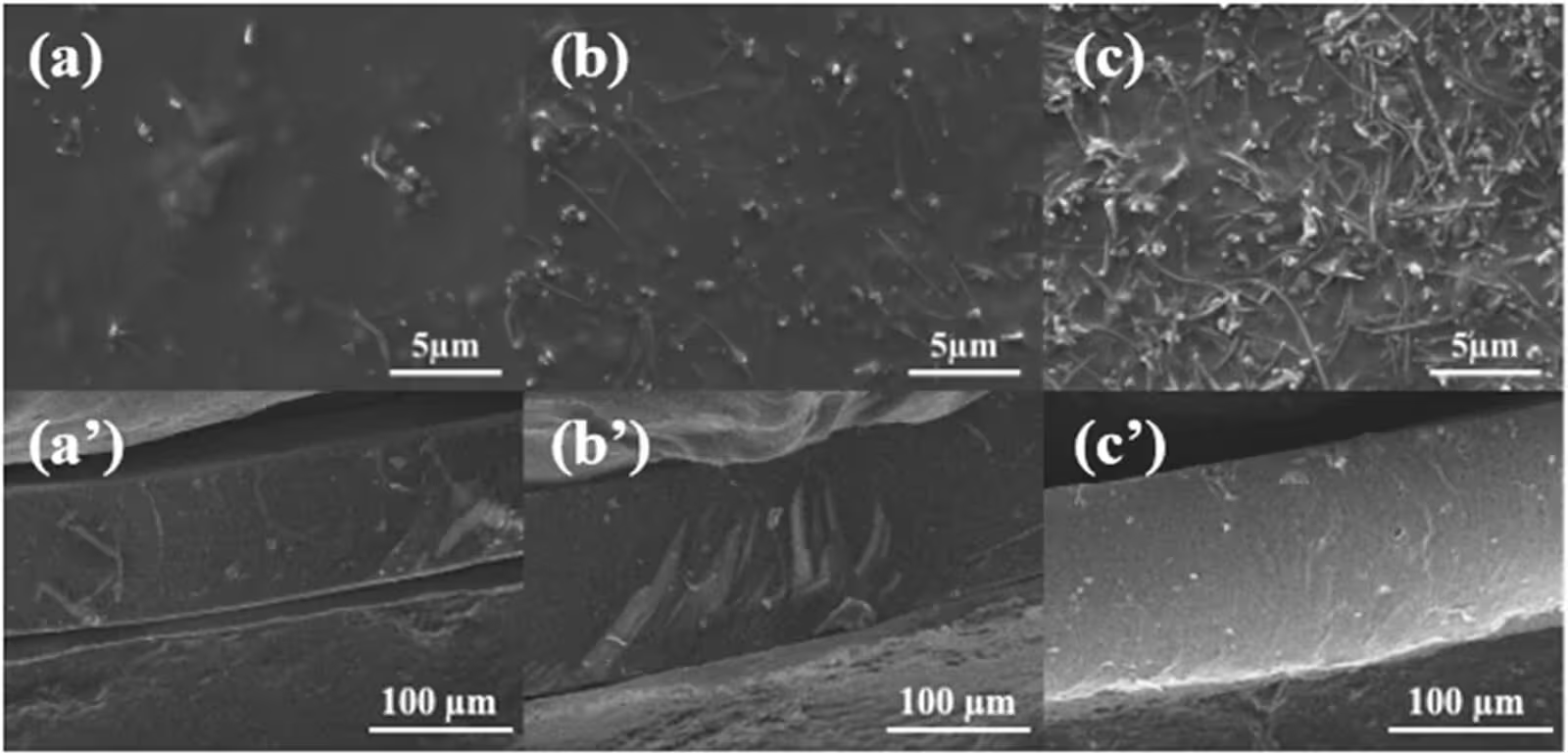
The incorporation of acid-treated carbon nanotubes improves surface wettability and creates a dense, interconnected fibrous network within the polymer matrix. As the concentration of these acid-treated nanotubes increases, the water contact angle decreases to 29.48 degrees, indicating high surface affinity for water. This hydrophilic network facilitates rapid capillary water transport to the evaporation interface.
Under 1 sun irradiation, equivalent to 1 kilowatt per square meter, the optimized membrane achieves an evaporation rate of 1.618 kg per square meter per hour. The equivalent evaporation enthalpy drops to 1.71 megajoules per kilogram, suggesting that water molecules bound within the hydrated polymer network exist in an altered energetic state that requires less energy to vaporize than bulk water.
How Well Does the Device Purify Seawater and Dye Solutions?
The researchers tested the purification performance using simulated seawater containing major ions such as sodium, magnesium, calcium, and potassium. After solar-driven distillation, the sodium concentration in the collected condensate dropped from 10,052 milligrams per liter down to 1.92 milligrams per liter. This residual level falls well below the 200 milligrams per liter limit recommended by the World Health Organization for drinking water safety.
Additional tests using aqueous solutions of rhodamine B and methylene blue dyes demonstrated complete removal of nonvolatile organic contaminants. The collected condensate appeared entirely colorless and transparent, confirming that physical evaporation-condensation separation successfully traps dye molecules on the feed side.
Can the Membrane Resist Salt Accumulation During Extended Operation?
Continuous desalination often leads to salt crystallization on the evaporator surface, which can degrade long-term performance. When operated continuously for 24 hours in a 3.5 percent sodium chloride solution, the membrane showed minor salt accumulation in its central region. However, after the light source was turned off for 6 hours under dark conditions, the deposited salt completely redissolved due to ongoing water supply from the hydrophilic polymer matrix.
The authors note that while the membrane exhibits stable photothermal behavior and effective salt resistance under controlled laboratory settings, long-term outdoor deployment will require further evaluation across fluctuating environmental conditions and varying raw water compositions.
The research was published in ACS omega on November 10, 2026.
This article has been fact checked for accuracy, with information verified against reputable sources. Learn more about us and our editorial process.
Last reviewed on .
Article history
- Latest version
Reference(s)
- Piao, Shuqing., et al. “Casting-Derived PVA/PDMS Janus Membranes with Stable Photothermal Conversion for Solar Desalination.” ACS Omega, vol. 11, no. 46, November 10, 2026, pp. 72578-72591. American Chemical Society (ACS), doi: 10.1021/acsomega.6c08851. <https://doi.org/10.1021/acsomega.6c08851>.
Cite this page:
- Posted by Robert Brown