Archaeologists Uncover Massive Medieval Cemetery With Bodies Stacked Five Layers Deep
Archaeologists uncover a mysterious ancient burial site, raising questions about who repeatedly returned to lay their dead to rest in this location.
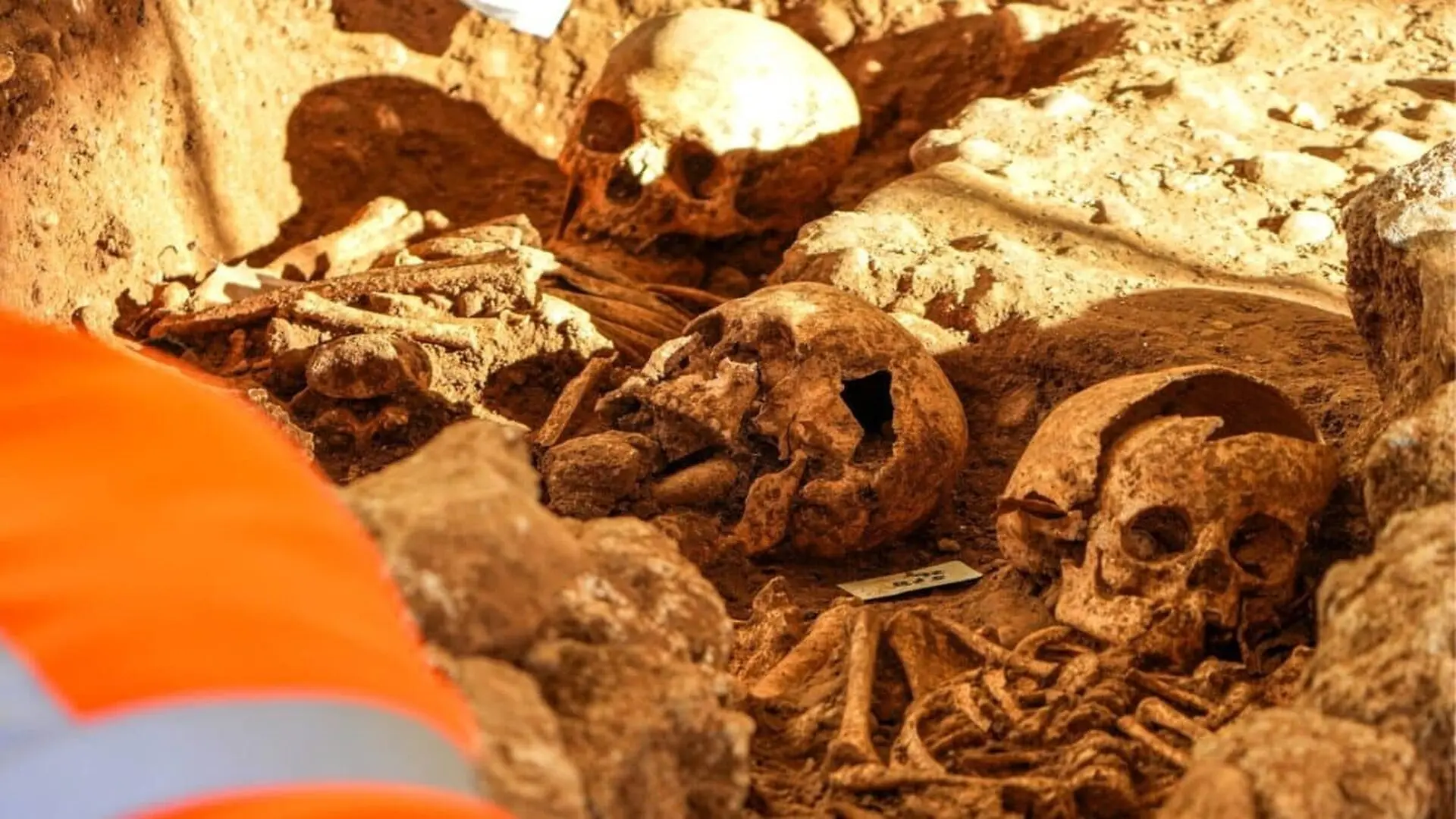
Archaeologists working in a field near Noyon, northern France, have unearthed a dense medieval burial site, revealing a layered necropolis that challenges initial assumptions about the region’s history. Excavations at the Beaurains-lès-Noyon site, prompted by the upcoming construction of the Seine-Nord Europe canal, have uncovered at least 546 graves, with the remains stacked up to five layers deep around the ruins of a small, central structure.
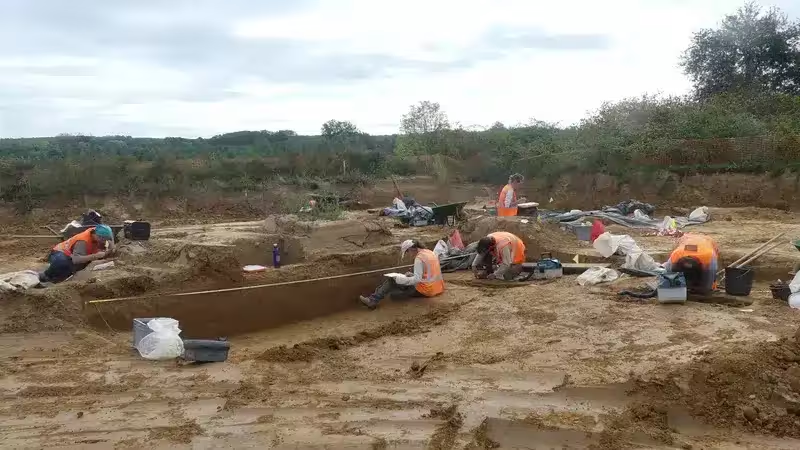
The discovery was made by a team from the private archaeology firm Éveha. Under French law, major infrastructure projects that threaten potential archaeological heritage must undergo rigorous preventive archaeology. Initial test trenches conducted in 2024 confirmed the presence of human remains, leading to a full-scale investigation that spanned from January to September 2026.
The vertical stacking of graves suggests a strong cultural mandate to be interred near the central building, likely a chapel or church, which the local population held in high regard. As space in the immediate vicinity of the structure reached capacity, later generations buried their deceased directly atop those who came before them, creating a stratified historical record spanning the 11th to the 14th centuries.
“546 graves, knowing that we have only uncovered part of them, is a large number for a rural site,” said lead archaeologist Élodie Wermuth, speaking to France 3 Hauts-de-France. While the site’s exact relationship to surrounding medieval villages remains unclear, the location is significant due to its proximity to Noyon, a city of immense political importance during the Middle Ages, having hosted the coronations of both Charlemagne and Hugh Capet.

The investigation has fueled debate over whether the cemetery served a standard village parish or was associated with a leper house, a common institution in the medieval landscape. Pathological indicators found on the earliest skeletons hint at the presence of leprosy, a debilitating bacterial infection that prompted social isolation during the period. However, the discovery of men, women, and children in typical family groupings complicates the theory, pointing toward a standard community burial ground.
Researchers are currently keeping both possibilities open. It is plausible that the site served as a general parish cemetery that also provided a final resting place for individuals suffering from severe physical ailments, or that its function evolved over the three centuries it was in use. A full report, expected in 2029, will integrate radiocarbon dating and osteological analysis to provide a clearer chronology and a deeper understanding of the population’s health and demographics.

This article has been fact checked for accuracy, with information verified against reputable sources. Learn more about us and our editorial process.
Last reviewed on .
Article history
- Latest version
Reference(s)
- “L'essentiel du Canal - Canal Seine-Nord Europe.”, June 28, 2022 Canal Seine-Nord Europe <https://www.canal-seine-nord-europe.fr/lessentiel-du-canal/>.
- “L'archéologie préventive | Ministère de la Culture.”, September 10, 2026 <https://www.culture.gouv.fr/thematiques/archeologie/l-archeologie-en-france/les-operations-archeologiques/l-archeologie-preventive>.
- Gorgeu, Guillaume. “546 sépultures, datant du Moyen Âge, découvertes dans le cadre des travaux du canal Seine-Nord Europe : "c'est.”, September 19, 2026 France 3 Hauts-de-France <https://france3-regions.franceinfo.fr/hauts-de-france/oise/546-sepultures-datant-du-moyen-age-decouvertes-dans-le-cadre-des-travaux-du-canal-seine-nord-europe-c-est-beaucoup-pour-un-contexte-rural-3413540.html>.
Cite this page:
- Posted by Vikram Desai