Simple Chemical Additives Boost Oxygen Reduction Rates Up To Tenfold
Adding fluorinated molecules to the electrolyte microenvironment increases acid strength and accelerates catalytic turnover without requiring complex ligand redesigns.
Accelerating clean energy technologies relies heavily on improving the oxygen reduction reaction, a chemical transformation that dictates efficiency in fuel cells and metal-air batteries. Achieving fast and selective oxygen reduction using molecular catalysts usually requires complex chemical redesigns of the catalyst framework, but a new study points to a simpler path using soluble chemical additives. By introducing small molecules that form hydrogen bonds with the surrounding solution rather than binding directly to the metal center, researchers successfully accelerated the reaction rate by up to an order of magnitude.
The research, published in Discover Electrochemistry, was conducted by Anjila I. Siddiqui and Biswajit Mondal. Their laboratory-scale experiments focused on cobalt and iron salen complexes, which are popular molecular catalysts for oxygen reduction, operating in non-aqueous organic solvents.
How Do Soluble Additives Boost Catalytic Rates Without Changing the Catalyst?
Instead of permanently modifying the catalyst structure to include proton-donating groups, the team tested two well-known hydrogen-bond donors, namely hexafluoroisopropanol and a fluorinated thiourea derivative called TFMP thiourea. These additives were introduced alongside acetic acid, which serves as a weak proton source in the electrolyte solution. The authors hypothesized that non-covalent hydrogen bonding between the additives and the acid molecules would increase the effective proton availability without disturbing the primary coordination sphere of the metal catalysts.
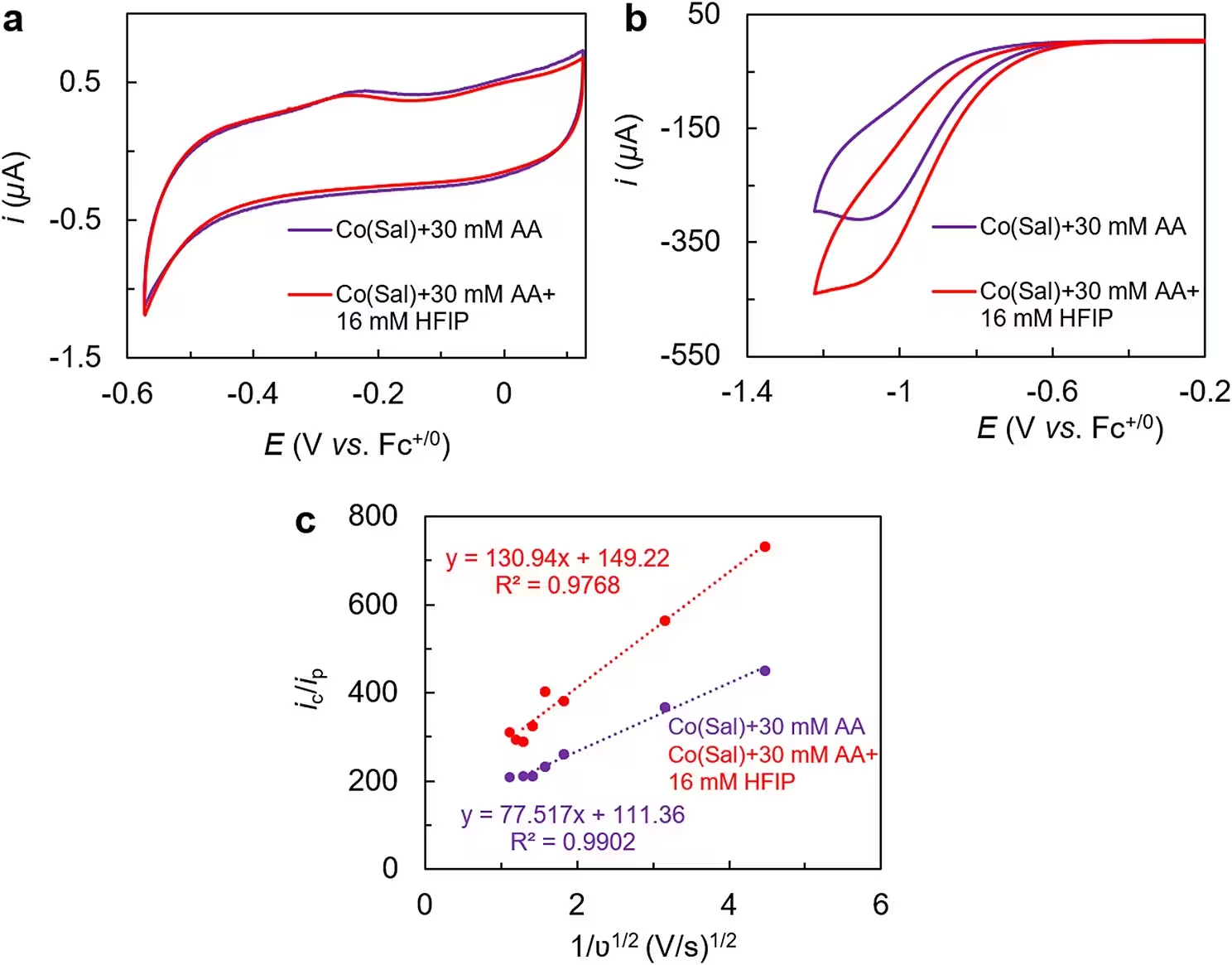
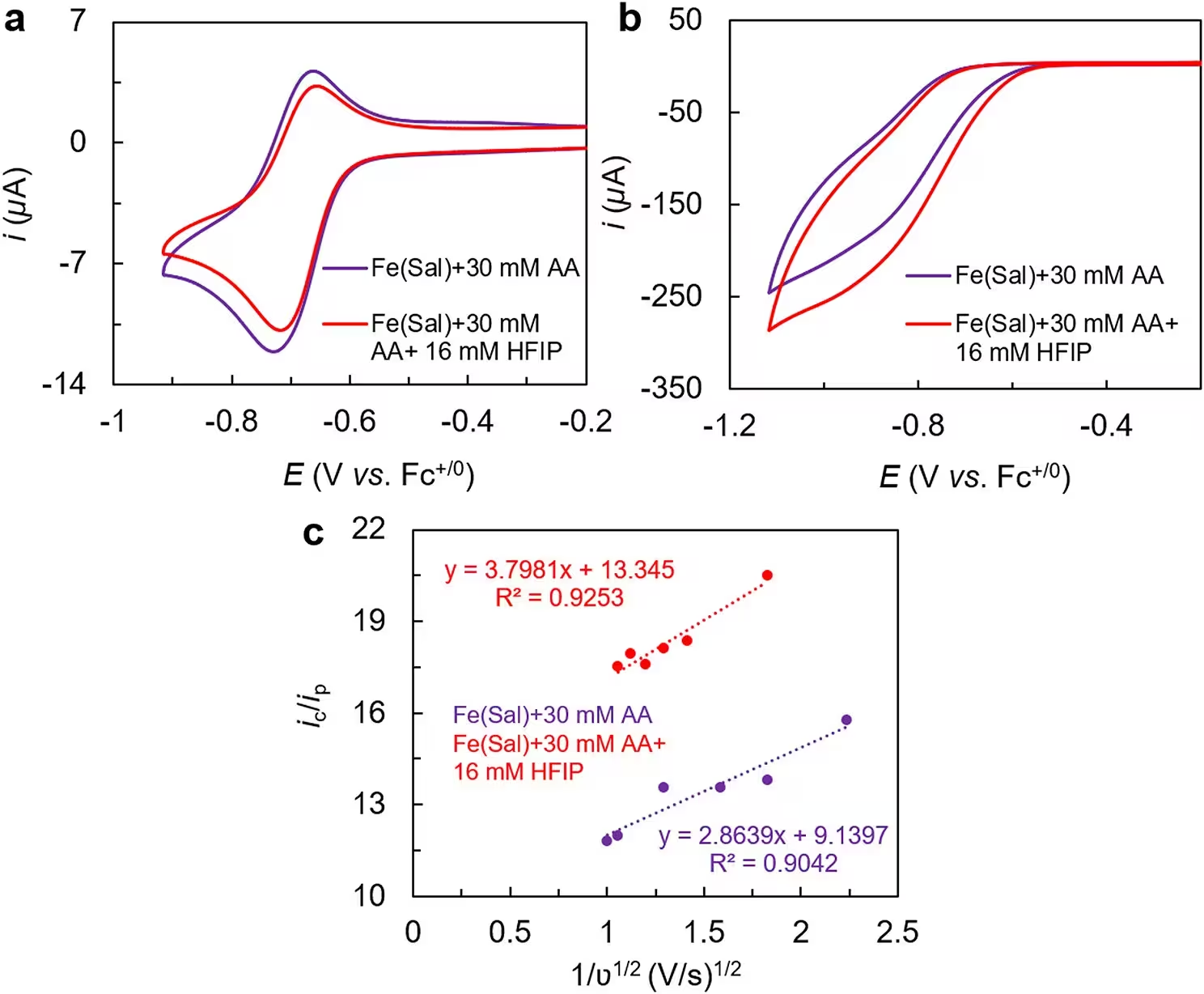
Electrochemical testing using cyclic voltammetry revealed that adding hexafluoroisopropanol increased the oxygen reduction rate by nearly two times for the iron-based catalyst and by roughly ten times for the cobalt-based catalyst, all without shifting the potential required to start the reaction. In contrast, adding TFMP thiourea caused a significant positive shift in the onset potential by up to one hundred and forty millivolts, indicating that it makes the reduction process thermodynamically easier.
What Role Does Enhanced Brønsted Acidity Play in the Reaction?
Spectroscopic measurements and open-circuit potential analyses confirmed that the additives interact directly with the acetic acid rather than the metal complexes. Proton nuclear magnetic resonance spectroscopy showed clear changes in resonance peaks and broadening when the hydrogen-bond donors were mixed with the acid. Furthermore, open-circuit potential measurements under a hydrogen atmosphere demonstrated that the effective acidity of the solution increased upon adding the hydrogen-bond donors.
Homogeneous chemical kinetics experiments using decamethylferrocene as a chemical reductant corroborated the electrochemical findings. The reaction rate constant jumped from eighteen thousandths per second with acetic acid alone to one hundred and sixty-seven thousandths per second when TFMP thiourea was added to the acid mixture, confirming that the rate enhancement is an intrinsic feature of the catalytic process rather than an artifact of the electrode surface.
Does Additive-Mediated Catalysis Alter Product Selectivity?
While accelerating the reaction is vital, maintaining control over the reaction pathway determines whether water or unwanted hydrogen peroxide is produced. Rotating ring-disk electrode measurements showed that hexafluoroisopropanol accelerates the reaction kinetics while leaving the hydrogen peroxide yield largely unchanged at around ten percent for iron and twenty-eight percent for cobalt. However, TFMP thiourea increased hydrogen peroxide selectivity to nineteen percent for the iron catalyst and thirty-six percent for the cobalt catalyst, suggesting that it interacts more closely with oxygen reduction intermediates.
These findings demonstrate that soluble hydrogen-bond donors offer a versatile, modular strategy for tuning molecular electrocatalytic performance by modulating proton delivery in the microenvironment.
The research was published in Discover Electrochemistry on November 25, 2026.
This article has been fact checked for accuracy, with information verified against reputable sources. Learn more about us and our editorial process.
Last reviewed on .
Article history
- Latest version
Reference(s)
- Siddiqui, Anjila I., et al. “Synergy between exogeneous H-bond donor and Brønsted acid in tuning the oxygen reduction reaction.” Discover Electrochemistry, vol. 3, no. 1, November 25, 2026 Springer Science and Business Media LLC, doi: 10.1007/s44373-026-00190-7. <https://doi.org/10.1007/s44373-026-00190-7>.
Cite this page:
- Posted by Anjali Singh