Proteins Act As Natural Soaps Inside Cell Droplets
Simulations reveal how amino acid sequences independently tune the surface tension of biological condensates.
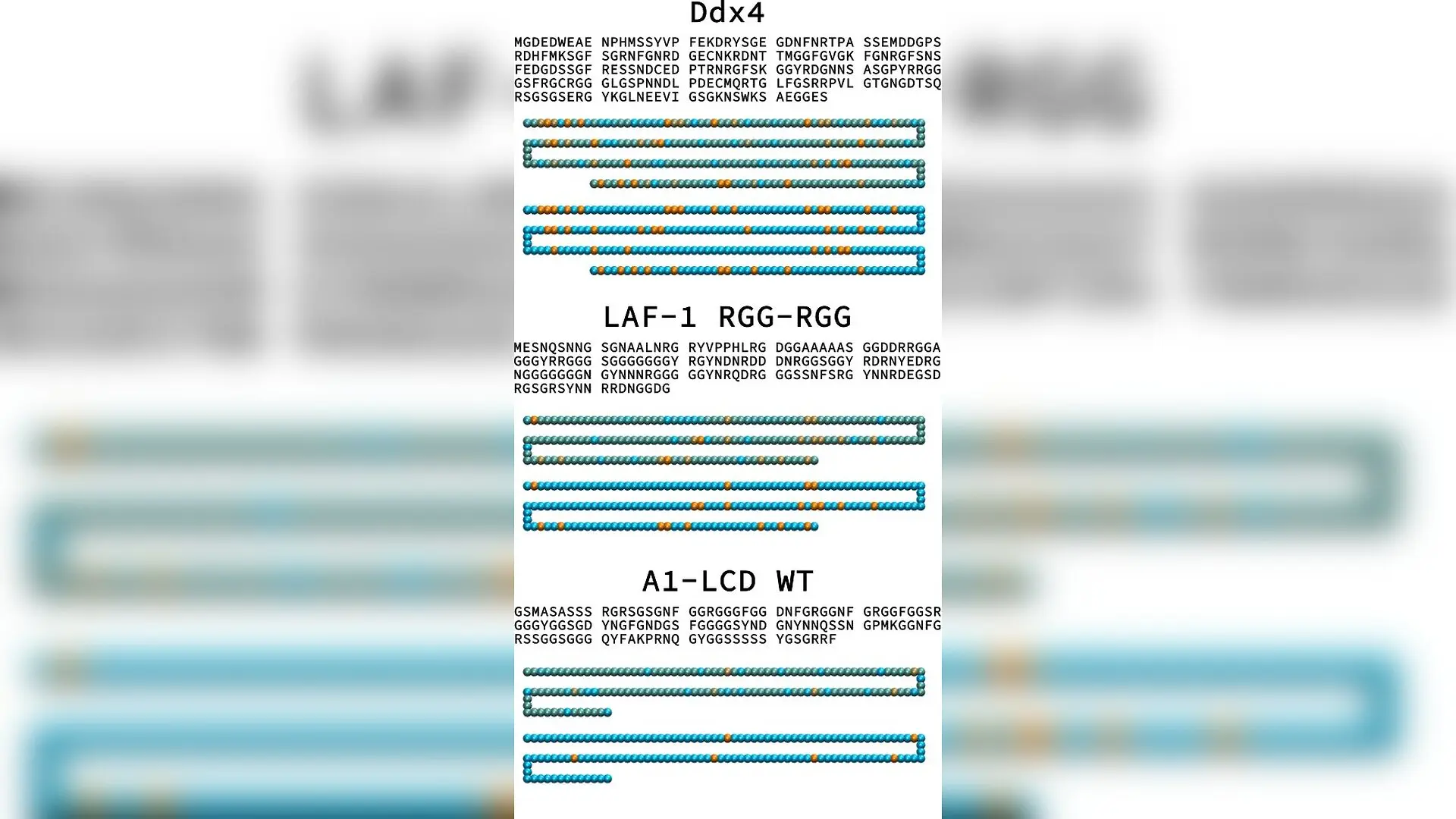
Biomolecular condensates can naturally act as their own soaps, reducing their surface tension through a molecular mechanism that researchers call self-surfactancy. These membraneless droplets, which form inside living cells to organize biochemical reactions, manage to keep surprisingly low surface tensions despite being packed with dense, liquid-like phases. A team of researchers from the Leibniz-Institut für Polymerforschung Dresden and the Technische Universität Dresden investigated this behavior using molecular dynamics simulations, shedding new light on how protein composition controls droplet physics.
The study, published on the arXiv preprint server, explores how intrinsically disordered proteins, which drive droplet formation without fixed structures, manage their boundaries. Unlike traditional artificial surfactants with clearly separated oil-loving and water-loving ends, these biological polymers distribute their hydrophobic (water-fearing) and polar (water-loving) building blocks all along their chains. The authors, Nora-Elen Giesinger, Jens-Uwe Sommer, and Arash Nikoubashman, modeled these chains as bead-spring heteropolymers to see how varying polar fractions and sequence patterns alter interfacial properties.
How Sequence Arrangement Controls Droplet Surface Tension
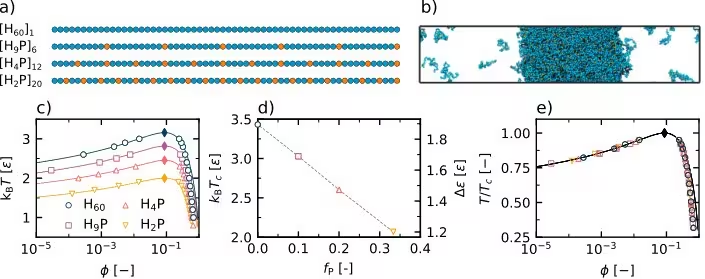
To understand the forces at play, the researchers examined regular repeating sequences containing different ratios of hydrophobic (H) and polar (P) beads, such as chains with fixed lengths of sixty residues. They found that overall composition sets the basic stage for phase behavior, which is well described by classical Flory-Huggins theory. Increasing the fraction of polar residues weakens the effective interaction energy between beads, systematically lowering the critical temperature at which the liquid and vapor phases merge.
However, the real surprise emerged when the team tested different sequence patterns while keeping the overall composition constant at twenty percent polar content. While the bulk phase behavior remained nearly identical across these variants, their surface tensions varied significantly. The researchers observed that polar residues preferentially migrate toward the outer edge of the droplet interface, while hydrophobic residues stay tucked away inside the dense core. This spatial reorganization reduces the energetic penalty of exposing water-fearing groups to the surrounding cellular fluid.
Why Self-Surfactancy Matters for Cellular Compartments
The simulations revealed that specific sequence arrangements can lower surface tension far beyond what overall composition alone achieves. For instance, certain blockier sequences exhibited surface tensions lower than regular chains with much higher polar fractions. This occurs because clustering polar residues reduces the configurational penalty of moving them to the boundary, making the self-surfactancy mechanism more efficient.
The authors note several limitations when translating these findings to actual biology, notably that their minimal model uses a simplified two-letter alphabet that might amplify self-surfactancy compared to the complex twenty-amino-acid palette of real proteins. Furthermore, the work isolates amphiphilic effects from electrostatic charges and salt concentrations, which also influence real cellular condensates. Nevertheless, these insights point to a powerful design principle, suggesting that nature and synthetic protein engineers can tune droplet wetting and fusion behavior independently of bulk phase separation simply by altering amino acid patterning.
The study was posted to the arXiv preprint server on November 19, 2026.
This article has been fact checked for accuracy, with information verified against reputable sources. Learn more about us and our editorial process.
Last reviewed on .
Article history
- Latest version
Reference(s)
- Giesinger, Nora-Elen. “Sequence-encoded amphiphilicity controls the interfacial tension of biomolecular condensates.” arXiv.org <http://arxiv.org/abs/2611.25966v1>.
Cite this page:
- Posted by Bilal Abbasi