Scientists May Have Finally Solved The Mystery Of The Bright Salt Deposits On Ceres
New research reveals how migrating ice and salt reshape the surface of Ceres, exposing hidden deposits and solving a long-standing planetary mystery.
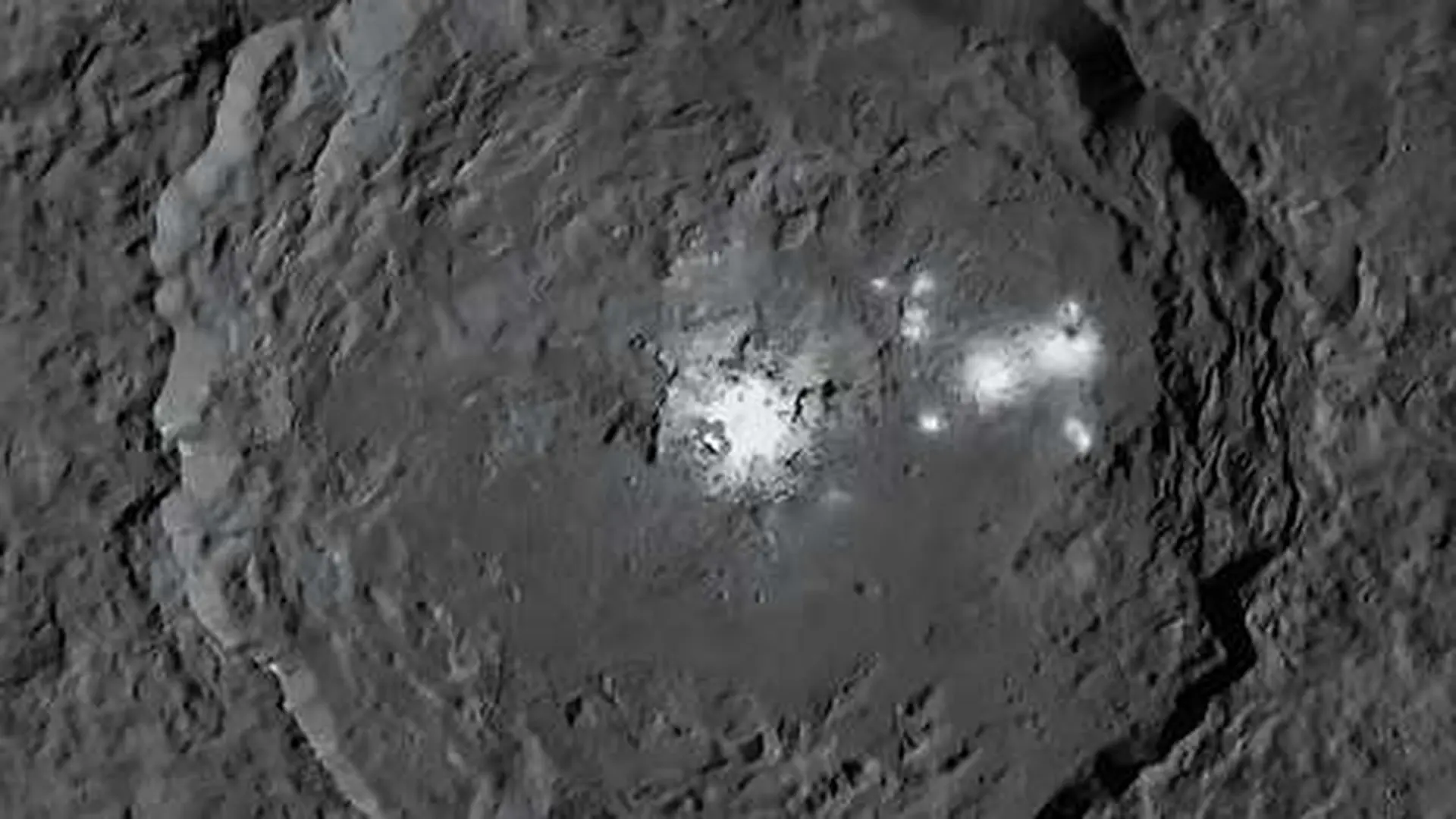
The icy, salt-dusted surface of Ceres may be the product of a slow-moving, natural refining process. New research indicates that the dwarf planet’s puzzling patchwork of bright, salt-heavy deposits and persistent water ice might not stem from vastly different original compositions, but rather from a geological feedback loop that gradually separates these materials over time.
The Evolution of a Frozen World
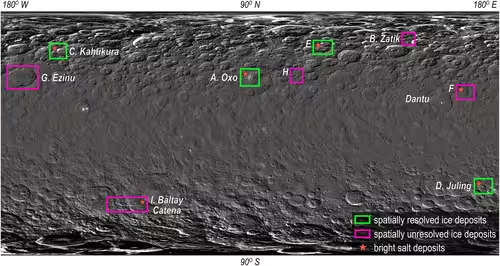
Since the arrival of NASA’s Dawn spacecraft, the dwarf planet Ceres—the largest inhabitant of the asteroid belt between Mars and Jupiter—has remained a geological enigma. The mission revealed a dark, cratered world punctuated by striking, reflective patches. The most famous of these, located within Occator Crater, confirmed the presence of salts that hinted at a complex chemical history beneath the surface.
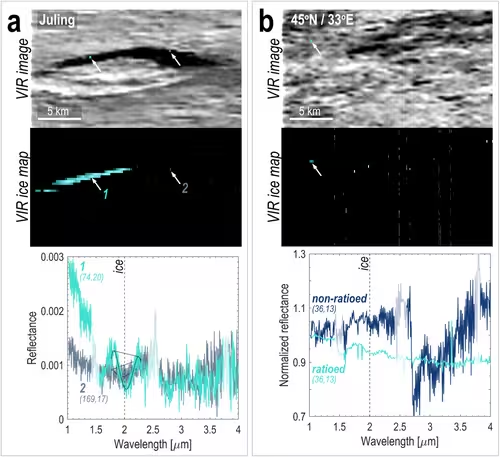
Scientists have long struggled to reconcile why some regions appear heavily salted while others remain shrouded in water ice. The latest analysis suggests that rather than originating as distinct, salt-rich formations, these disparate landscapes are likely the result of water ice moving across the surface through a process of sublimation.
When icy, salty material is exposed to the harsh environment of space, the water ice component shifts directly into vapor. As the ice vanishes, it leaves behind an increasing concentration of salts. These liberated water molecules may then drift toward colder, more hospitable pockets on the surface, where they condense back into ice. Over eons, this cycle creates a feedback loop: one area becomes increasingly enriched with salt, while a neighboring region becomes an ice-rich reservoir.
Decoding Thermal Sorting
The findings, detailed in the Journal of Geophysical Research: Planets, draw parallels between the surface of Ceres and the icy moons of the outer solar system, where similar thermal sorting mechanisms dictate the distribution of minerals. This model challenges the assumption that visible surface chemistry provides a pristine look at the material originally deposited by geological events.
“We proposed a qualitative model of long-term surface evolution of Ceres’ salty ices based on observations that is akin to thermal segregation [sorting] on icy satellites,” the authors explain. “Ice in deposits with salts sublimates more readily and may move to colder areas, resulting in a feedback that creates compositional differences between colder, icy surfaces and warmer, salt-richer regions.”
By shifting the focus from initial deposition to long-term physical transformation, researchers can better account for the survival of ice in regions where it should theoretically have vanished long ago. If ice is being continuously redistributed and replenished, it suggests that the “paradox” of ice persistence is merely a misunderstanding of how active the surface remains.
Reassessing the Dwarf Planet’s Past
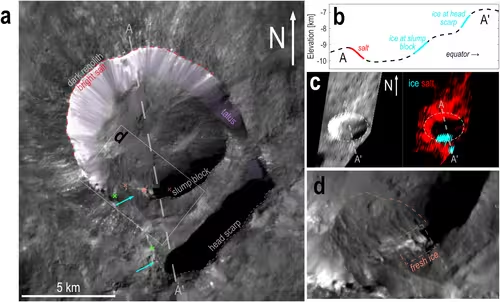
This model forces a revision of how planetary scientists interpret the chemical composition of Ceres. If salts become artificially concentrated at the surface through sublimation, then the measurements gathered by orbital instruments may not accurately reflect the depth of salt reservoirs located below.
Furthermore, the study highlights that while the mechanism is consistent, the local environment—including crater depth, sun exposure, and temperature fluctuations—likely plays a significant role in determining where salts accumulate and where ice lingers. Ultimately, the bright, salty crust of Ceres may be less a direct window into its deep-seated geology and more a testament to the ongoing, slow-motion reshuffling of its icy materials.
This article has been fact checked for accuracy, with information verified against reputable sources. Learn more about us and our editorial process.
Last reviewed on .
Article history
- Latest version
Reference(s)
- Kachmar, V. V.., et al. “Ceres' Salty Ices: Sublimation‐Driven Evolution From Water Ice Exposures to Na‐Carbonate Deposits.” Journal of Geophysical Research: Planets, vol. 131, no. 10, October 20, 2026 American Geophysical Union (AGU), doi: 10.1029/2025JE009421. <https://agupubs.onlinelibrary.wiley.com/doi/10.1029/2025JE009421>.
Cite this page:
- Posted by Bilal Abbasi