Researchers Measure Silica Depletion Without Solid Recovery, And Reveal Surprising Findings About Sponge Proteins
A streamlined colorimetric method bypasses tedious silica recovery steps to reveal that certain catalytic mutations do not halt silicic acid consumption.
Marine organisms and terrestrial plants build remarkable glass-like structures from dissolved silicon, relying on specialised proteins to orchestrate this mineralisation process. For years, scientists studying these silica-condensing proteins have relied on a colourimetric test that requires recovering solid silica and dissolving it in strong bases, a tedious workflow that often leads to incomplete recovery and inaccurate results. Now, researchers have developed a streamlined analytical approach that bypasses solid silica recovery entirely by measuring the depletion of reactive silicic acid directly in solution.
John M. Edwards and Lu Shin from the research team detailed their novel protocol in a study published in Analytical and Bioanalytical Chemistry, offering a more reproducible way to evaluate biosilicification. Biosilicification is the process by which living organisms form mineralised silica structures. The traditional method often employs tetraethyl orthosilicate, known as TEOS, as a synthetic substrate. However, TEOS is largely immiscible with water and requires a two-step reaction involving both the hydrolysis of ethoxy groups and subsequent silica condensation. This makes it difficult to determine whether a protein is truly accelerating silica formation or merely helping to break down the chemical precursor.
How Pre-Hydrolysed Substrates Improve Accuracy
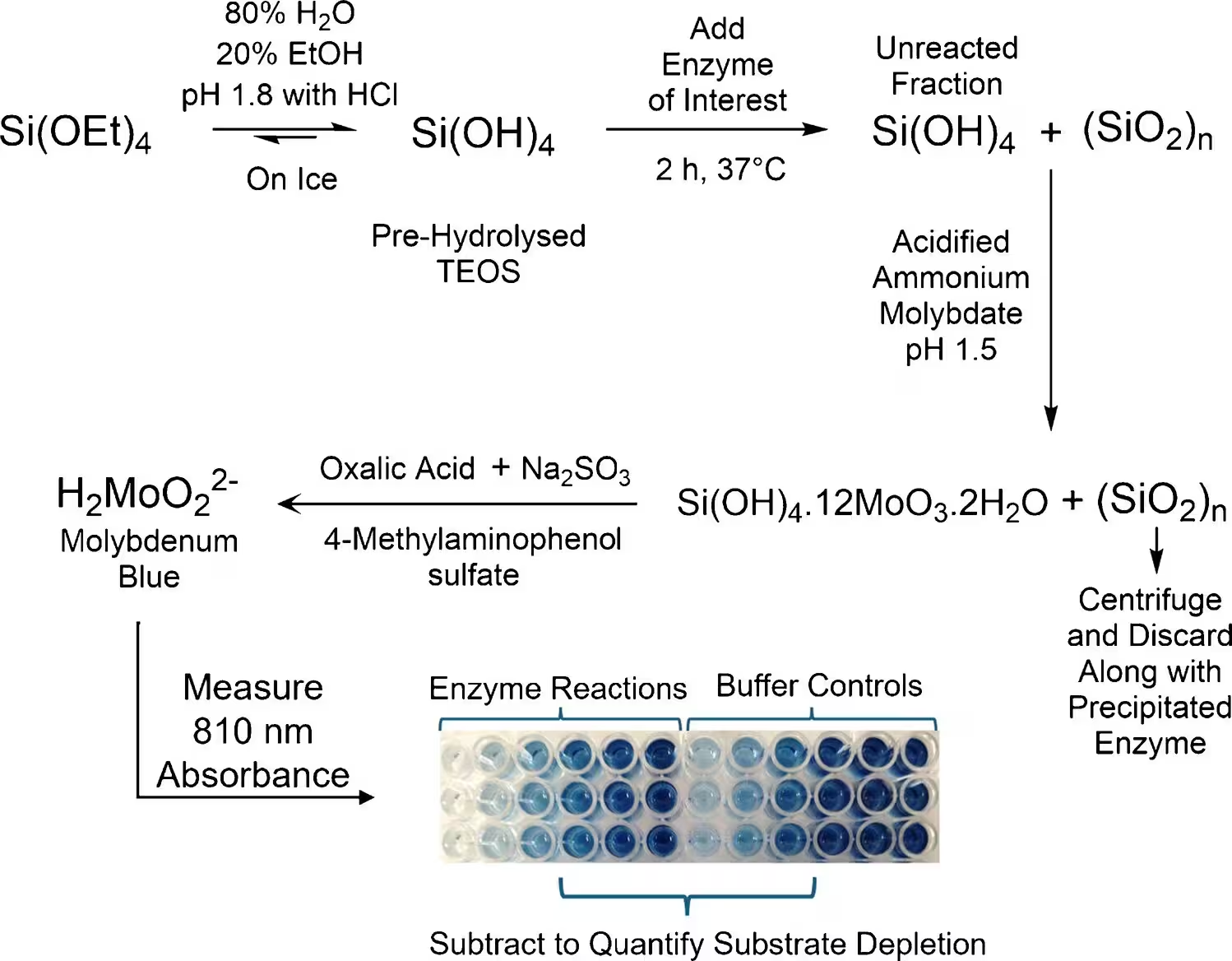
To untangle these chemical steps, the authors pre-hydrolysed TEOS in an acidic water and ethanol mixture at pH 1.8 to generate a stable, homogeneous solution of monomeric orthosilicic acid. This preparation served as a clean substrate for the actual condensation reactions, which were carried out at 37 degrees Celsius using a pH 8.5 buffer to maintain consistency with previous studies. By measuring how much of this reactive silicic acid vanished from the mixture rather than trying to harvest the final silica precipitate, the team eliminated the errors caused by scraping and washing microscopic pellets.
The updated protocol introduces a single centrifugation step after adding acidified ammonium molybdate, which simultaneously halts the reaction, precipitates the protein, and pellets any insoluble silica. The remaining supernatant is then treated with colorimetric reagents to form a molybdenum blue complex, allowing accurate spectrophotometric reading at 810 nanometers. This setup avoids the risks of strong alkaline solutions leaching silicates from laboratory glassware, a common pitfall that previously inflated measurements.
Tracking Reaction Kinetics Over Time
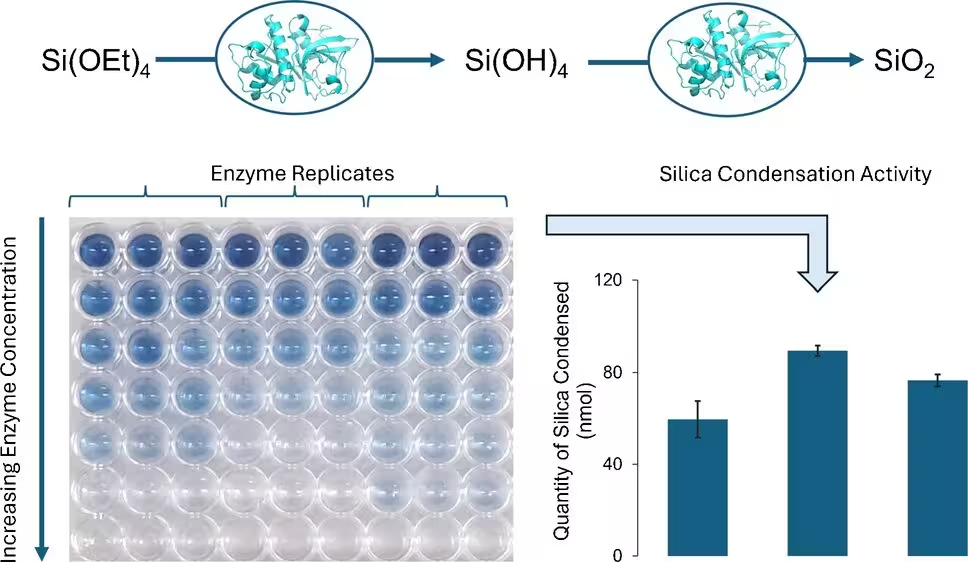
One major advantage of monitoring substrate depletion is the ability to track enzymatic activity continuously rather than relying solely on a single endpoint measurement. When the researchers tested silicatein-alpha from the marine sponge Suberites domuncula, referred to as Silα, they observed a clear enzyme dose-response curve. Increasing the amount of Silα protein led to a steady drop in residual silicic acid until the available substrate was nearly exhausted.
Time-course experiments revealed that the reaction rate is initially rapid before gradually slowing down. For a reaction containing 5 micromolar of Silα and 196 micromolar of silicic acid, the consumption of substrate plateaued after about 100 minutes. The data allowed the team to calculate an apparent turnover number of roughly 30 substrate molecules per enzyme molecule under these experimental conditions.
Testing Mutants and Reassessing Catalytic Triads
The research team also applied the new method to glassin, a silica-condensing protein from the glass sponge Euplectella aspergillum, alongside chymotrypsin as a negative control. While glassin demonstrated clear silica condensation activity, chymotrypsin showed virtually no activity, confirming the specificity of the assay. Interestingly, when the researchers tested Silα substitution mutants where key catalytic triad residues were replaced, the depletion assay showed little difference in activity compared to the wild-type protein.
This finding challenged previous assumptions drawn from TEOS-based assays, where those same mutations significantly reduced recovered silica. The authors suggest that the traditional TEOS method conflates a protein’s role in hydrolysing TEOS with its ability to condense silica. The depletion assay indicates that while those mutated residues may assist in TEOS hydrolysis, the overall protein scaffold continues to drive substantial silicic acid consumption through non-specific surface interactions or substrate sequestration.
The research was published in Analytical and Bioanalytical Chemistry on November 27, 2026.
This article has been fact checked for accuracy, with information verified against reputable sources. Learn more about us and our editorial process.
Last reviewed on .
Article history
- Latest version
Cite this page:
- Posted by Bilal Abbasi