Twisted Semiconductor Bilayers Reveal Novel Topological Chern Metal States
A theoretical model shows how spin spiral textures in moire bilayers drive topological metal phases with coexisting bulk conduction and protected edge modes.
Twisted semiconductor bilayers display unusual topological metallic states when their internal magnetic moments form spiral patterns. Physicists Kaushal Kumar Kesharpu and Evgenii A. Kochetov from the Bogoliubov Laboratory of Theoretical Physics at the Joint Institute for Nuclear Research investigated how these twisted quantum materials handle electrical charges and magnetism. Their work sheds light on how such systems can conduct electricity while simultaneously exhibiting robust topological properties.
The research focuses on transition metal dichalcogenide bilayers, which are atomically thin semiconductor sheets stacked and twisted relative to one another. When two such layers are twisted at a small angle, they form a periodic interference pattern known as a moiré superlattice. This geometry traps electrons in localized pockets and flattens their energy bands, which dramatically amplifies electronic correlations. At certain carrier fillings, these strong interactions cause the electrons to separate into spinless charge carriers called holons and a background of magnetic moments known as spinons.
The authors report their theoretical framework in a study published on the arXiv preprint server. By applying an external electric displacement field perpendicular to the layers, the researchers broke the vertical inversion symmetry. This displacement field induces a chiral interaction that forces the local magnetic moments to rotate within the plane, creating a layer-polarized antiferromagnetic spin spiral.
How Does Spin-Charge Separation Shape Electronic Bands?
To understand the behavior of the system, the researchers utilized an effective low-energy Hamiltonian based on the su(2|1) coherent state formalism. This mathematical approach naturally prevents double occupancy at any single site without requiring artificial gauge fields or constraints. When mobile spinless holons move through the non-coplanar spin spiral background, the interaction warps their energy dispersion curves asymmetrically.
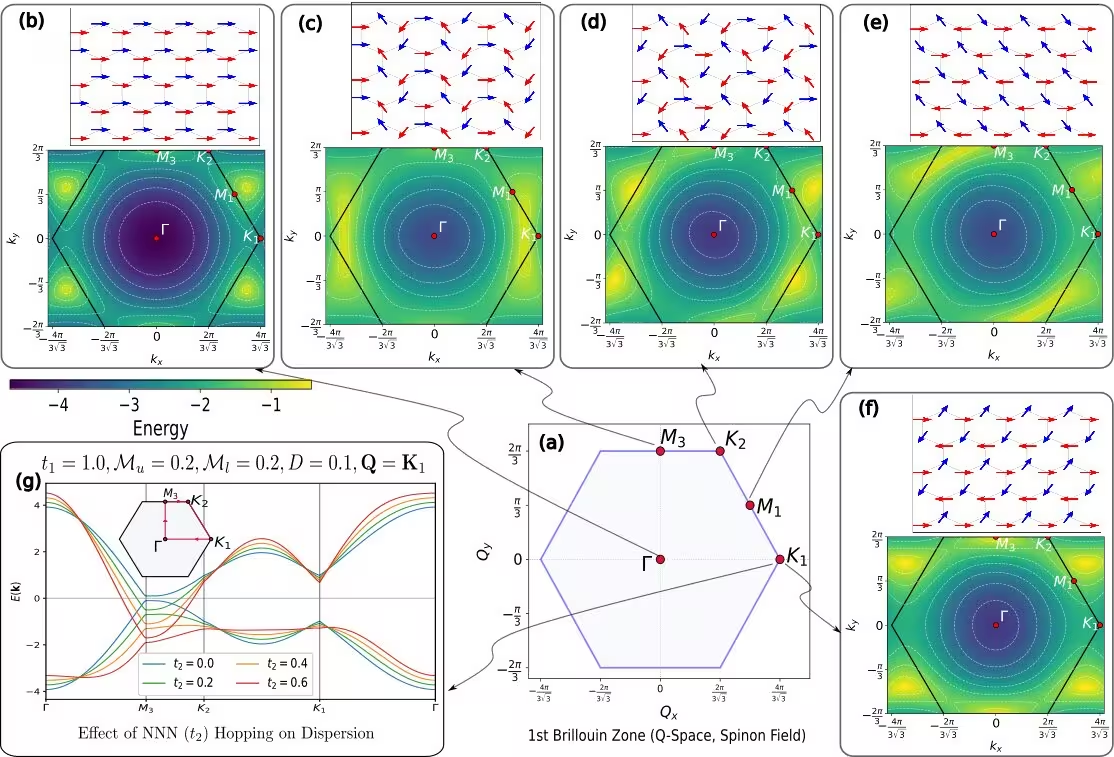
The team discovered that this pronounced band warping closes the global indirect band gap across most of the parameter space. While true topological insulators are thereby restricted to fine-tuned critical trajectories, a finite local direct gap persists across broad regions. This local gap stabilizes a topological Chern metal phase with a Chern number of negative or positive one. Computing the density of states and Chern numbers across the Brillouin zone, the researchers demonstrated that these phases naturally host partially filled Fermi pockets.
What Happens When External Electric Fields Shift the System?
The topological properties can be controlled directly by tuning the external vertical displacement field. When the displacement field is adjusted, the bulk bands undergo a topological band inversion at high-symmetry points in the moiré Brillouin zone. In a finite ribbon geometry, this inversion gives rise to counter-propagating chiral edge modes that bridge the local direct gap on opposite boundaries.
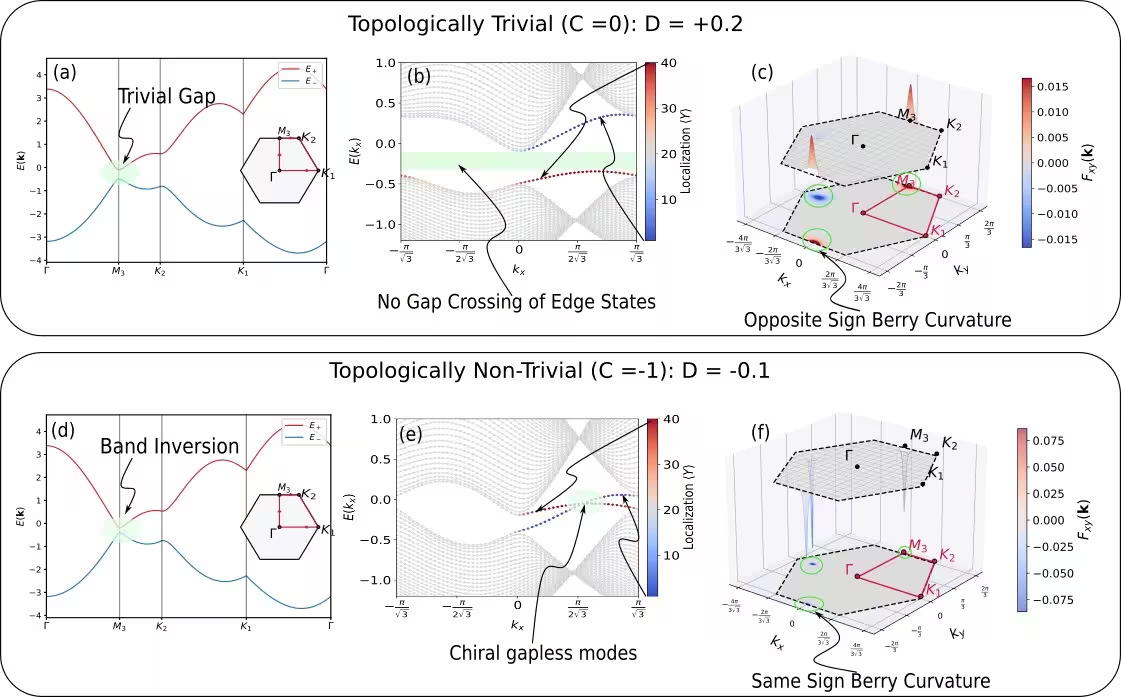
Unlike conventional topological insulators that feature an insulating bulk, this Chern metal exhibits bulk metallic transport alongside protected edge states. The persistence of a finite density of states at the Fermi level means that the system supports dissipative longitudinal conduction alongside an anomalous Hall response. The authors suggest that this mechanism provides a purely electronic route to anomalous Hall states in strongly correlated moiré materials without relying on heavy-fermion Kondo hybridization.
What Are the Limitations and Future Experimental Tests?
The validity of this model relies on specific physical regimes, including the strong-coupling Mott-Hubbard limit where on-site repulsion significantly exceeds interlayer and intralayer hopping parameters. Additionally, the static spinon background approximation applies primarily at low temperatures where long-range magnetic order is established. The researchers note that dynamical fluctuations could potentially modify phase boundaries near continuous transitions.
These theoretical predictions offer clear targets for experimental groups working with dual-gated moiré heterostructures such as twisted molybdenum ditelluride or tungsten diselenide. Tuning the displacement field should trigger a transition from a trivial insulator into the Chern metal regime, marked by the onset of an asymmetric anomalous Hall resistance paired with finite longitudinal resistance. Combining transport measurements with optical techniques like reflective magnetic circular dichroism and nano-scale magnetic imaging could soon verify the coexistence of these topological states with the underlying helical spin textures.
The study was posted to the arXiv preprint server on November 25, 2026.
This article has been fact checked for accuracy, with information verified against reputable sources. Learn more about us and our editorial process.
Last reviewed on .
Article history
- Latest version
Reference(s)
- Kesharpu, Kaushal. “Emergent Chern metal in strongly correlated moiré bilayers.” arXiv.org <http://arxiv.org/abs/2611.34780v1>.
- Posted by Anjali Singh