Mathematicians Solve 1979 Liquid Crystal Puzzle by Proving Twelve Discotic Columnar Phases
A rigorous statistical mechanics analysis shows how thermal fluctuations and entropic effects lock independent molecular layers into ordered columns.

When disk-shaped molecules pack densely into a solid lattice, they form specialized arrangements known as discotic columnar liquid crystals, which play a crucial role in modern organic electronics and tunable optical materials. For decades, mathematicians and physicists debated whether a classic three-dimensional lattice model introduced in 1979 by Ole Heilmann and Elliott Lieb would naturally produce these ordered columns under low temperatures. Now, a new mathematical study published on the arXiv preprint server by Qidong He from Northeastern University proves that the model indeed resolves into exactly twelve distinct discotic columnar phases.
How Do Flat Plquettes Form One-Dimensional Columns in Three Dimensions?
The mathematical system in question, designated as Model III by Heilmann and Lieb, consists of flat, square-shaped plate-like objects called tetramers arranged on a simple cubic grid. These molecules feature hard-core exclusions that prevent them from overlapping, alongside a lateral attraction operating exclusively between coplanar and aligned neighbors. At absolute zero temperature, energy considerations force the system into a completely layered structure where each individual plane is fully packed and crystalline. However, these layers can slide independently of one another without any energetic penalty, resulting in an uncountably infinite number of ground states and complete zero-temperature degeneracy.
The core mystery tackled by the author was determining how thermal fluctuations at low positive temperatures manage to lift this vast degeneracy. While attractive forces act entirely within the individual planes rather than perpendicular to them, the system experiences a subtle entropic stabilization effect. By evaluating the behavior of minimum-energy transverse defects, the research establishes that matching parities across adjacent layers permit a greater density of excitations, creating an order-by-disorder mechanism that synchronizes the entire crystal stack.
What Does Rigorous Low-Temperature Analysis Reveal About Phase Transitions?
To rigorously prove that the system locks into ordered columns, the author employed a multi-step analytical framework combining reflection positivity, chessboard estimates, and the theory of strongly percolating sets. The investigation first confirms the existence of three distinct orientational phases corresponding to the three orthogonal coordinate planes of the cubic lattice. Next, by examining mesoscopic slices, the analysis splits each orientational regime into four separate possibilities governed by the dominant internal parities of the tetramers.
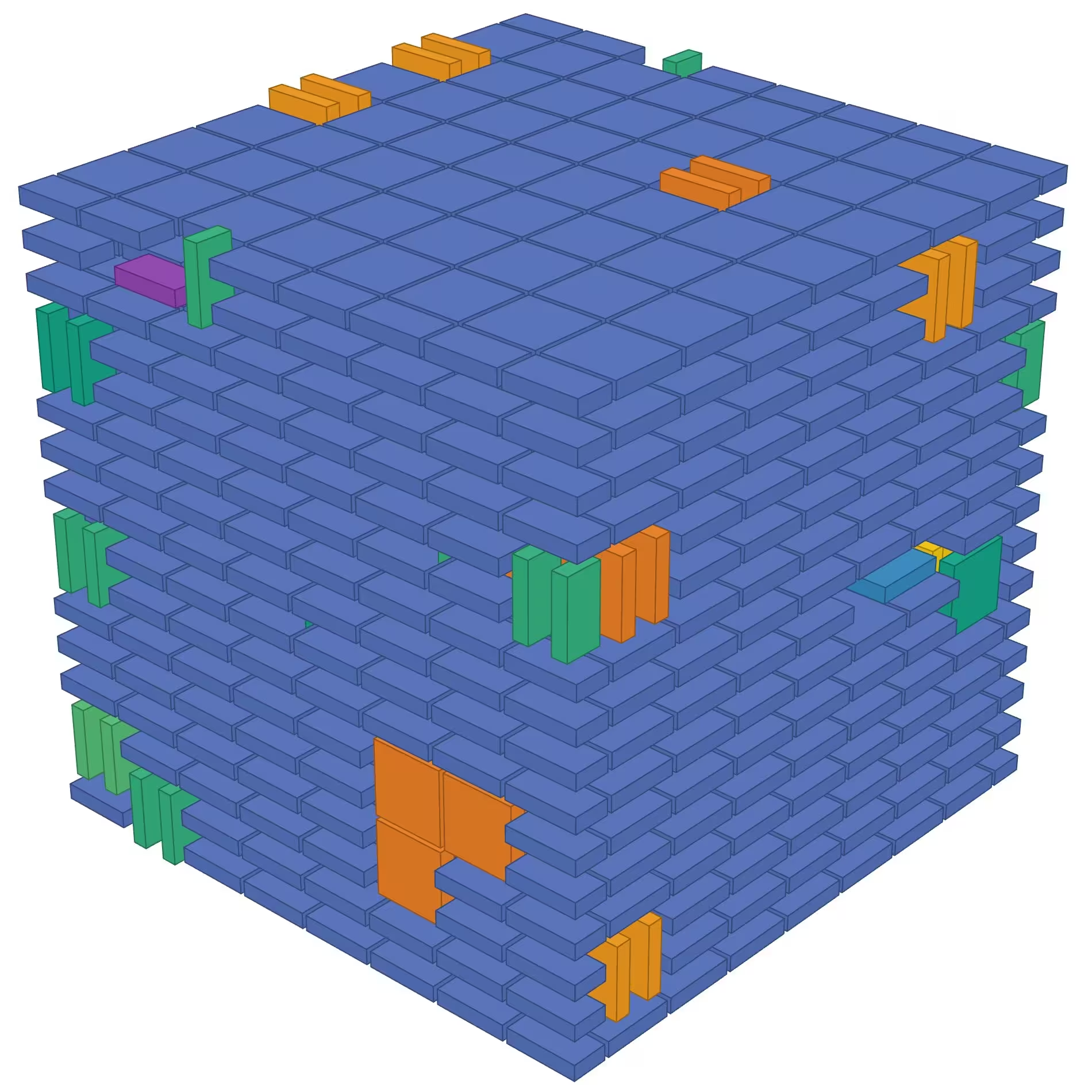
The most delicate part of the proof involved constructing a specialized repair map to control transverse defects and establish rigorous synchronization estimates between adjacent mesoscopic layers. By ruling out long chains of broken links through Peierls-type conditions, the author demonstrated that mismatched parities are exponentially suppressed at low temperatures. Finally, implementing van den Berg disagreement percolation techniques on arXiv demonstrated that these twelve states represent unique, extremal, and periodic Gibbs measures.
Why Do These Theoretical Findings Matter for Condensed Matter Physics?
This comprehensive resolution bridges a long-standing gap between computer simulations of hard-plate lattice gases and rigorous statistical mechanics. While prior numerical simulations indicated that similar hard-particle models undergo complex structural transitions as density increases, turning those observations into mathematical proofs has proven exceptionally difficult. By demonstrating how side-to-side molecular attractions drive two-dimensional translational symmetry breaking in three dimensions, this work provides a firm mathematical foundation for understanding self-organizing discotic mesophases.
The study was posted to the arXiv preprint server on November 25, 2026.
This article has been fact checked for accuracy, with information verified against reputable sources. Learn more about us and our editorial process.
Last reviewed on .
Article history
- Latest version
Reference(s)
- He, Qidong. “Discotic columnar phase in a three-dimensional monomer-tetramer model of Heilmann and Lieb with side-to-side attraction.” arXiv.org <http://arxiv.org/abs/2611.34796v1>.
- He, Qidong. “Discotic columnar phase in a three-dimensional monomer-tetramer model of Heilmann and Lieb with side-to-side attraction.” arXiv.org <https://arxiv.org/abs/2611.34796>.
Cite this page:
- Posted by Bilal Abbasi