Researchers Identify Two Plant Compounds That Target Human Cancer Receptors, But Can They Stop Tumor Growth
Computer simulations reveal how plant-derived glycosides engage critical receptor binding pockets differently than standard synthetic drugs.
Researchers led by Suvadip Ghara have identified two plant-derived natural compounds that interact dynamically with the human epidermal growth factor receptor kinase domain, revealing distinct binding modes compared to conventional synthetic cancer drugs. The investigation, published in Blue Biotechnology, evaluated 745 plant-based compounds using computer simulations to uncover alternative inhibitory scaffolds for oncology drug discovery.
How Do Natural Scaffolds Target Cancer Proteins?
Epidermal growth factor receptor, known as EGFR, is a cell-surface enzyme that transmits signals regulating cell growth, division, and survival. In many human cancers, including non-small cell lung cancer, this receptor becomes hyperactive and drives uncontrolled tumor proliferation. Traditional synthetic drugs inhibit this target by binding to a specific pocket in the kinase domain, but cancer cells frequently mutate to escape these treatments. Natural products offer structurally complex alternatives with diverse chemical geometries that may engage the receptor differently.
What Did the Molecular Simulations Reveal About Bergenin?
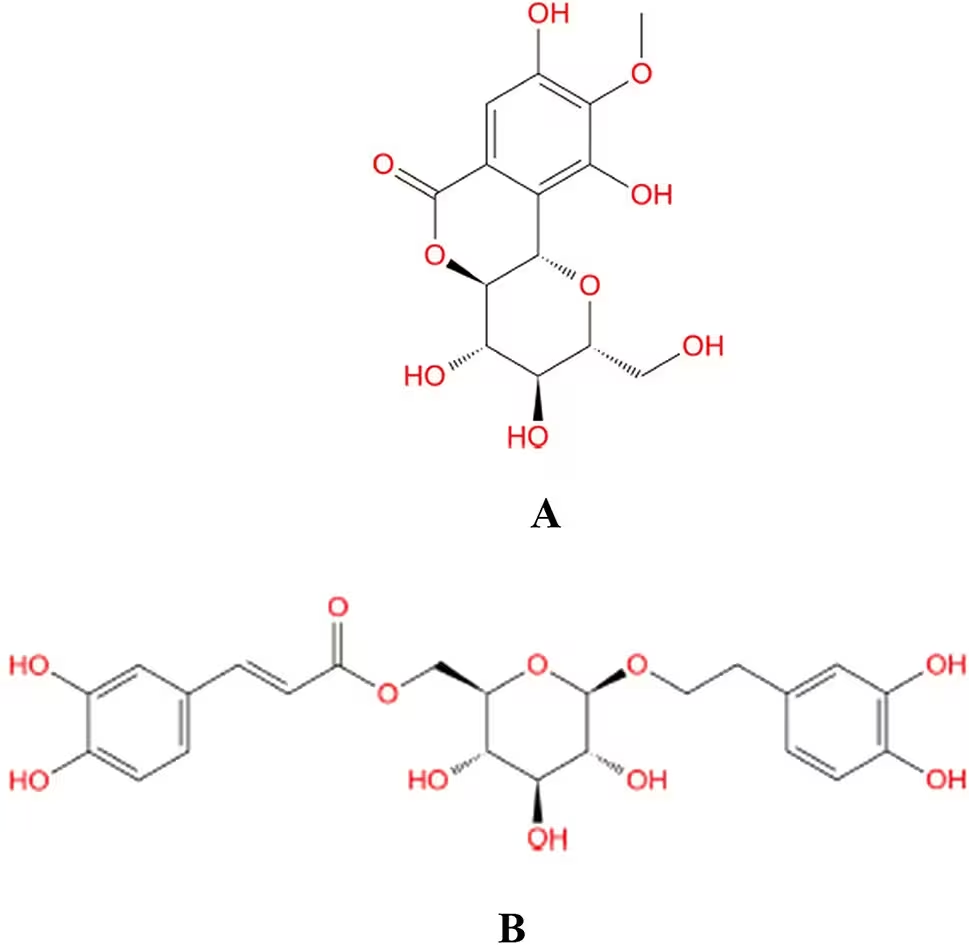
The team screened a library of plant-derived compounds and selected bergenin and calceolarioside B for detailed computational analysis using 100 ns molecular dynamics simulations. Bergenin is a compact isocoumarin glycoside containing 23 heavy atoms and a molecular weight of 328.278 Da. During the simulation, bergenin exhibited a rigid internal structure with an internal root-mean-square deviation of 0.43 Å while maintaining stable hydrophobic contact with the receptor residue Phe723.
Why Did Calceolarioside B Show Stronger Hinge Recognition?
Calceolarioside B is a larger phenylethanoid glycoside comprising 34 heavy atoms and a molecular weight of 478.457 Da with 16 rotatable bonds. The simulations demonstrated that calceolarioside B achieved near-continuous hydrogen-bond occupancy with the hinge residue Met793, remaining engaged for 95.6% of the trajectory frames. This persistent contact closely mimics the primary binding anchor utilized by clinically approved receptor tyrosine kinase inhibitors.
What Are the Limitations of These Computational Findings?
The computational models were built exclusively on the wild-type human EGFR structure cataloged under PDB ID 8SC7 and did not evaluate mutant receptor variants associated with drug resistance. Furthermore, the investigators noted data export inconsistencies in their molecular mechanics generalized born surface area calculations, requiring them to exclude those specific binding free-energy estimations from their quantitative conclusions. The authors emphasize that these molecular dynamics findings serve strictly as a hypothesis-generating foundation requiring rigorous biochemical enzyme assays and cellular proliferation tests before any therapeutic utility can be confirmed.
The research was published in Blue Biotechnology on November 27, 2026.
This article has been fact checked for accuracy, with information verified against reputable sources. Learn more about us and our editorial process.
Last reviewed on .
Article history
- Latest version
Reference(s)
- Ghara, Suvadip., et al. “Identification of natural product scaffolds targeting the epidermal growth factor receptor (EGFR) tyrosine kinase domain.” Blue Biotechnology, vol. 3, no. 1, November 27, 2026 Springer Science and Business Media LLC, doi: 10.1186/s44315-026-00067-9. <https://doi.org/10.1186/s44315-026-00067-9>.
Cite this page:
- Posted by Bilal Abbasi