Webb Telescope Reveals Ancient Galaxy Where Stars Formed in Strange Dense Clumps
The James Webb Space Telescope has spotted a distant galaxy filled with dense stellar clumps, offering fresh insights into star formation in the early universe.
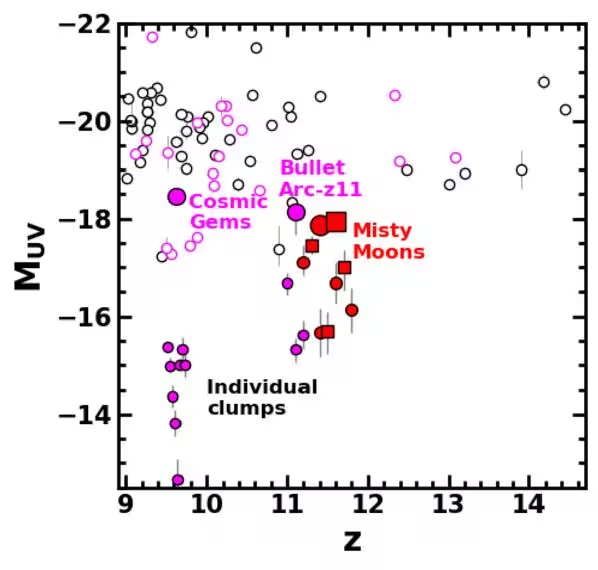
Astronomers using the James Webb Space Telescope (JWST) have identified a remarkable galaxy from the dawn of time, characterized by an unusual concentration of star formation. Dubbed “Misty Moons,” this ancient system dates back to a period between 370 million and 410 million years after the Big Bang, offering a rare glimpse into the chaotic environment of the early universe.
The study, published in The Astrophysical Journal on Oct. 19, describes a galaxy where at least 80% of its stellar mass is packed into small, dense clumps. This structural arrangement is starkly different from the more uniform star formation patterns observed in modern, nearby galaxies.
Cosmic Lensing Reveals Distant Structure
The discovery was made possible by the powerful gravitational field of the foreground galaxy cluster MACS0257-2325. This cluster acts as a cosmic magnifying glass, bending and brightening the light of more distant objects through gravitational lensing. Led by Minami Nakane of the University of Tokyo, the research team utilized JWST’s Near-Infrared Camera (NIRCam) to observe these magnified images.
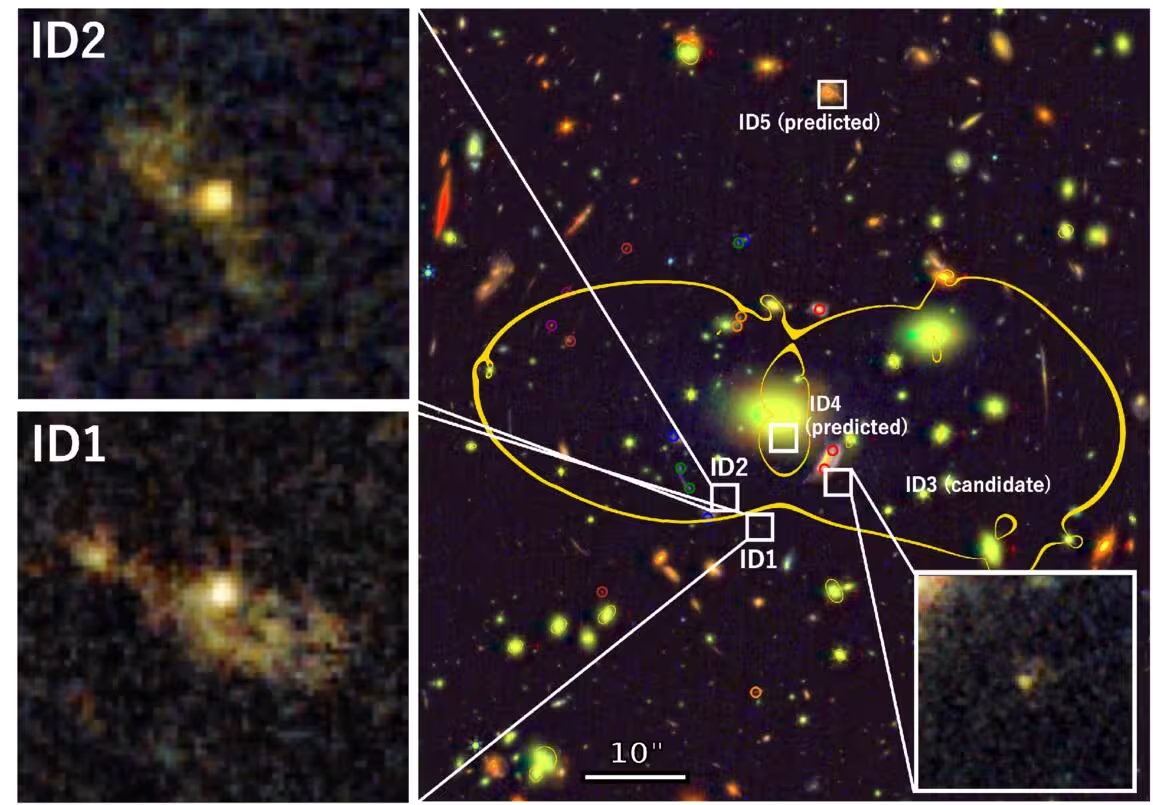
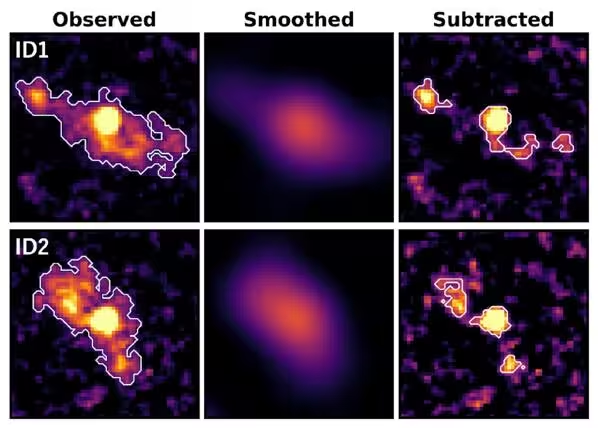
The lensing effect amplified the light of Misty Moons by a factor of 20 to 30, allowing astronomers to reconstruct its original form. By carefully stripping away the distortions created by the foreground cluster, researchers identified several bright, compact nodes within the galaxy, each harboring approximately 10 million solar masses of stars aged between 40 million and 70 million years.
High-Intensity Star Formation
Beyond its clumpy architecture, Misty Moons is defined by extreme stellar productivity. The star formation rate surface density in these regions is up to 10,000 times higher than that of local dwarf galaxies. This suggests that the early universe provided a uniquely hospitable environment for the rapid assembly of dense, massive stellar associations, some of which may have eventually evolved into the globular clusters observed today.
Potential Hidden Engines
While the data points toward intense star formation, the researchers have not ruled out other contributors to the galaxy’s luminosity. It remains possible that a central, actively accreting supermassive black hole is present, providing an additional source of radiation. Distinguishing between the light of young star clusters and the output of an active galactic nucleus will require future spectroscopic observations.
For cosmologists, Misty Moons serves as a critical test case for models of early galaxy evolution. The prevalence of such “clumpy” structures at high redshifts hints that the assembly of the first galaxies was a fragmented and violent process, fundamentally different from the orderly growth observed in the current epoch.
This article has been fact checked for accuracy, with information verified against reputable sources. Learn more about us and our editorial process.
Last reviewed on .
Article history
- Latest version
Reference(s)
- Nakane, Minami., et al. “VENUS: A Strongly Lensed Clumpy Galaxy at z ∼ 11–12 Behind the Galaxy Cluster MACS J0257.1-2325.” The Astrophysical Journal, vol. 1010, no. 2, October 19, 2026, pp. 237 American Astronomical Society, doi: 10.3847/1538-4357/ae8d09. <https://iopscience.iop.org/article/10.3847/1538-4357/ae8d09>.
Cite this page:
- Posted by Karan Das