Astronomers Caught a Star Spiraling Into Its Giant Companion in a Rare Cosmic Merger
Astronomers have reconstructed the dramatic final moments of a star in Andromeda, using Webb data to confirm its fatal merger with a giant companion.
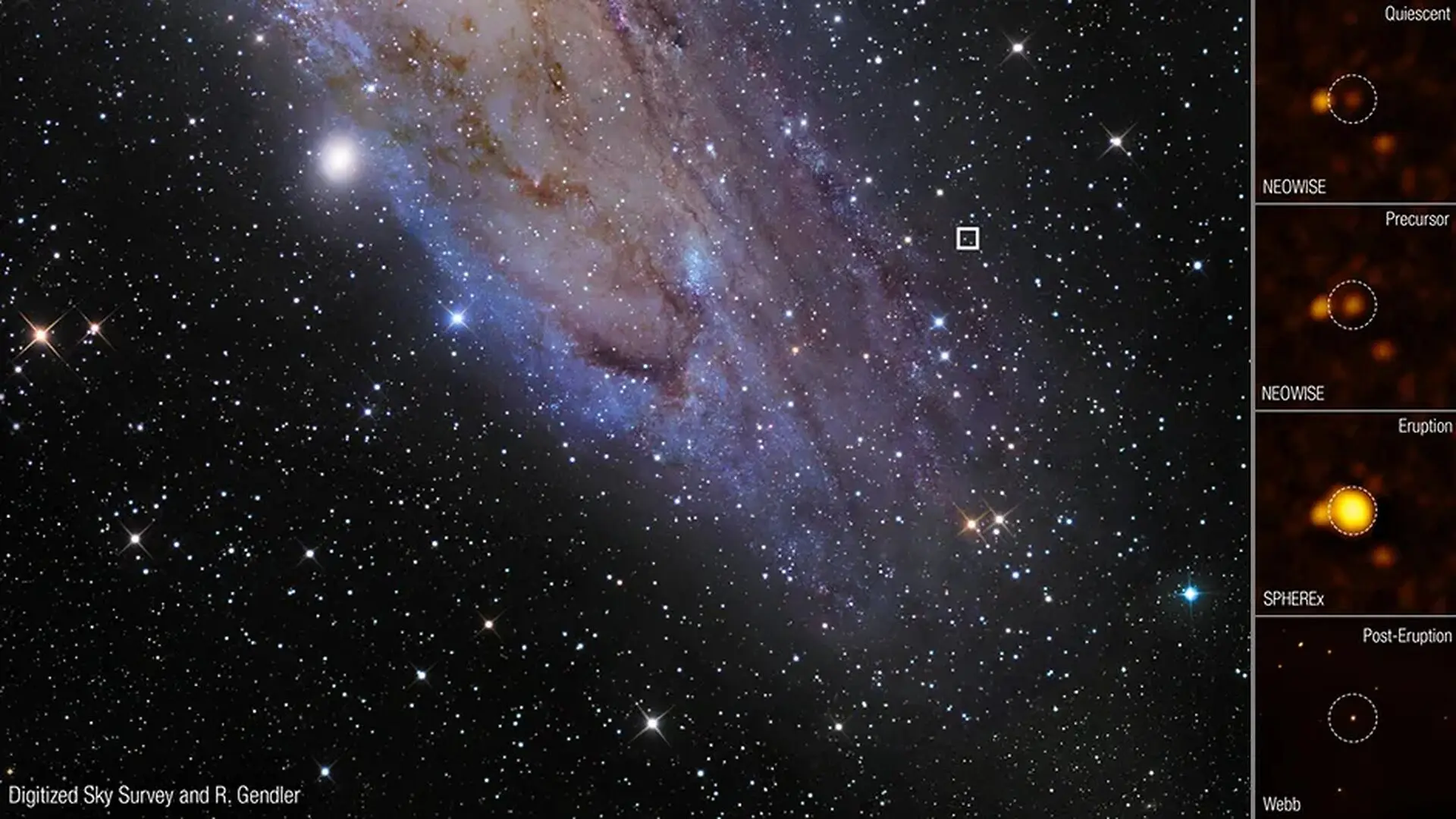
Astronomers have captured an unprecedented view of a rare cosmic event, documenting the final moments of two stars as they spiraled into a single, violent merger. The system, located on the outskirts of the Andromeda galaxy and cataloged as AT 2025abao—affectionately dubbed “Bao”—provided a unique opportunity to witness the hidden mechanics of stellar evolution in real time.
The study, led by NASA Hubble Fellow Viraj Karambelkar of Columbia University and published in Nature, details a process known as common envelope evolution. In this rare scenario, a smaller companion star plunges deep into the extended, gaseous atmosphere of a larger, aging giant star, eventually leading to a complete merger.
An Early Warning in the Infrared
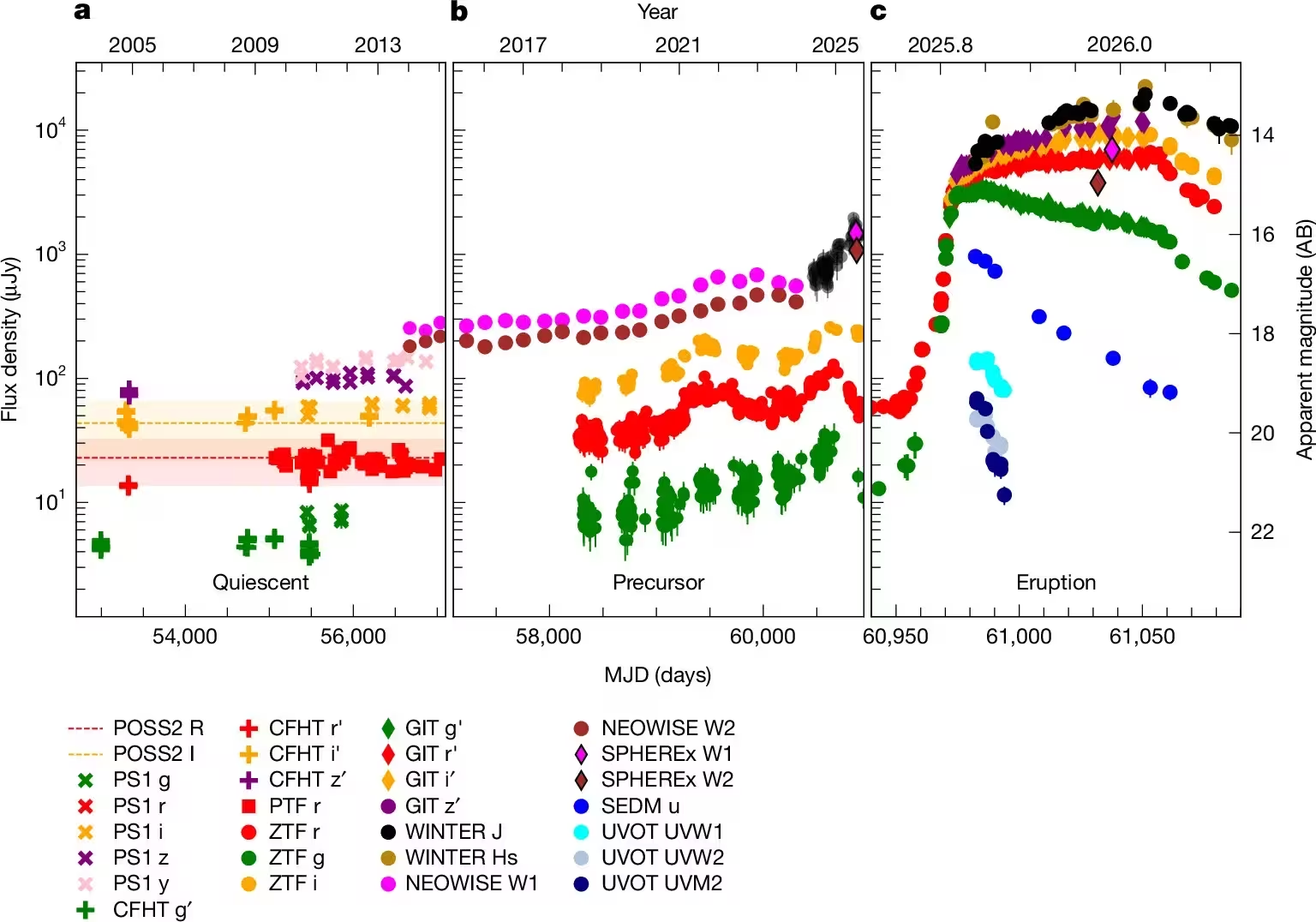
Typically, stellar mergers are notoriously difficult to predict, often occurring without warning. However, Bao offered researchers a significant head start. After remaining stable for decades, the system began a subtle, gradual brightening in 2018. By 2023, infrared monitoring missions, including NASA’s NEOWISE, flagged the system for closer inspection.
“We thought it would take centuries for an outburst to happen,” noted co-author Nadia Blagorodnova of the University of Barcelona. Because the team was already monitoring the system, they were positioned to collect vital data when the event culminated in a dramatic eruption in late 2025.
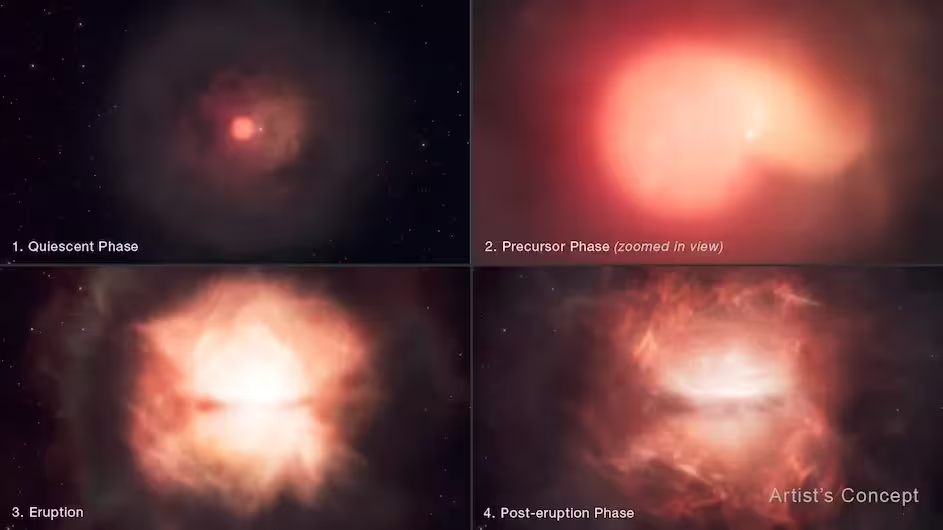
As the smaller star was drawn into the giant’s outer layers, the interaction shed light on the usually invisible “precursor” phase of a merger. The system brightened in two distinct episodes, with infrared observations proving critical in identifying the dust clouds generated by the encroaching companion. This allowed scientists to distinguish between changes in the star’s actual surface and the surrounding obscuring material.
The Physics of a Cosmic Plunge
The research team identified the primary star as an asymptotic giant branch star, roughly seven times the mass of the Sun. Its companion, a much smaller object around 0.7 solar masses, acted as a brake on the giant’s envelope. As the two stars shared a common gaseous boundary, the orbital energy of the smaller star was converted into heat and motion, causing the giant’s envelope to expand significantly.
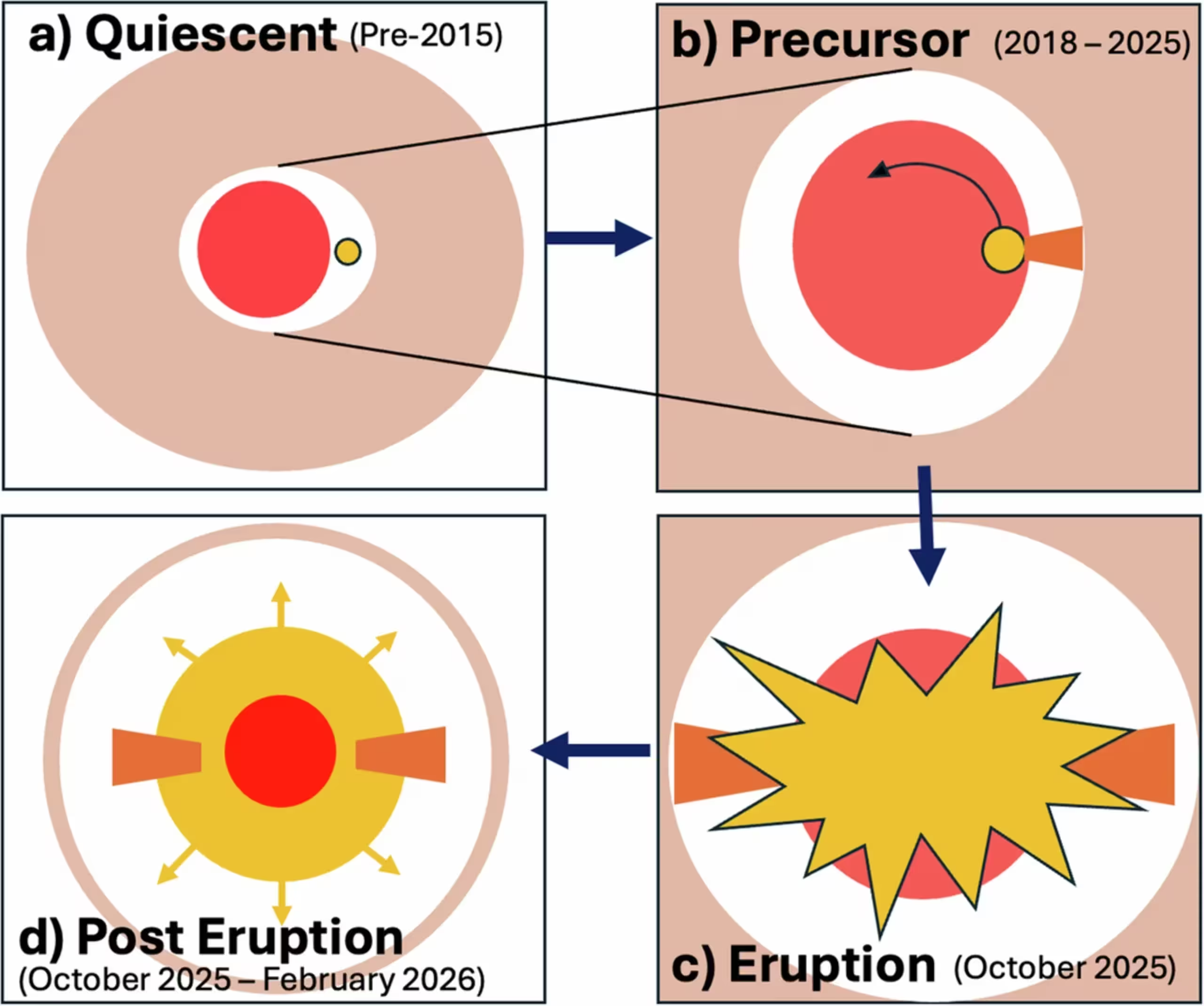
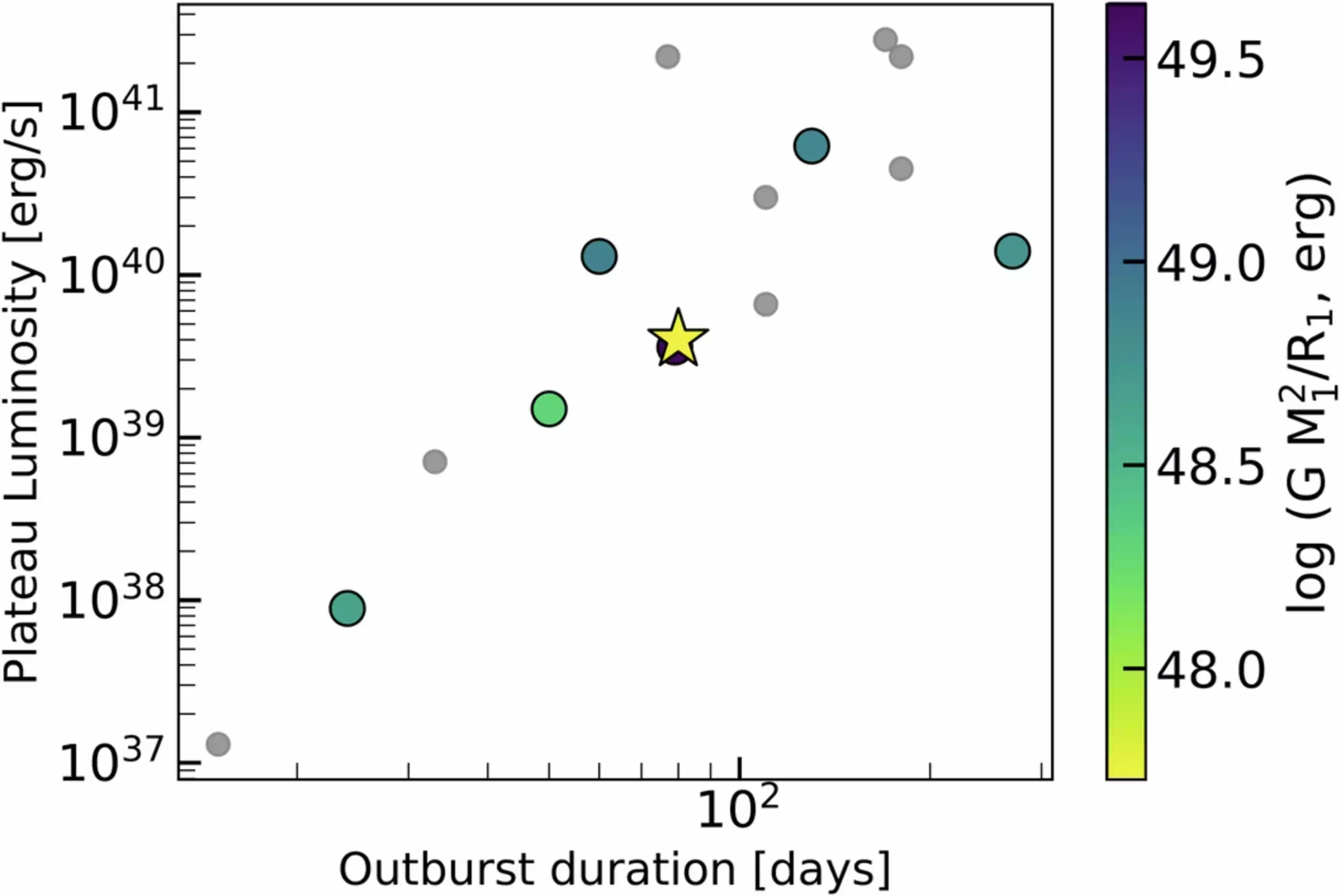
In October 2025, the system underwent a major outburst, brightening a hundredfold in visible light—a hallmark of a “luminous red nova.” By utilizing observations from the James Webb Space Telescope in late December 2025, the team confirmed the presence of a warmer stellar surface shrouded in dust. Crucially, the location of this dust suggested it had been ejected during a much earlier stage of the star’s life, providing a historical record of the system’s instability before the final, fatal plunge.
Refining Future Searches
The case of Bao suggests that many stellar interactions move energy into the motion of ejecta rather than simply radiating it away. By tracking the velocity of hydrogen-rich gas as it collided with older material, the team concluded that the energy exchange was consistent with a total merger, rather than a scenario where the stars survived in a tight binary orbit.
This study demonstrates the immense value of multi-wavelength, long-term monitoring. As space observatories like the Nancy Grace Roman Space Telescope begin their missions, astronomers expect to identify more of these rare, gradual transitions. By catching these systems in their “death spiral” stage, researchers hope to move beyond theoretical models and finally observe the precise mechanisms that dictate the life and death of binary star systems.
Essential Resources on Stellar Evolution
- Instruments on NASA’s Roman Space Telescope Get in Sync for Science (NASA, November 2026)
- The Slow Brightening of WNTR23bzdiq/WTP19aalzlk: Possible Onset of Common Envelope Evolution in an Asymptotic Giant Branch Star? (The Astrophysical Journal, November 2025)
- NASA Webb’s Autopsy of Planet Swallowed by Star Yields Surprise (NASA Jet Propulsion Laboratory, April 2025)
- Star Duo Forms ‘Fingerprint’ in Space, NASA’s Webb Finds (NASA Jet Propulsion Laboratory, October 2022)
- Convection reconciles the difference in efficiencies between low-mass and high-mass common envelopes (Monthly Notices of the Royal Astronomical Society, August 2022)
This article has been fact checked for accuracy, with information verified against reputable sources. Learn more about us and our editorial process.
Last reviewed on .
Article history
- Latest version
Reference(s)
- <https://www.columbia.edu/>.
- Karambelkar, Viraj. “An inspiral of a star inside a common envelope with its giant companion - Nature.”, vol. 659, no. 8141, pp. 628-633. Nature, doi: 10.1038/s41586-026-11221-z. <https://www.nature.com/articles/s41586-026-11221-z>.
- <https://www.ub.edu/web/ub/en/>.
- Balzer, Ashley. “Instruments on NASA’s Roman Space Telescope Get in Sync for Science - NASA Science.”, November 13, 2026 NASA <https://science.nasa.gov/blogs/roman/2026/11/13/instruments-on-nasas-roman-space-telescope-get-in-sync-for-science/>.
- Karambelkar, Viraj R.., et al. “The Slow Brightening of WNTR23bzdiq/WTP19aalzlk: Possible Onset of Common Envelope Evolution in an Asymptotic Giant Branch Star?.” The Astrophysical Journal, vol. 993, no. 1, October 28, 2025, pp. 109 American Astronomical Society, doi: 10.3847/1538-4357/ae00bc. <https://doi.org/10.3847/1538-4357/ae00bc>.
- Laboratory, Jet. “NASA Webb’s Autopsy of Planet Swallowed by Star Yields Surprise.” NASA Jet Propulsion Laboratory (JPL) <https://www.jpl.nasa.gov/news/nasa-webbs-autopsy-of-planet-swallowed-by-star-yields-surprise/>.
- Laboratory, Jet. “Star Duo Forms ‘Fingerprint’ in Space, NASA’s Webb Finds.” NASA Jet Propulsion Laboratory (JPL) <https://www.jpl.nasa.gov/news/star-duo-forms-fingerprint-in-space-nasas-webb-finds/>.
- Wilson, E C., et al. “Convection reconciles the difference in efficiencies between low-mass and high-mass common envelopes.” Monthly Notices of the Royal Astronomical Society, vol. 516, no. 2, August 23, 2022, pp. 2189-2195. Oxford University Press (OUP), doi: 10.1093/mnras/stac2300. <https://doi.org/10.1093/mnras/stac2300>.
Cite this page:
- Posted by Aisha Ahmed