Cosmic Survey of 71 Million Galaxies Reveals Bizarre Alignment in Blue Discs
A massive new full-sky galaxy catalogue shows blue star-forming discs align tangentially with the cosmic web, defying classic cosmological models.
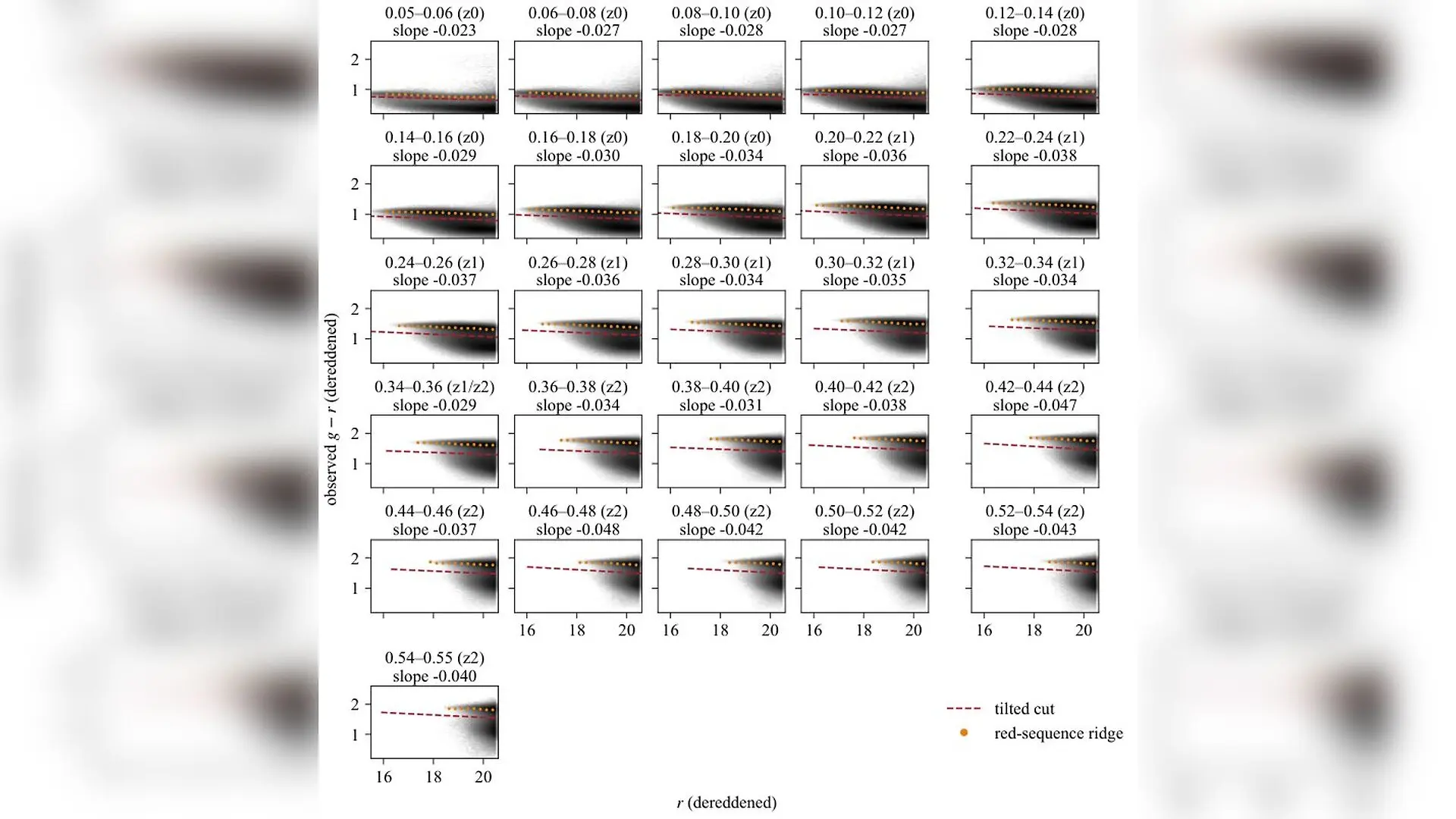
Cosmologists mapping the large-scale distribution of 71 million galaxies have detected a strong and unexpected alignment pattern in blue star-forming disc galaxies, challenging decades of assumptions about how cosmic structures shape galactic orientation. By analyzing data from a comprehensive new full-sky redshift catalogue compiled from space-based observations, the research team found that blue disc galaxies align tangentially with the cosmic tidal field, meaning their shapes stretch perpendicular to the invisible gravitational webs spanning the Universe.
For the past sixty years, understanding how galaxies align with one another and with the cosmic web has been vital for cosmology. These intrinsic alignments create systematic signals that can contaminate weak gravitational lensing measurements, which astronomers use to map dark matter. While red spheroidal galaxies have long been known to exhibit strong radial alignments, pointing toward massive clusters, blue disc galaxies have historically yielded null detections or ambiguous results. To resolve this discrepancy, the authors combined spectrophotometric data from the SPHEREx satellite with the DESI Legacy Imaging Surveys, as described in a study published on the arXiv preprint server, yielding precise distances and shapes for millions of galaxies across the sky.
How Galaxy Morphology Dictates Alignment Signals
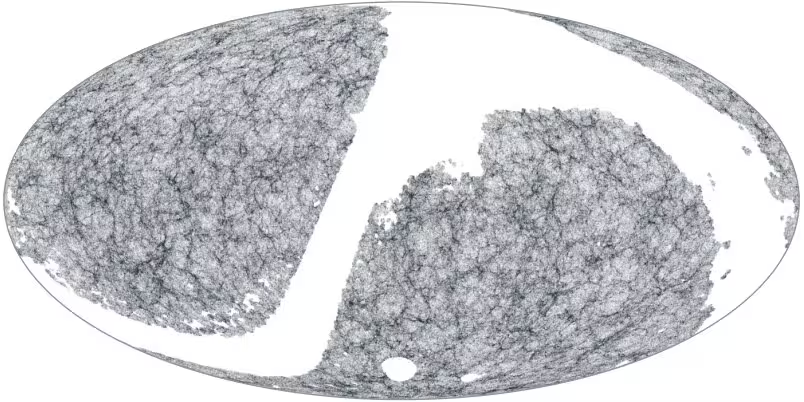
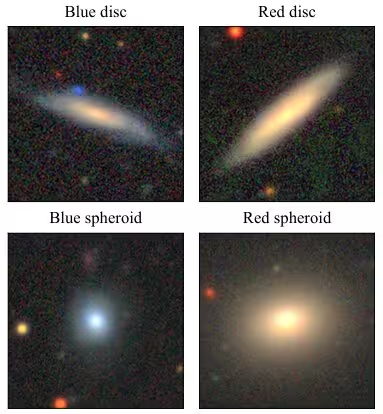
The research team separated their massive galaxy sample into distinct morphological and color groups using Sérsic index measurements and dereddened colors. This categorization isolated red spheroidal galaxies, which are dusty systems filled with older stars, from blue disc galaxies, which are star-forming systems rich in young stars. When measuring the cross-correlation between galaxy shapes and positions, the team identified robust signals across multiple redshift slices ranging from 0.05 to 0.55.
Blue disc galaxies showed a clear tangential alignment detected at high statistical significance, reaching a combined 22.5-sigma level across intermediate and high redshift bins. Conversely, red spheroidal galaxies displayed powerful radial alignments peaking at a massive 65-sigma combined significance. The authors also tracked the cross-component of the alignment signals, finding them consistent with zero, which serves as a reassuring quality check ruling out major measurement systematics. Furthermore, calculations regarding gravitational lensing contamination showed that lensing could only account for roughly 3 percent of the observed blue disc signal, confirming that the alignments are an intrinsic property of the galaxies themselves.
Why This Discovery Contradicts Classic Tidal Torque Theory
The nature of these alignments provides critical insight into how galaxies respond to the cosmic tidal field, which represents the differential pull of gravity stretching and squeezing matter throughout space. Traditional models, known as classic tidal torque theory, predict that disc galaxy alignments should be governed by a quadratic response to the initial Gaussian tidal field. However, a quadratic response requires alignment patterns to remain identical regardless of whether a galaxy resides in an overdense cluster or an underdense void.
To test this, the team measured galaxy alignments around the densest and emptiest regions of the cosmic web. The results revealed that the alignment signal actively flips sign, shifting from radial configurations around voids to tangential configurations around clusters. This behavior matches a linear response to the tidal field rather than a quadratic one. Such findings contradict standard hydrodynamical simulations and classic theoretical frameworks, which previously suggested that disc galaxies should either lack large-scale alignments or exhibit radial tendencies.
Implications for Future Dark Energy Surveys
The discovery carries profound implications for upcoming cosmology projects that rely on weak gravitational lensing to probe dark energy and cosmic expansion. Next-generation initiatives such as the Euclid mission, the Vera C. Rubin Observatory’s Legacy Survey of Space and Time, and the Nancy Grace Roman Space Telescope will use billions of blue star-forming galaxies as their primary source catalog.
Because these blue discs possess significant intrinsic alignments comparable in amplitude to red spheroidal galaxies, cosmological analyses risk severe bias if alignment models remain uncalibrated. The authors emphasize that future surveys must account for galaxy size, morphology, and local environment when modeling intrinsic alignments. Whether these large tangential alignments arise from complex non-linear tidal torquing or other uncharted physical mechanisms, theorists must now reevaluate how galaxies acquire their orientations across cosmic history.
The study was posted to the arXiv preprint server on November 19, 2026.
This article has been fact checked for accuracy, with information verified against reputable sources. Learn more about us and our editorial process.
Last reviewed on .
Article history
- Latest version
Reference(s)
- Murray, Calum. “Star-forming disc galaxies align tangentially with the cosmic tidal field.” arXiv.org <http://arxiv.org/abs/2611.26593v1>.
Cite this page:
- Posted by Aisha Ahmed