Milky Way Chemical Census Reveals a Bizarre U-Shaped Aging Pattern Across 580,000 Stars
A massive stellar catalog spanning five major surveys shows that the galaxy’s elemental distribution shifted dramatically over billions of years.
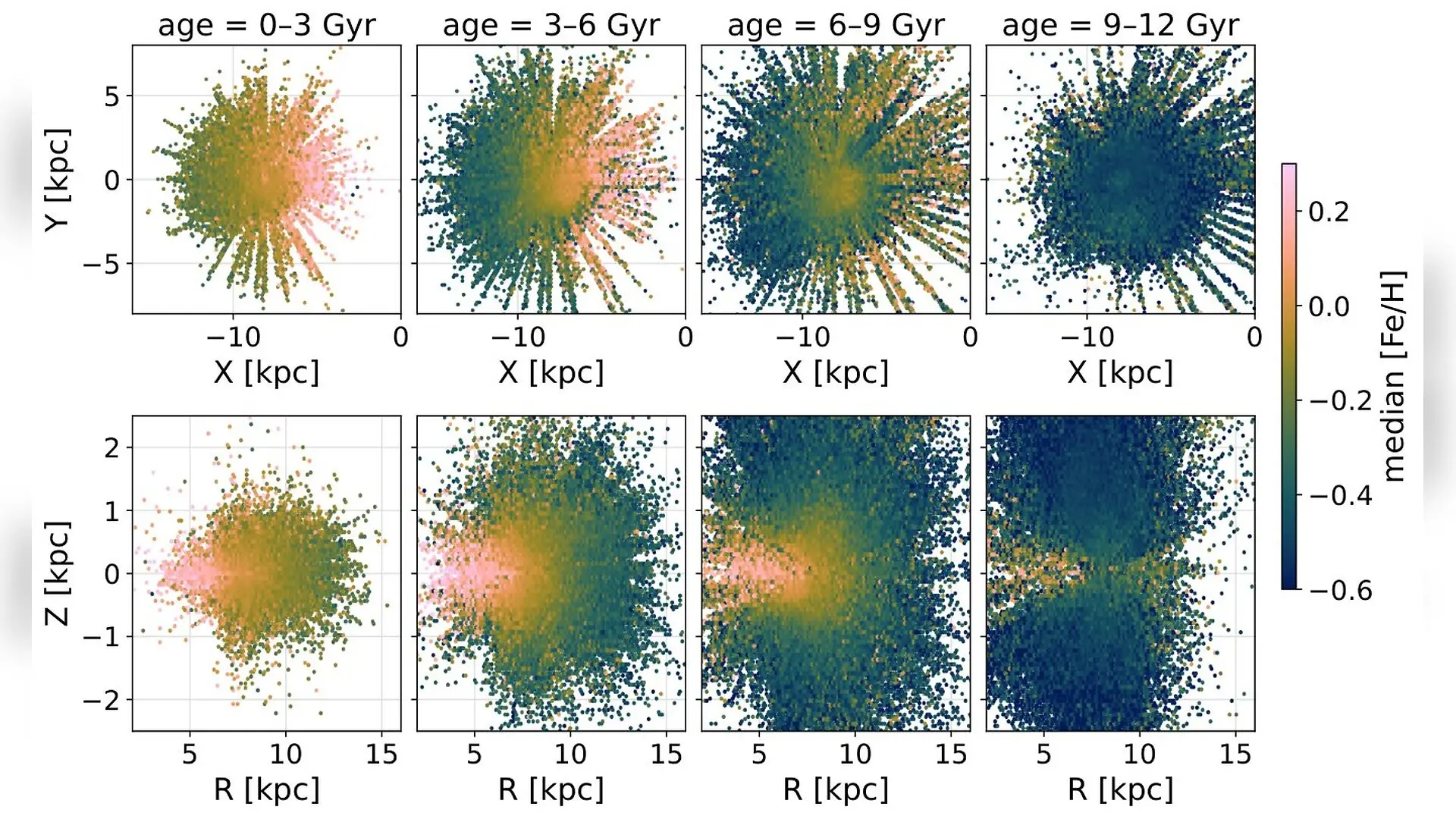
A massive census of roughly 580,000 giant stars reveals that the chemical makeup of our Milky Way changed in surprising ways over billions of years. By harmonizing data from five major stellar mapping projects, astronomers tracked how heavy elements are distributed across the galactic disk and discovered a peculiar U-shaped pattern in how these metallicity patterns age.
Tracing Galactic History With 580,000 Giant Stars
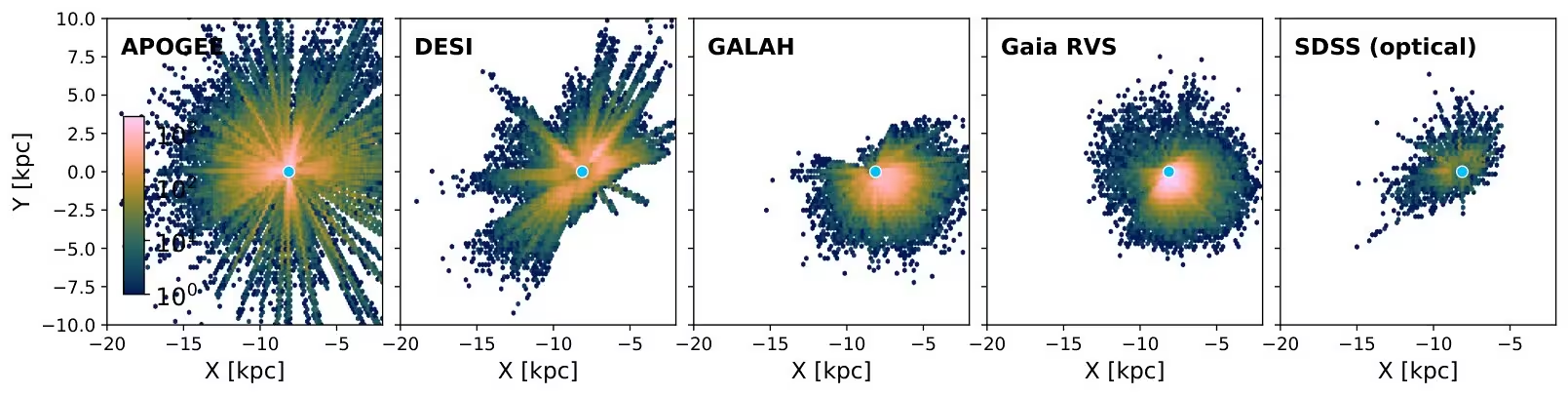
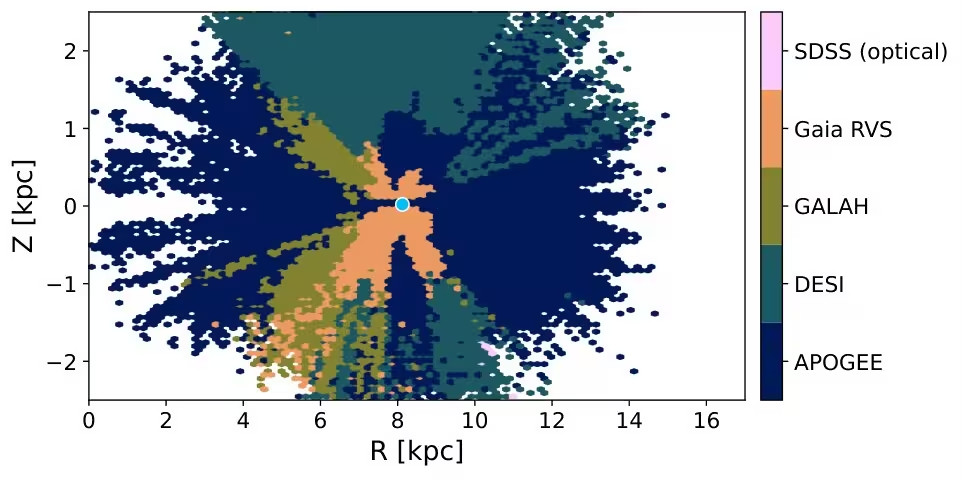
To build a unified view of the Milky Way, researchers led by Jeff Shen and colleagues utilized a self-consistent catalog spanning roughly 580,000 giant stars. The study, available on the arXiv preprint server, combined observations from five large spectroscopic surveys including APOGEE, GALAH, DESI, SDSS, and Gaia RVS. Because different telescopes and pipelines normally use incompatible measurement scales, combining them directly often creates phantom chemical gradients. The authors overcame this by applying a unified deep learning model that placed every star onto a single, standardized framework without requiring patchwork adjustments.
By determining precise stellar ages alongside iron and magnesium abundances, the team mapped how the galaxy assembled its stellar populations over time. The distribution of elements like iron provides a historical record of star formation, telling scientists how quickly different regions enriched their surrounding gas clouds with heavier elements forged inside dying stars.
Why the Metal Distribution Curve Follows a U-Shape
When the researchers measured the radial distribution of iron across the galactic disk, they found that the steepness of the chemical gradient depends heavily on stellar age in a non-monotonic fashion. For young stars under 2 billion years old, the gradient is relatively shallow, showing a variation of about -0.03 dex per kiloparsec. As stellar age increases toward intermediate ages of 5 to 6 billion years, the gradient steepens sharply to roughly -0.07 dex per kiloparsec. Beyond that peak, for the oldest populations exceeding 10 billion years of age, the gradient flattens out entirely to near zero.
This U-shaped age dependence means that intermediate-age stars display the strongest inner-to-outer metal contrast in the galaxy. The youngest and oldest stars, by contrast, are much more uniform across wide radial distances. The team found that this behavior is driven almost entirely by the thin disk population, whereas the older, alpha-enhanced thick disk maintains weak gradients at all ages.
Could Stellar Migration and Early Mixing Explain the Oldest Stars?
The flattening of the chemical gradient in the oldest stellar populations points to specific physical mechanisms in galactic evolution. One leading explanation is efficient radial migration, where gravitational churning near spiral arms shuffles stars across the disk over billions of years. This stellar diffusion mixes metal-rich stars outward and metal-poor stars inward, effectively erasing the original chemical contrasts of the earliest generations.
What the Magnesium Abundances Reveal About Early Starbursts
In contrast to the strong evolution seen in iron, the radial distribution of magnesium remains remarkably flat across all age bins. Magnesium is produced primarily by rapid core-collapse supernovae, serving as a tracer for prompt star-formation timescales. The absence of a strong radial gradient in magnesium suggests that the early universe experienced a vigorous, disk-wide starburst phase that established a uniform baseline before inside-out growth and slow iron enrichment took over.
The study was posted to the arXiv preprint server on November 19, 2026.
This article has been fact checked for accuracy, with information verified against reputable sources. Learn more about us and our editorial process.
Last reviewed on .
Article history
- Latest version
Reference(s)
- Shen, Jeff. “Chemical Cartography Across Time: The Age-Dependent Chemical Structure of the Milky Way with a Homogeneous Sample of 580,000 Giants from Five Surveys.” arXiv.org <http://arxiv.org/abs/2611.26550v1>.
Cite this page:
- Posted by John Williams