Teenagers With Scoliosis Reveal Hidden Alterations in Brain Body Maps
A new study shows adolescents with the spinal condition experience distinct impairments in touch perception, joint position sense, and movement visualization.
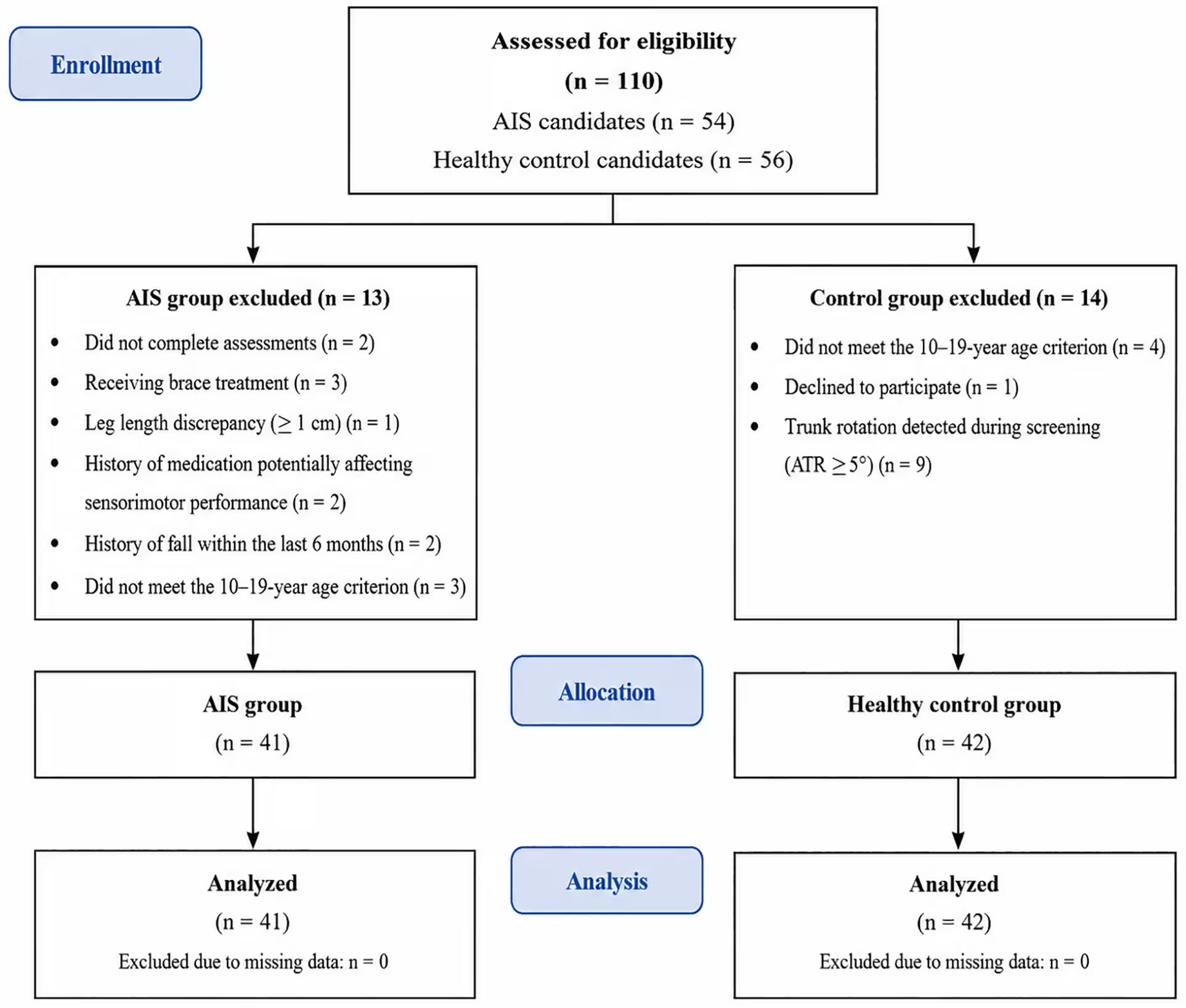
Adolescent idiopathic scoliosis involves more than just a curved spine, as teenagers with the condition display distinct impairments in how their brains and bodies process touch and movement. The study, published in PLOS One by Sema Çetin and colleagues, sheds light on the hidden neurological side of spinal deformities by examining 41 adolescents with the condition and 42 healthy peers.
How Sense of Touch and Joint Position Change in Scoliosis
The cross-sectional case-control study compared participants aged 10 to 19 years old, measuring tactile acuity through two-point discrimination testing, active repositioning error for proprioception, left-right body judgment tasks, and motor imagery capabilities. Researchers found that adolescents with scoliosis had significantly higher two-point discrimination thresholds at multiple paraspinal sites, meaning their ability to distinguish two distinct points of touch on their back was reduced compared to healthy controls. They also showed greater repositioning errors during lumbar and thoracic bending movements, indicating a compromised joint position sense.
Furthermore, teenagers in the scoliosis group demonstrated higher external visual imagery scores on the Vividness of Movement Imagery Questionnaire-2. Because higher scores reflect less vivid mental imagery, this points to difficulties in visualizing body movements from an external perspective. In contrast, measures like pressure pain thresholds and left-right judgment task accuracy showed no significant differences between the two groups after adjusting for multiple comparisons.
Why Brain Body Maps Matter for Spinal Health
These findings support the expanding scientific view that adolescent idiopathic scoliosis is a multifactorial disorder linked to central nervous system and sensorimotor integration challenges, rather than just a bone and muscle issue. The brain relies on an internal body map known as the body schema to control posture and coordinate movement. When sensory input from the skin and muscles is disrupted, it can distort the brain’s perception of where the body is in space.
Statistical receiver operating characteristic curve analysis revealed that proprioceptive errors, particularly during lumbar right lateral flexion and lumbar flexion, were the strongest discriminators between teenagers with scoliosis and healthy participants. A stepwise discriminant analysis combining tactile and proprioceptive metrics correctly classified over 80 percent of the participants, though the authors caution that these models require external validation in larger independent groups before any clinical diagnostic application can be considered.
Psychosocial Impacts and Limitations of the Findings
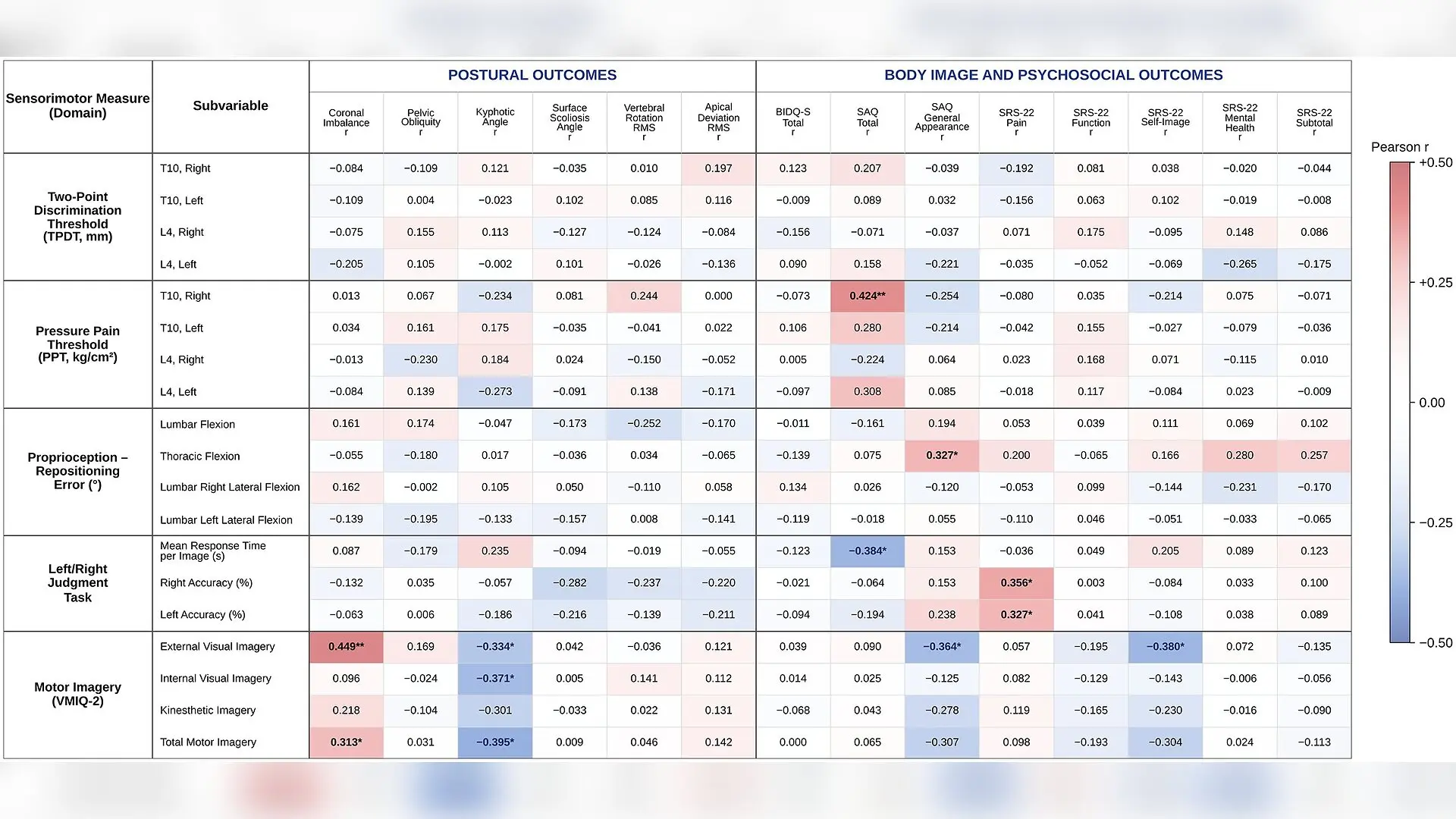
Beyond sensorimotor tests, the study evaluated psychosocial well-being and found that adolescents with scoliosis experienced substantially greater body image disturbance, poorer perceived spinal appearance, and reduced scores in specific domains of the Scoliosis Research Society-22 questionnaire. While exploratory correlation tests initially suggested nominal links between motor imagery and spinal alignment features like coronal imbalance, these relationships did not survive strict false discovery rate corrections.
The authors acknowledge several limitations, including a final sample size slightly below their initial target and a fixed testing sequence that could have introduced minor learning effects. Because the side-specific touch and position tests were recorded anatomically rather than mapped specifically to the convex or concave side of each spinal curve, curve-specific asymmetries remain to be explored. Future longitudinal research incorporating advanced neuroimaging will be essential to determine whether these sensorimotor alterations are a cause, consequence, or co-occurring feature of the spinal curvature.
The research was published in PLOS One on November 19, 2026.
This article has been fact checked for accuracy, with information verified against reputable sources. Learn more about us and our editorial process.
Last reviewed on .
Article history
- Latest version
Reference(s)
- Çetin, Sema., et al. “Sensorimotor representation in adolescents with idiopathic scoliosis compared with healthy controls: Proprioception, tactile acuity, left–right judgment, and motor imagery.” PLOS One, vol. 21, no. 11, November 19, 2026, pp. e0362560 Public Library of Science (PLoS), doi: 10.1371/journal.pone.0362560. <https://doi.org/10.1371/journal.pone.0362560>.
Cite this page:
- Posted by Susan White