Astronomers Detect Massive Exomoon That Challenges What It Means to Be a Planet
Astronomers have discovered a massive exomoon candidate, challenging our current understanding of the boundary between planets and natural satellites.
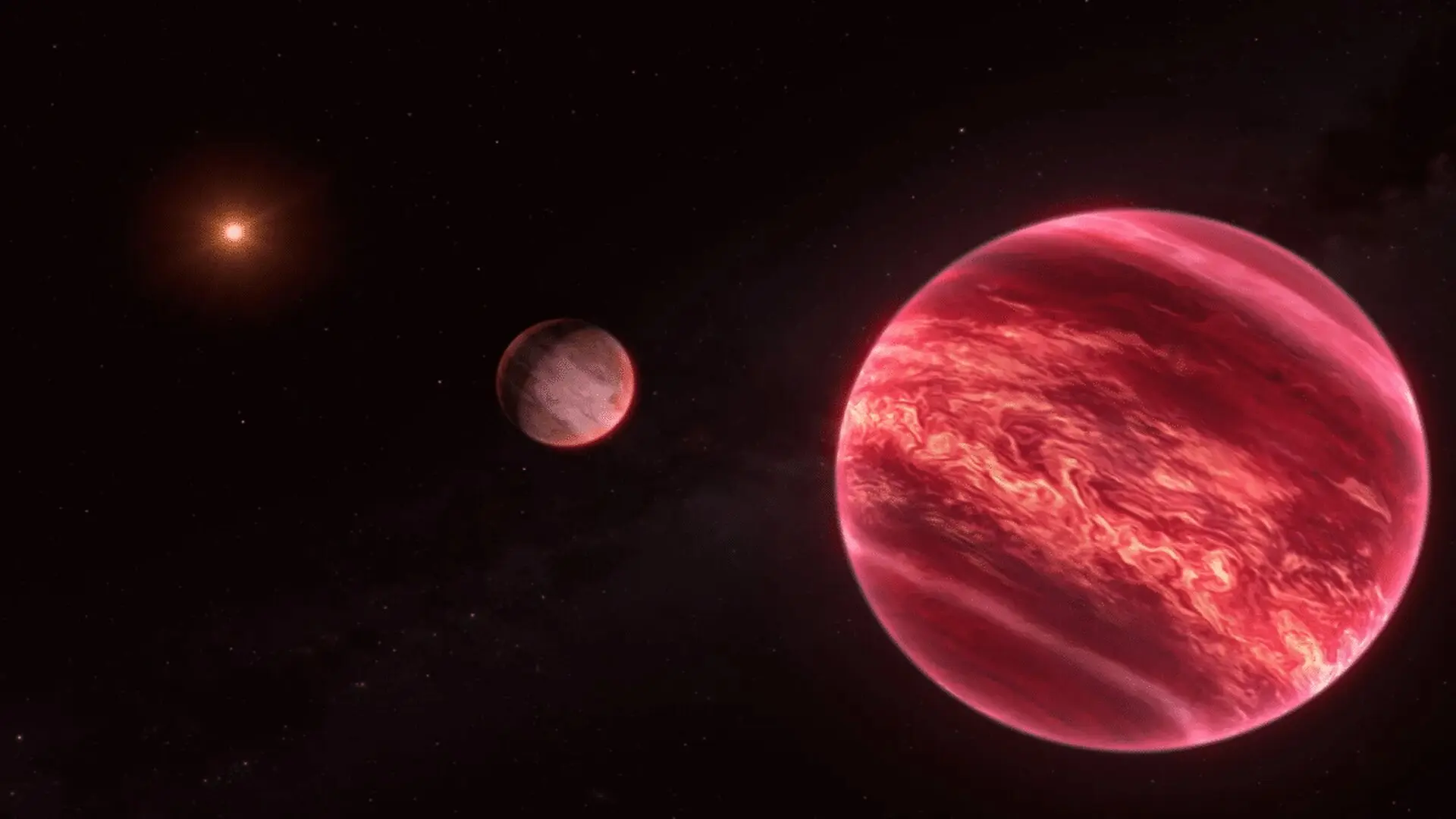
Astronomers have unveiled evidence of a massive potential exomoon within the distant CD-35 2722 system, where a gargantuan object appears to circle a companion rather than a star. This discovery, detailed in the journal Nature, represents a significant milestone in the search for moons orbiting worlds beyond our own, while simultaneously complicating the rigid definitions used to categorize planets and satellites.
Challenging Conventional Planetary Hierarchies
In our own celestial neighborhood, the rules of orbital mechanics are intuitive: Earth orbits the Sun, while the Moon orbits Earth. Jupiter and Saturn maintain vast networks of satellites bound by their gravity. However, as researchers look further into the cosmos, they are encountering systems that defy these established templates. The candidate found in CD-35 2722 serves as a prime example of this complexity.
The system features a potential satellite caught in the gravitational pull of a much larger companion, which itself traverses an orbit around a star. The primary intrigue lies not just in the orbital structure, but in the physical stature of the objects involved. The suspected moon is a massive, gaseous body, bearing little resemblance to the icy or rocky satellites typically found in our solar system. This planetary-scale mass forces a difficult question: how should astronomers classify an object that possesses the physical characteristics of a planet but the dynamic behavior of a moon?

“This system is somewhat hard to define using Solar-System-based words like ‘planet’ and ‘moon’,” notes researcher Hoy, who holds affiliations with the Universidad Diego Portales and the Millennium Nucleus of Young Exoplanets and their Moons (YEMS) in Chile. The dilemma highlights a limitation in current astronomical taxonomy, which remains heavily rooted in observations of our own local environment. Because an object’s physical composition does not dictate its orbital trajectory, the distinction between a planet and a moon is becoming increasingly blurred.
“The exosatellite is clearly massive enough to be a planet, but it does not orbit a star, though it orbits an object that orbits a star,” Hoy explains. “Being the third wheel in this system makes us want to call it a moon, even if it is nothing like the small, rocky moons we have in our system.”
A Nested Web of Massive Companions
The architecture of CD-35 2722 is defined by a series of nested gravitational relationships. Alice Zurlo, director of YEMS and a co-author of the study, describes the arrangement: “The satellite we report is a giant gaseous body orbiting a highly massive companion, itself several times the mass of Jupiter.”
This configuration challenges the traditional view of a primary planet orbited by a secondary, significantly smaller moon. By comparison, while Jupiter’s moons like Ganymede are substantial, they are mere fractions of the planet’s total mass. In the CD-35 2722 system, the potential satellite and its host are both giants, forcing astronomers to reconsider the criteria for planetary classification. As Zurlo points out, “We have a clear delineation between the planets and the Sun in the Solar System, so defining things like moons is simple. In the CD-35 2722 system, where we are blurring the lines between stars, planets, and moons, the whole thing becomes more complicated to describe.”
Beyond the linguistic hurdles, the discovery offers a vital window into the formation of diverse planetary architectures. Determining whether this giant satellite formed within a circum-companion disk or was captured through other dynamic interactions remains a top priority. As astronomers continue to analyze the data, CD-35 2722 stands as a testament to the unexpected variety of systems waiting to be uncovered in the deep reaches of space.
This article has been fact checked for accuracy, with information verified against reputable sources. Learn more about us and our editorial process.
Last reviewed on .
Article history
- Latest version
Reference(s)
- Hoy, Kevin. “Planetary-mass exosatellite detected around the substellar companion of a star - Nature.”, vol. 655, no. 8124, pp. 865-869. Nature, doi: 10.1038/s41586-026-10751-w. <https://www.nature.com/articles/s41586-026-10751-w>.
Cite this page:
- Posted by Aisha Ahmed